 Red Hat Summit
このコンテンツは選択した言語では利用できません。
End-user Guide
Using Red Hat CodeReady Workspaces 2.1
Abstract
Chapter 2. Che-Theia IDE basics
This section describes basics workflows and commands for Che-Theia: the native integrated development environment for Red Hat CodeReady Workspaces.
2.1. Defining custom commands for Che-Theia
The Che-Theia IDE allows users to define custom commands in a devfile that are then available when working in a workspace.
The following is an example of the commands section of a devfile.
- CodeReady Workspaces commands
theia:build-
The
exectype implies that the CodeReady Workspaces runner is used for command execution. The user can specify the component in whose container the command is executed. -
The
commandfield contains the command line for execution. -
The
workdiris the working directory in which the command is executed.
-
The
- Visual Studio Code (VS Code) tasks
run-
The type is
vscode-task. -
For this type of command, the
referenceContentfield must contain content with task configurations in the VS Code format. - For more information about VS Code tasks, see the Task section on the Visual Studio User Guide page.
-
The type is
- VS Code launch configurations
debug-
The type is
vscode-launch. - It contains the launch configurations in the VS Code format.
- For more information about VS Code launch configurations, see the Debugging section on the Visual Studio documentation page.
-
The type is
For a list of available tasks and launch configurations, see the tasks.json and the launch.json configuration files in the /workspace/.theia directory where the configuration from the devfile is exported to.
2.1.1. Che-Theia task types
Two types of tasks exist in a devfile: tasks in the VS Code format and CodeReady Workspaces commands. Tasks from the devfile are copied to the configuration file when the workspace is started. Depending on the type of the task, the task is then available for running:
- CodeReady Workspaces commands: From the Terminal → Run Task menu in the configured tasks section, or from the My Workspace panel
- Tasks in the VS Code format: From the Run Tasks menu
To run the task definitions provided by plug-ins, select the Terminal → Run Task menu option. The tasks are placed in the detected tasks section.
2.1.2. Running and debugging
Che-Theia supports the Debug Adapter Protocol. This protocol defines a generic way for how a development tool can communicate with a debugger. It means Che-Theia works with all implementations.
Prerequisites
- A running instance of Red Hat CodeReady Workspaces. To install an instance of Red Hat CodeReady Workspaces, see the CodeReady Workspaces 2.1 Installation GuideCodeReady Workspaces 'quick-starts'.
Procedure
To debug an application:
Click Debug → Add Configuration to add debugging or launch configuration to the project.
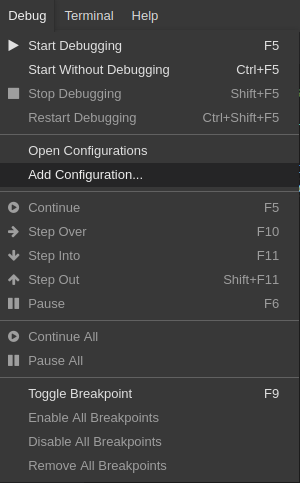
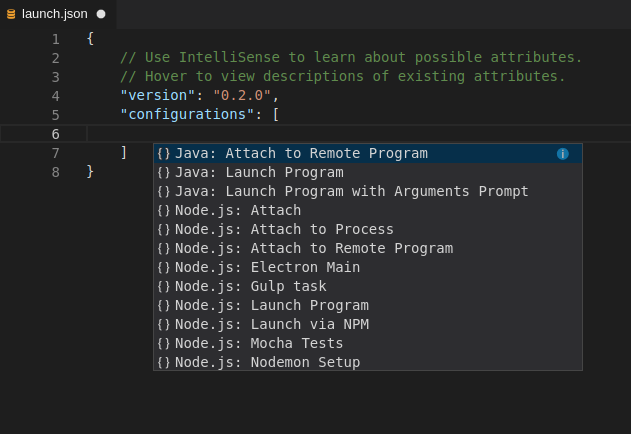
From the pop-up menu, select the appropriate configuration for the application that you want to debug.
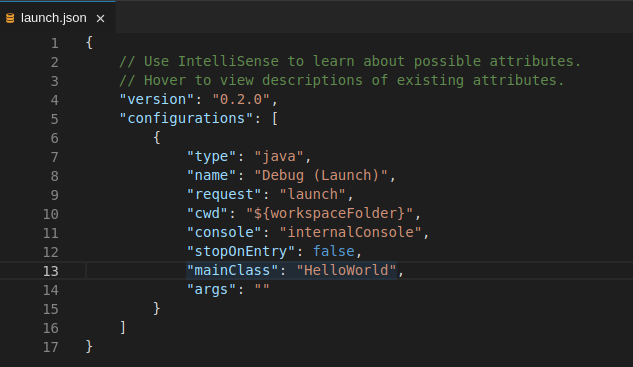
Update the configuration by modifying or adding attributes.
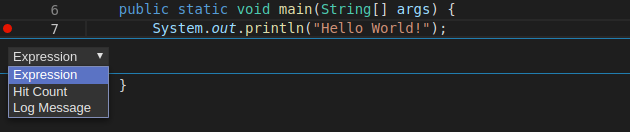
Breakpoints can be toggled by clicking the editor margin.
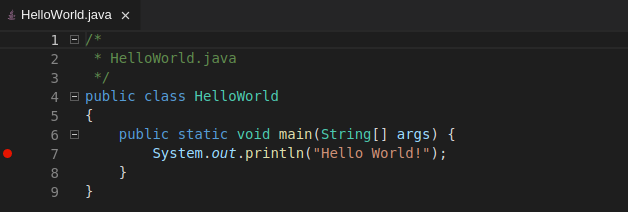
Open the context menu of the breakpoint to add conditions.
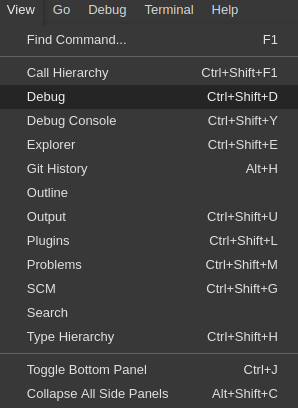
To start debugging, click View → Debug.
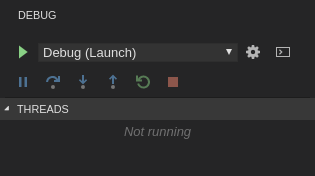
In the Debug view, select the configuration and press F5 to debug the application. Or, start the application without debugging by pressing Ctrl+F5.
2.1.3. Editing a task and launch configuration
Procedure
To customize the configuration file:
-
Edit the
tasks.jsonorlaunch.jsonconfiguration files. Add new definitions to the configuration file or modify the existing ones.
NoteThe changes are stored in the configuration file.
-
To customize the task configuration provided by plug-ins, select the Terminal → Configure TasksS menu option, and choose the task to configure. The configuration is then copied to the
tasks.jsonfile and is available for editing.
2.2. Version Control
Red Hat CodeReady Workspaces natively supports the VS Code SCM model. By default, Red Hat CodeReady Workspaces includes the native VS Code Git extension as a Source Code Management (SCM) provider.
2.2.1. Managing Git configuration: identity
The first thing to do before starting to use Git is to set a user name and email address. This is important because every Git commit uses this information.
Prerequisites
- The Visual Studio Code Git extension installed.
Procedure
To configure Git identity using the CodeReady Workspaces user interface, go to in Preferences.
Open File > Settings > Open Preferences:
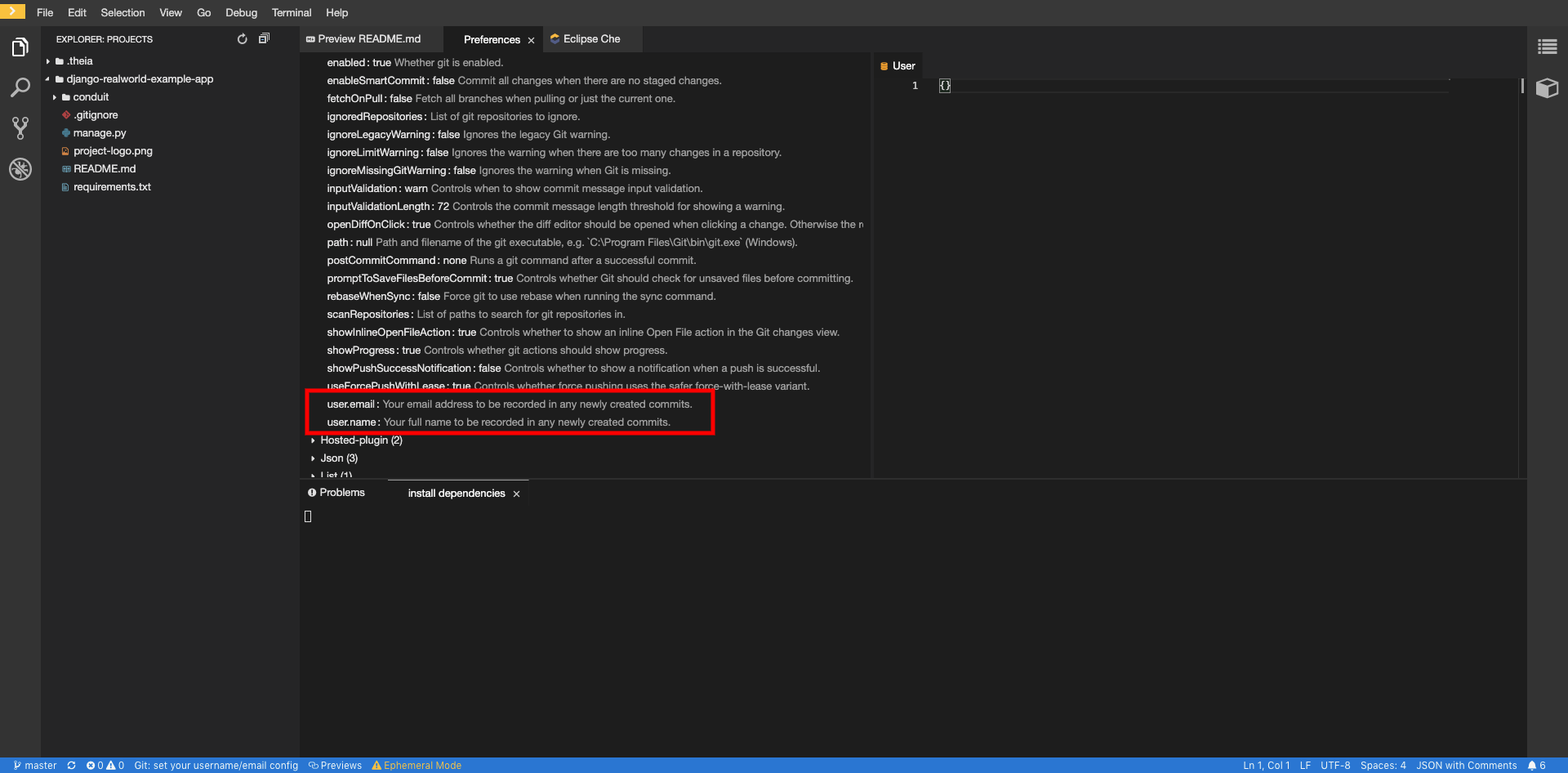
In the opened window, navigate to the Git section, and find:
 user.name
 user.email
 user.name
 user.email
Copy to Clipboard Copied! Toggle word wrap Toggle overflow And configure the identity.
To configure Git identity using the command line, open the terminal of the Che-Theia container.
Navigate to the My Workspace view, and open Plugins > theia-ide… > New terminal:

Execute the following commands:
git config --global user.name "John Doe"
git config --global user.email johndoe@example.com
$ git config --global user.name "John Doe"
$ git config --global user.email johndoe@example.com
Copy to Clipboard Copied! Toggle word wrap Toggle overflow
Che-Theia permanently stores this information and restores it on future workspace starts.
2.2.2. Accessing a Git repository using HTTPS
Prerequisites
- Git is installed. Install Git if needed by following Getting Started - Installing Git.
Procedure
To clone a repository using HTTPS:
- Use the clone command provided by the Visual Studio Code Git extension.
Alternatively, use the native Git commands in the terminal to clone a project.
-
Navigate to destination folder using the
cdcommand. Use
git cloneto clone a repository:git clone <link>
$ git clone <link>Copy to Clipboard Copied! Toggle word wrap Toggle overflow Red Hat CodeReady Workspaces supports git self-signed SSL certificates. See Deploying Red Hat CodeReady Workspaces with support for git repositories with self-signed certificates to learn more.
2.2.3. Accessing a Git repository using a generated SSH key pair
2.2.3.1. Generating an SSH key using the CodeReady Workspaces command palette
The following section describes a generation of an SSH key using the CodeReady Workspaces command palette and its further use in Git provider communication. This SSH key restricts permissions for the specific Git provider; therefore, the user has to create a unique SSH key for each Git provider in use.
Prerequisites
- A running instance of CodeReady Workspaces. To install an instance of Red Hat CodeReady Workspaces, see the CodeReady Workspaces 2.1 Installation GuideCodeReady Workspaces 'quick-starts'.
- An existing workspace defined on this instance of CodeReady Workspaces Creating a workspace from user dashboard.
- Personal GitHub account or other Git provider account created.
Procedure
A common SSH key pair that works with all the Git providers is present by default. To start using it, add the public key to the Git provider.
Generate an SSH key pair that only works with a particular Git provider:
In the CodeReady Workspaces IDE, press F1 to open the Command Palette, or navigate to View → Find Command in the top menu.
The command palette can be also activated by pressing Ctrl+Shift+p (or Cmd+Shift+p on macOS).
-
Search for SSH: generate key pair for particular host by entering
generateinto the search box and pressing Enter once filled. Provide the hostname for the SSH key pair such as, for example,
github.com.The SSH key pair is generated.
Click the button and copy the public key from the editor and add it to the Git provider.
Because of this action, the user can now use another command from the command palette: Clone git repository by providing an SSH secured URL.
2.2.3.2. Adding the associated public key to a repository or account on GitHub
To add the associated public key to a repository or account on GitHub:
- Navigate to github.com.
- Click the drop-down arrow next to the user icon in the upper right corner of the window.
- Click Settings → SSH and GPG keys and then click the button.
- In the Title field, type a title for the key, and in the Key field, paste the public key copied from CodeReady Workspaces.
- Click the button.
2.2.3.3. Adding the associated public key to a Git repository or account on GitLab
To add the associated public key to a Git repository or account on GitLab:
- Navigate to gitlab.com.
- Click the user icon in the upper right corner of the window.
- Click Settings → SSH Keys.
- In the Title field, type a title for the key and in the Key field, paste the public key copied from CodeReady Workspaces.
- Click the button.
2.2.4. Managing pull requests using the GitHub PR plug-in
To manage GitHub pull requests, the VS Code GitHub Pull Request plug-in is available in the list of plug-ins of the workspace.
2.2.4.1. Using the GitHub Pull Requests plug-in
Prerequisites
- GitHub OAuth is configured. See Configuring GitHub OAuth.
Procedure
- Authenticate by running the GitHub authenticate command.
- You will be redirected to GitHub to authorize CodeReady Workspaces.
- When CodeReady Workspaces is authorized, refresh the browser page where CodeReady Workspaces is running to update the plug-in with the GitHub token.
Alternatively, manually fetch the GitHub token and paste it to the plug-in by running the GitHub Pull Requests: Manually Provide Authentication Response command.
2.2.4.2. Creating a new pull request
- Open the GitHub repository. To be able to execute remote operations, the repository must have a remote with an SSH URL.
- Checkout a new branch and make changes that you want to publish.
- Run the GitHub Pull Requests: Create Pull Request command.
2.3. Che-Theia Troubleshooting
This section describes some of the most frequent issues with the Che-Theia IDE.
- Che-Theia shows a notification with the following message:
Plugin runtime crashed unexpectedly, all plugins are not working, please reload the page. Probably there is not enough memory for the plugins. This means that one of the Che-Theia plug-ins that are running in the Che-Theia IDE container requires more memory than the container has. To fix this problem, increase the amount of memory for the Che-Theia IDE container:
- Navigate to the CodeReady Workspaces Dashboard.
- Select the workspace in which the problem happened.
- Switch to the Devfile tab.
-
In the
componentssection of the devfile, find a component of thecheEditortype. -
Add a new property,
memoryLimit: 1024M(or increase the value if it already exists). - Save changes and restart the workspace.
Additional resources
- Asking the community for help: Mattermost channel dedicated to Red Hat CodeReady Workspaces.
- Reporting a bug: Red Hat CodeReady Workspaces repository issues.
Chapter 3. Workspaces overview
Red Hat CodeReady Workspaces provides developer workspaces with everything needed to a code, build, test, run, and debug applications. To allow that, the developer workspaces provide four main components:
- The source code of a project.
- A web-based IDE.
- Tool dependencies, needed by developers to work on a project
- Application runtime: a replica of the environment where the application runs in production
Pods manage each component of a CodeReady Workspaces workspace. Therefore, everything running in a CodeReady Workspaces workspace is running inside containers. This makes a CodeReady Workspaces workspace highly portable.
The embedded browser-based IDE is the point of access for everything running in a CodeReady Workspaces workspace. This makes a CodeReady Workspaces workspace easily shareable.
By default, it is possible to run only one workspace at a time. To change the default value, see: {link-limits-for-user-workspaces}.
| Features | Traditional IDE workspaces | Red Hat CodeReady Workspaces workspaces |
|---|---|---|
| Configuration and installation required | Yes. | No. |
| Embedded tools | Partial. IDE plug-ins need configuration. Dependencies need installation and configuration. Example: JDK, Maven, Node. | Yes. Plug-ins provide their dependencies. |
| Application runtime provided | No. Developers have to manage that separately. | Yes. Application runtime is replicated in the workspace. |
| Shareable | No. Or not easily | Yes. Developer workspaces are shareable with a URL. |
| Versionable | No | Yes. Devfiles exist with project source code. |
| Accessible from anywhere | No. Installation is needed. | Yes. Only requires a browser. |
To start a CodeReady Workspaces workspace, following options are available:
Use the Dashboard to discover CodeReady Workspaces 2.1:
Use a devfile as the preferred way to start a CodeReady Workspaces 2.1 workspace:
Use the browser-based IDE as the preferred way to interact with a CodeReady Workspaces 2.1 workspace. For an alternative way to interact with a CodeReady Workspaces 2.1 workspace, see: Remotely accessing workspaces.
3.1. Configuring a workspace using a devfile
To quickly and easily configure a CodeReady Workspaces workspace, use a devfile. For an introduction to devfiles and instructions for their use, see the instructions in this section.
3.1.1. What is a devfile
A devfile is a file that describes and define a development environment:
- the source code
- the development components (browser IDE tools and application runtimes)
- a list of pre-defined commands
- projects to clone
Devfiles are YAML files that CodeReady Workspaces consumes and transforms into a cloud workspace composed of multiple containers. The devfile can be saved in the root folder of a Git repository, a feature branch of a Git repository, a publicly accessible destination, or as a separate, locally stored artifact.
When creating a workspace, CodeReady Workspaces uses that definition to initiate everything and run all the containers for the required tools and application runtimes. CodeReady Workspaces also mounts file-system volumes to make source code available to the workspace.
Devfiles can be versioned with the project source code. When there is a need for a workspace to fix an old maintenance branch, the project devfile provides a definition of the workspace with the tools and the exact dependencies to start working on the old branch. Use it to instantiate workspaces on demand.
CodeReady Workspaces maintains the devfile up-to-date with the tools used in the workspace:
- Projects of the workspace (path, Git location, branch)
- Commands to perform daily tasks (build, run, test, debug)
- Runtime environment (container images to run the application)
- Che-Theia plug-ins with tools, IDE features, and helpers that a developer would use in the workspace (Git, Java support, SonarLint, Pull Request)
3.1.2. Disambiguation between stacks and devfiles
This section describes differences between stacks in CodeReady Workspaces 2.0 and devfiles in CodeReady Workspaces 2.1
Starting with CodeReady Workspaces 2.1:
- A stack is a pre-configured CodeReady Workspaces workspace.
- A devfile is a configuration YAML file that CodeReady Workspaces consumes and transforms in a cloud workspace composed of multiple containers.
In CodeReady Workspaces 2.0, stacks were defined by a stacks.json file that was included with the che server. In contrast, in CodeReady Workspaces 2.1, the stacks.json file does not exist. Instead, a stack is defined in the devfile registry, which is a separate service. Every single devfile in the registry corresponds to a stack.
Note that in CodeReady Workspaces 2.0, stacks and workspaces were defined using two different formats. However, with CodeReady Workspaces 2.1, the devfile format is used to define both the stacks and the workspaces. Nevertheless, a user opening the user dashboard does not notice any difference: in CodeReady Workspaces 2.1, a list of stacks is still present to choose from as a starting point to create a workspace.
3.1.3. Creating a workspace from the default branch of a Git repository
A CodeReady Workspaces workspace can be created by pointing to a devfile that is stored in a Git source repository. The CodeReady Workspaces instance then uses the discovered devfile.yaml file to build a workspace using the /f?url= API.
Prerequisites
- A running instance of Red Hat CodeReady Workspaces. To install an instance of Red Hat CodeReady Workspaces, see the CodeReady Workspaces 2.1 Installation GuideCodeReady Workspaces quick-starts.
-
The
devfile.yamlfile in the root folder of a Git repository available over HTTPS. See Making a workspace portable using a devfile for detailed information about creating and using devfiles.
Procedure
Run the workspace by opening the following URL: https://codeready-<openshift_deployment_name>.<domain_name>/f?url=https://<GitRepository>
Example
https://che.openshift.io/f?url=https://github.com/eclipse/che
https://che.openshift.io/f?url=https://github.com/eclipse/che3.1.4. Creating a workspace from a feature branch of a Git repository
A CodeReady Workspaces workspace can be created by pointing to devfile that is stored in a Git source repository on a feature branch of the user’s choice. The CodeReady Workspaces instance then uses the discovered devfile to build a workspace.
Prerequisites
- A running instance of Red Hat CodeReady Workspaces. To install an instance of Red Hat CodeReady Workspaces, see the CodeReady Workspaces 2.1 Installation GuideCodeReady Workspaces quick-starts.
-
The
devfile.yamlfile in the root folder of a Git repository on a specific branch of the user’s choice available over HTTPS. See Making a workspace portable using a devfile for detailed information about creating and using devfiles.
Procedure
Execute the workspace by opening the following URL: https://codeready-<openshift_deployment_name>.<domain_name>/f?url=<GitHubBranch>
Example
Use following URL format to open an experimental quarkus-quickstarts branch hosted on che.openshift.io.
https://che.openshift.io/f?url=https://github.com/maxandersen/quarkus-quickstarts/tree/che
https://che.openshift.io/f?url=https://github.com/maxandersen/quarkus-quickstarts/tree/che3.1.5. Creating a workspace from a publicly accessible standalone devfile using HTTP
A workspace can be created using a devfile, the URL of which is pointing to the raw content of the devfile. The CodeReady Workspaces instance then uses the discovered devfile to build a workspace.
Prerequisites
- A running instance of Red Hat CodeReady Workspaces. To install an instance of Red Hat CodeReady Workspaces, see the CodeReady Workspaces 2.1 Installation GuideCodeReady Workspaces quick-starts.
-
The publicly-accessible standalone
devfile.yamlfile. See Making a workspace portable using a Devfile for detailed information about creating and using devfiles.
Procedure
-
Execute the workspace by opening the following URL:
{prod-fun}/f?url=https://<yourhosturl>/devfile.yaml
Example
https://che.openshift.io/f?url=https://gist.githubusercontent.com/themr0c/ef8e59a162748a8be07e900b6401e6a8/raw/8802c20743cde712bbc822521463359a60d1f7a9/devfile.yaml
https://che.openshift.io/f?url=https://gist.githubusercontent.com/themr0c/ef8e59a162748a8be07e900b6401e6a8/raw/8802c20743cde712bbc822521463359a60d1f7a9/devfile.yaml3.1.6. Overriding devfile values using factory parameters
Values in the following sections of a remote devfile can be overridden using specially constructed additional factory parameters:
-
apiVersion -
metadata -
projects -
attributes
Prerequisites
- A running instance of Red Hat CodeReady Workspaces. To install an instance of Red Hat CodeReady Workspaces, see the CodeReady Workspaces 2.1 Installation GuideCodeReady Workspaces quick-starts.
-
A publicly accessible standalone
devfile.yamlfile. See Making a workspace portable using a Devfile for detailed information about creating and using devfiles.
Procedure
-
Open the workspace by navigating to the following URL:
https://codeready-<openshift_deployment_name>.<domain_name>/f?url=https://<hostURL>/devfile.yaml&override.<parameter.path>=<value>
Example of overriding the generateName property
Consider the following initial devfile:
To add or override generateName value, the following factory URL can be used:
https://che.openshift.io/f?url=https://gist.githubusercontent.com/themr0c/ef8e59a162748a8be07e900b6401e6a8/raw/8802c20743cde712bbc822521463359a60d1f7a9/devfile.yaml&override.metadata.generateName=myprefix
https://che.openshift.io/f?url=https://gist.githubusercontent.com/themr0c/ef8e59a162748a8be07e900b6401e6a8/raw/8802c20743cde712bbc822521463359a60d1f7a9/devfile.yaml&override.metadata.generateName=myprefixThe resulting workspace will have the following devfile model:
Example of overriding project source branch property
Consider the following initial devfile:
To add or override source branch value, the following factory URL can be used:
https://che.openshift.io/f?url=https://gist.githubusercontent.com/themr0c/ef8e59a162748a8be07e900b6401e6a8/raw/8802c20743cde712bbc822521463359a60d1f7a9/devfile.yaml&override.projects.web-java-spring-petclinic.source.branch=1.0.x
https://che.openshift.io/f?url=https://gist.githubusercontent.com/themr0c/ef8e59a162748a8be07e900b6401e6a8/raw/8802c20743cde712bbc822521463359a60d1f7a9/devfile.yaml&override.projects.web-java-spring-petclinic.source.branch=1.0.xThe resulting workspace will have the following devfile model:
Example of overriding or creating an attribute value
Consider the following initial devfile:
To add or override persistVolumes attribute value, the following factory URL can be used:
https://che.openshift.io/f?url=https://gist.githubusercontent.com/themr0c/ef8e59a162748a8be07e900b6401e6a8/raw/8802c20743cde712bbc822521463359a60d1f7a9/devfile.yaml&override.attributes.persistVolumes=true
https://che.openshift.io/f?url=https://gist.githubusercontent.com/themr0c/ef8e59a162748a8be07e900b6401e6a8/raw/8802c20743cde712bbc822521463359a60d1f7a9/devfile.yaml&override.attributes.persistVolumes=trueThe resulting workspace will have the following devfile model:
When overriding attributes, everything that follows the attributes keyword treat as an attribute name, so it’s possible to use dot-separated names:
https://che.openshift.io/f?url=https://gist.githubusercontent.com/themr0c/ef8e59a162748a8be07e900b6401e6a8/raw/8802c20743cde712bbc822521463359a60d1f7a9/devfile.yaml&override.attributes.dot.name.format.attribute=true
https://che.openshift.io/f?url=https://gist.githubusercontent.com/themr0c/ef8e59a162748a8be07e900b6401e6a8/raw/8802c20743cde712bbc822521463359a60d1f7a9/devfile.yaml&override.attributes.dot.name.format.attribute=trueThe resulting workspace will have the following devfile model:
3.1.7. Creating a workspace using crwctl and a local devfile
A CodeReady Workspaces workspace can be created by pointing the crwctl tool to a locally stored devfile. The CodeReady Workspaces instance then uses the discovered devfile to build a workspace.
Prerequisites
- A running instance of Red Hat CodeReady Workspaces. To install an instance of Red Hat CodeReady Workspaces, see the CodeReady Workspaces 2.1 Installation GuideCodeReady Workspaces quick-starts.
-
The CodeReady Workspaces CLI management tool. See the CodeReady Workspaces 2.1 Installation GuideInstalling the
crwctlmanagement tool. The devfile is available on the local filesystem in the current working directory. See Making a workspace portable using a Devfile for detailed information about creating and using devfiles.
Example
Download the
devfile.yamlfile from the GitHub repository to the current working directory.
Procedure
-
Run a workspace from a devfile using the
workspace:startparameter with thecrwctltool as follows:
crwctl workspace:start --devfile=devfile.yaml
$ crwctl workspace:start --devfile=devfile.yamlAdditional resources
3.2. Making a workspace portable using a devfile
To transfer a configured CodeReady Workspaces workspace, create and export the devfile of the workspace and load the devfile on a different host to initialize a new instance of the workspace. For detailed instructions on how to create such a devfile, see below.
3.2.1. What is a devfile
A devfile is a file that describes and define a development environment:
- the source code
- the development components (browser IDE tools and application runtimes)
- a list of pre-defined commands
- projects to clone
Devfiles are YAML files that CodeReady Workspaces consumes and transforms into a cloud workspace composed of multiple containers. The devfile can be saved in the root folder of a Git repository, a feature branch of a Git repository, a publicly accessible destination, or as a separate, locally stored artifact.
When creating a workspace, CodeReady Workspaces uses that definition to initiate everything and run all the containers for the required tools and application runtimes. CodeReady Workspaces also mounts file-system volumes to make source code available to the workspace.
Devfiles can be versioned with the project source code. When there is a need for a workspace to fix an old maintenance branch, the project devfile provides a definition of the workspace with the tools and the exact dependencies to start working on the old branch. Use it to instantiate workspaces on demand.
CodeReady Workspaces maintains the devfile up-to-date with the tools used in the workspace:
- Projects of the workspace (path, Git location, branch)
- Commands to perform daily tasks (build, run, test, debug)
- Runtime environment (container images to run the application)
- Che-Theia plug-ins with tools, IDE features, and helpers that a developer would use in the workspace (Git, Java support, SonarLint, Pull Request)
3.2.2. A minimal devfile
The following is the minimum content required in a devfile.yaml file:
apiVersion: 1.0.0
metadata:
  name: che-in-che-out
apiVersion: 1.0.0
metadata:
name: che-in-che-outFor a complete devfile example, see Red Hat CodeReady Workspaces in CodeReady Workspaces devfile.yaml.
name or generateName must be defined
Both name and generateName are optional parameters, but at least one of them must be defined. See Section 3.2.3, “Generating workspace names”.
3.2.3. Generating workspace names
To specify a prefix for automatically generated workspace names, set the generateName parameter in the devfile.yaml file:
apiVersion: 1.0.0
metadata:
  generateName: che-
apiVersion: 1.0.0
metadata:
  generateName: che-
The workspace name will be in the <generateName>YYYYY format (for example, che-2y7kp). Y is random [a-z0-9] character.
The following naming rules apply when creating workspaces:
-
When
nameis defined, it is used as the workspace name:<name> -
When only
generateNameis defined, it is used as the base of the generated name:<generateName>YYYYY
For workspaces created using a factory, defining name or generateName has the same effect. The defined value is used as the name prefix: <name>YYYYY or <generateName>YYYYY. When both generateName and name are defined, generateName takes precedence.
3.2.4. Writing a devfile for a project
This section describes how to create a minimal devfile for your project and how to include more than one projects in a devfile.
3.2.4.1. Preparing a minimal devfile
A minimal devfile sufficient to run a workspace consists of the following parts:
- Specification version
- Name
Example of a minimal devfile with no project
apiVersion: 1.0.0
metadata:
  name: minimal-workspace
apiVersion: 1.0.0
metadata:
name: minimal-workspaceWithout any further configuration, a workspace with the default editor is launched along with its default plug-ins, which are configured on the CodeReady Workspaces Server. Che-Theia is configured as the default editor along with the CodeReady Workspaces Machine Exec plug-in. When launching a workspace within a Git repository using a factory, the project from the given repository and branch is be created by default. The project name then matches the repository name.
Add the following parts for a more functional workspace:
- List of components: Development components and user runtimes
- List of projects: Source code repositories
- List of commands: Actions to manage the workspace components, such as running the development tools, starting the runtime environments, and others
Example of a minimal devfile with a project
3.2.4.2. Specifying multiple projects in a devfile
A single devfile can specify multiple projects. For each project, specify the type of the source repository, its location, and, optionally, the directory the project is cloned to.
Example of a devfile with two projects
In the preceding example, there are two projects defined, frontend and backend. Each project is located in its own repository. The backend project has a specific requirement to be cloned into the src/github.com/acmecorp/backend/ directory under the source root (implicitly defined by the CodeReady Workspaces runtime) while the frontend project will be cloned into the frontend/ directory under the source root.
Additional resources
For a detailed explanation of all devfile component assignments and possible values, see:
These sample devfiles are a good source of inspiration:
3.2.5. Devfile reference
This section contains devfile reference and instructions on how to use the various elements that devfiles consist of.
3.2.5.1. Adding projects to a devfile
Usually a devfile contains one or more projects. A workspace is created to develop those projects. Projects are added in the projects section of devfiles.
Each project in a single devfile must have:
- Unique name
- Source specified
Project source consists of two mandatory values: type and location.
type- The kind of project-source provider.
location- The URL of project source.
CodeReady Workspaces supports the following project types:
git- Projects with sources in Git. The location points to a clone link.
github-
Same as
gitbut for projects hosted on GitHub only. Usegitfor projects that do not use GitHub-specific features. zip- Projects with sources in a ZIP archive. Location points to a ZIP file.
3.2.5.1.1. Project-source type: git
- 1
startPointis the general value fortag,commitId, andbranch. ThestartPoint,tag,commitId, andbranchparameters are mutually exclusive. When more than one is supplied, the following order is used:startPoint,tag,commitId,branch.- 2
sparseCheckoutDirthe template for the sparse checkout Git feature. This is useful when only a part of a project (typically only a single directory) is needed.
Example 3.1. sparseCheckoutDir parameter settings
-
Set to
/my-module/to create only the rootmy-moduledirectory (and its content). Omit the leading slash (
my-module/) to create allmy-moduledirectories that exist in the project. Including, for example,/addons/my-module/.The trailing slash indicates that only directories with the given name (including their content) are created.
-
Use wildcards to specify more than one directory name. For example, setting
module-*checks out all directories of the given project that start withmodule-.
For more information, see Sparse checkout in Git documentation.
3.2.5.1.2. Project-source type: zip
source:
    type: zip
    location: http://host.net/path/project-src.zip
source:
    type: zip
location: http://host.net/path/project-src.zip3.2.5.1.3. Project clone-path parameter: clonePath
The clonePath parameter specifies the path into which the project is to be cloned. The path must be relative to the /projects/ directory, and it cannot leave the /projects/ directory. The default value is the project name.
Example devfile with projects
3.2.5.2. Adding components to a devfile
Each component in a single devfile must have a unique name.
3.2.5.2.1. Component type: cheEditor
Describes the editor used in the workspace by defining its id. A devfile can only contain one component of the cheEditor type.
components:
  - alias: theia-editor
    type: cheEditor
    id: eclipse/che-theia/next
components:
  - alias: theia-editor
    type: cheEditor
    id: eclipse/che-theia/next
When cheEditor is missing, a default editor is provided along with its default plug-ins. The default plug-ins are also provided for an explicitly defined editor with the same id as the default one (even if it is a different version). Che-Theia is configured as default editor along with the CodeReady Workspaces Machine Exec plug-in.
To specify that a workspace requires no editor, use the editorFree:true attribute in the devfile attributes.
3.2.5.2.2. Component type: chePlugin
Describes plug-ins in a workspace by defining their id. It is allowed to have several chePlugin components.
  components:
   - alias: exec-plugin
     type: chePlugin
     id: eclipse/che-machine-exec-plugin/0.0.1
  components:
   - alias: exec-plugin
     type: chePlugin
id: eclipse/che-machine-exec-plugin/0.0.1Both types above use an ID, which is slash-separated publisher, name and version of plug-in from the CodeReady Workspaces Plug-in registry.
List of available CodeReady Workspaces plug-ins and more information about registry can be found in the CodeReady Workspaces plug-in registry GitHub repository.
3.2.5.2.3. Specifying an alternative component registry
To specify an alternative registry for the cheEditor and chePlugin component types, use the registryUrl parameter:
  components:
   - alias: exec-plugin
     type: chePlugin
     registryUrl: https://my-customregistry.com
     id: eclipse/che-machine-exec-plugin/0.0.1
  components:
   - alias: exec-plugin
     type: chePlugin
     registryUrl: https://my-customregistry.com
id: eclipse/che-machine-exec-plugin/0.0.13.2.5.2.4. Specifying a component by linking to its descriptor
An alternative way of specifying cheEditor or chePlugin, instead of using the editor or plug-in id (and optionally an alternative registry), is to provide a direct link to the component descriptor (typically named meta.yaml) by using the reference field:
  components:
   - alias: exec-plugin
     type: chePlugin
     reference: https://raw.githubusercontent.com.../plugin/1.0.1/meta.yaml
  components:
   - alias: exec-plugin
     type: chePlugin
     reference: https://raw.githubusercontent.com.../plugin/1.0.1/meta.yaml
It is impossible to mix the id and reference fields in a single component definition; they are mutually exclusive.
3.2.5.2.5. Tuning chePlugin component configuration
A chePlugin component may need to be precisely tuned, and in such case, component preferences can be used. The example shows how to configure JVM using plug-in preferences.
  id: redhat/java/0.38.0
  type: chePlugin
  preferences:
     java.jdt.ls.vmargs: '-noverify -Xmx1G -XX:+UseG1GC -XX:+UseStringDeduplication'
  id: redhat/java/0.38.0
  type: chePlugin
  preferences:
java.jdt.ls.vmargs: '-noverify -Xmx1G -XX:+UseG1GC -XX:+UseStringDeduplication'Preferences may also be specified as an array:
  id: redhat/java/0.38.0
  type: chePlugin
  preferences:
     go.lintFlags: ["--enable-all", "--new"]
  id: redhat/java/0.38.0
  type: chePlugin
  preferences:
go.lintFlags: ["--enable-all", "--new"]3.2.5.2.6. Component type: kubernetes
A complex component type that allows to apply configuration from a list of OpenShift components.
The content can be provided through the reference attribute, which points to the file with the component content.
Alternatively, to post a devfile with such components to REST API, the contents of the OpenShift list can be embedded into the devfile using the referenceContent field:
3.2.5.2.7. Overriding container entrypoints
As with the understood by OpenShift).
There can be more containers in the list (contained in Pods or Pod templates of deployments). To select which containers to apply the entrypoint changes to.
The entrypoints can be defined as follows:
The entrypoints list contains constraints for picking the containers along with the command and args parameters to apply to them. In the example above, the constraint is parentName: mysqlServer, which will cause the command to be applied to all containers defined in any parent object called mysqlServer. The parent object is assumed to be a top level object in the list defined in the referenced file, which is app-deployment.yaml in the example above.
Other types of constraints (and their combinations) are possible:
containerName- the name of the container
parentName- the name of the parent object that (indirectly) contains the containers to override
parentSelector- the set of labels the parent object needs to have
A combination of these constraints can be used to precisely locate the containers inside the referenced OpenShift list.
3.2.5.2.8. Overriding container environment variables
To provision or override entrypoints in a OpenShift or OpensShift component, configure it in the following way:
This is useful for temporary content or without access to editing the referenced content. The specified environment variables are provisioned into each init container and containers inside all Pods and Deployments.
3.2.5.2.9. Specifying mount-source option
To specify a project sources directory mount into container(s), use the mountSources parameter:
   components:
      - alias: appDeployment
        type: kubernetes
        reference: app-deployment.yaml
        mountSources: true
   components:
      - alias: appDeployment
        type: kubernetes
        reference: app-deployment.yaml
        mountSources: true
If enabled, project sources mounts will be applied to every container of the given component. This parameter is also applicable for chePlugin type components.
3.2.5.2.10. Component type: dockerimage
A component type that allows to define a container image-based configuration of a container in a workspace. A devfile can only contain one component of the dockerimage type. The dockerimage type of component brings in custom tools into the workspace. The component is identified by its image.
Example of a minimal dockerimage component
It specifies the type of the component, dockerimage and the image attribute names the image to be used for the component using the usual Docker naming conventions, that is, the above type attribute is equal to docker.io/library/golang:latest.
A dockerimage component has many features that enable augmenting the image with additional resources and information needed for meaningful integration of the tool provided by the image with Red Hat CodeReady Workspaces.
3.2.5.2.10.1. Mounting project sources
For the dockerimage component to have access to the project sources, you must set the mountSources attribute to true.
The sources is mounted on a location stored in the CHE_PROJECTS_ROOT environment variable that is made available in the running container of the image. This location defaults to /projects.
3.2.5.2.10.2. Container Entrypoint
The command attribute of the dockerimage along with other arguments, is used to modify the entrypoint command of the container created from the image. In Red Hat CodeReady Workspaces the container is needed to run indefinitely so that you can connect to it and execute arbitrary commands in it at any time. Because the availability of the sleep command and the support for the infinity argument for it is different and depends on the base image used in the particular images, CodeReady Workspaces cannot insert this behavior automatically on its own. However, you can take advantage of this feature to, for example, start necessary servers with modified configurations, etc.
3.2.5.2.11. Persistent Storage
Components of any type can specify the custom volumes to be mounted on specific locations within the image. Note that the volume names are shared across all components and therefore this mechanism can also be used to share file systems between components.
Example specifying volumes for dockerimage type:
Example specifying volumes for cheEditor/chePlugin type:
Example specifying volumes for kubernetes/openshift type:
3.2.5.2.12. Specifying container memory limit for components
To specify a container(s) memory limit for dockerimage, chePlugin, cheEditor, use the memoryLimit parameter:
This limit will be applied to every container of the given component.
For the cheEditor and chePlugin component types, RAM limits can be described in the plug-in descriptor file, typically named meta.yaml.
If none of them are specified, system-wide defaults will be applied (see description of CHE_WORKSPACE_SIDECAR_DEFAULT__MEMORY__LIMIT__MB system property).
3.2.5.2.13. Specifying container memory request for components
To specify a container(s) memory request for chePlugin or cheEditor, use the memoryRequest parameter:
This limit will be applied to every container of the given component.
For the cheEditor and chePlugin component types, RAM requests can be described in the plug-in descriptor file, typically named meta.yaml.
If none of them are specified, system-wide defaults are applied (see description of CHE_WORKSPACE_SIDECAR_DEFAULT__MEMORY__REQUEST__MB system property).
3.2.5.2.14. Specifying container CPU limit for components
To specify a container(s) CPU limit for chePlugin, cheEditor or dockerimage use the cpuLimit parameter:
This limit will be applied to every container of the given component.
For the cheEditor and chePlugin component types, CPU limits can be described in the plug-in descriptor file, typically named meta.yaml.
If none of them are specified, system-wide defaults are applied (see description of CHE_WORKSPACE_SIDECAR_DEFAULT__CPU__LIMIT__CORES system property).
3.2.5.2.15. Specifying container CPU request for components
To specify a container(s) CPU request for chePlugin, cheEditor or dockerimage use the cpuRequest parameter:
This limit will be applied to every container of the given component.
For the cheEditor and chePlugin component types, CPU requests can be described in the plug-in descriptor file, typically named meta.yaml.
If none of them are specified, system-wide defaults are applied (see description of CHE_WORKSPACE_SIDECAR_DEFAULT__CPU__REQUEST__CORES system property).
3.2.5.2.16. Environment variables
Red Hat CodeReady Workspaces allows you to configure Docker containers by modifying the environment variables available in component’s configuration. Environment variables are supported by the following component types: dockerimage, chePlugin, cheEditor, kubernetes, openshift. In case component has multiple containers, environment variables will be provisioned to each container.
- The variable expansion works between the environment variables, and it uses the OpenShift convention for the variable references.
- The predefined variables are available for use in custom definitions.
The following environment variables are pre-set by the CodeReady Workspaces server:
-
CHE_PROJECTS_ROOT: The location of the projects directory (note that if the component does not mount the sources, the projects will not be accessible). -
CHE_WORKSPACE_LOGS_ROOT__DIR: The location of the logs common to all the components. If the component chooses to put logs into this directory, the log files are accessible from all other components. -
CHE_API_INTERNAL: The URL to the CodeReady Workspaces server API endpoint used for communication with the CodeReady Workspaces server. -
CHE_WORKSPACE_ID: The ID of the current workspace. -
CHE_WORKSPACE_NAME: The name of the current workspace. -
CHE_WORKSPACE_NAMESPACE: The CodeReady Workspaces namespace of the current workspace. This environment variable is the name of the user or organization that the workspace belongs to. Note that this is different from the OpenShift namespace or OpenShift project to which the workspace is deployed. -
CHE_MACHINE_TOKEN: The token used to authenticate the request against the CodeReady Workspaces server. -
CHE_MACHINE_AUTH_SIGNATUREPUBLICKEY: The public key used to secure the communication with the CodeReady Workspaces server. -
CHE_MACHINE_AUTH_SIGNATURE__ALGORITHM: The encryption algorithm used in the secured communication with the CodeReady Workspaces server.
A devfiles may only need the CHE_PROJECTS_ROOT environment variable to locate the cloned projects in the component’s container. More advanced devfiles might use the CHE_WORKSPACE_LOGS_ROOT__DIR environment variable to read the logs (for example as part of a devfile command). The environment variables used to securely access the CodeReady Workspaces server are mostly out of scope for devfiles and are present only for advanced use cases that are usually handled by the CodeReady Workspaces plug-ins.
3.2.5.2.17. Endpoints
Components of any type can specify the endpoints that the Docker image exposes. These endpoints can be made accessible to the users if the CodeReady Workspaces cluster is running using a OpenShift ingress or an OpenShift route and to the other components within the workspace. You can create an endpoint for your application or database, if your application or database server is listening on a port and you want to be able to directly interact with it yourself or you want other components to interact with it.
Endpoints have several properties as shown in the following example:
Here, there are two Docker images, each defining a single endpoint. Endpoint is an accessible port that can be made accessible inside the workspace or also publicly (example, from the UI). Each endpoint has a name and port, which is the port on which certain server running inside the container is listening. The following are a few attributes that you can set on the endpoint:
-
discoverable: If an endpoint is discoverable, it means that it can be accessed using its name as the host name within the workspace containers (in the OpenShift parlance, a service is created for it with the provided name). 55 -
public: The endpoint will be accessible outside of the workspace, too (such endpoint can be accessed from the CodeReady Workspaces user interface). Such endpoints are publicized always on port80or443(depending on whethertlsis enabled in CodeReady Workspaces). -
protocol: For public endpoints the protocol is a hint to the UI on how to construct the URL for the endpoint access. Typical values arehttp,https,ws,wss. secure: A boolean (defaulting tofalse) specifying whether the endpoint is put behind a JWT proxy requiring a JWT workspace token to grant access. The JWT proxy is deployed in the same Pod as the server and assumes the server listens solely on the local loopback interface, such as127.0.0.1.WarningListening on any other interface than the local loopback poses a security risk because such server is accessible without the JWT authentication within the cluster network on the corresponding IP addresses.
-
path: The URL of the endpoint. -
unsecuredPaths: A comma-separated list of endpoint paths that are to stay unsecured even if thesecureattribute is set totrue. cookiesAuthEnabled: When set totrue(the default isfalse), the JWT workspace token is automatically fetched and included in a workspace-specific cookie to allow requests to pass through the JWT proxy.WarningThis setting potentially allows a CSRF attack when used in conjunction with a server using POST requests.
When starting a new server within a component, CodeReady Workspaces autodetects this, and the UI offers to automatically expose this port as a public port. This is useful for debugging a web application, for example. It is impossible to do this for servers that autostart with the container (for example, a database server). For such components, specify the endpoints explicitly.
Example specifying endpoints for kubernetes/openshift and chePlugin/cheEditor types:
3.2.5.2.18. OpenShift resources
Complex deployments can be described using OpenShift resource lists that can be referenced in the devfile. This makes them a part of the workspace.
- Because a CodeReady Workspaces workspace is internally represented as a single deployment, all resources from the OpenShift list are merged into that single deployment.
- Be careful when designing such lists because this can result in name conflicts and other problems.
-
Only the following subset of the OpenShift objects are supported:
deployments,pods,services,persistent volume claims,secrets, andconfig maps. Kubernetes Ingresses are ignored, but OpenShift routes are supported. A workspace created from a devfile using any other object types fails to start. - When running CodeReady Workspaces on a OpenShift cluster, only OpenShift lists are supported. When running CodeReady Workspaces on an OpenShift cluster, both OpenShift lists are supported.
The preceding component references a file that is relative to the location of the devfile itself. Meaning, this devfile is only loadable by a CodeReady Workspaces factory to which you supply the location of the devfile and therefore it is able to figure out the location of the referenced OpenShift resource list.
The following is an example of the postgres.yaml file.
For a basic example of a devfile with an associated OpenShift list, see web-nodejs-with-db-sample on redhat-developer GitHub.
If you use generic or large resource lists from which you will only need a subset of resources, you can select particular resources from the list using a selector (which, as the usual OpenShift selectors, works on the labels of the resources in the list).
Additionally, it is also possible to modify the entrypoints (command and arguments) of the containers present in the resource list. For details of the advanced use case, see the reference (TODO: link).
3.2.5.3. Adding commands to a devfile
A devfile allows to specify commands to be available for execution in a workspace. Every command can contain a subset of actions, which are related to a specific component in whose container it will be executed.
You can use commands to automate the workspace. You can define commands for building and testing your code, or cleaning the database.
The following are two kinds of commands:
- CodeReady Workspaces specific commands: You have full control over what component executes the command.
-
Editor specific commands: You can use the editor-specific command definitions (example:
tasks.jsonandlaunch.jsonin Che-Theia, which is equivalent to how these files work in VS Code).
3.2.5.3.1. CodeReady Workspaces-specific commands
Each CodeReady Workspaces-specific command features:
-
An
actionattribute that is a command to execute. A
componentattribute that specifies the container in which to execute the command.The commands are run using the default shell in the container.
The commands are run using the default shell in the container.Copy to Clipboard Copied! Toggle word wrap Toggle overflow
+
-
If a component to be used in a command must have an alias. This alias is used to reference the component in the command definition. Example:
alias: go-cliin the component definition andcomponent: go-cliin the command definition. This ensures that Red Hat CodeReady Workspaces can find the correct container to run the command in. - A command can have only one action.
3.2.5.3.2. Editor-specific commands
If the editor in the workspace supports it, the devfile can specify additional configuration in the editor-specific format. This is dependent on the integration code present in the workspace editor itself and so is not a generic mechanism. However, the default Che-Theia editor within Red Hat CodeReady Workspaces is equipped to understand the tasks.json and launch.json files provided in the devfile.
This example shows association of a tasks.json file with a devfile. Notice the vscode-task type that instructs the Che-Theia editor to interpret this command as a tasks definition and referenceContent attribute that contains the contents of the file itself. You can also save this file separately from the devfile and use reference attribute to specify a relative or absolute URL to it.
In addition to the vscode-task commands, the Che-Theia editor understands vscode-launch type using which you can specify the launch configurations.
3.2.5.3.3. Command preview URL
It is possible to specify a preview URL for commands that expose web UI. This URL is offered for opening when the command is executed.
The example above opens http://__<server-domain>__/myweb, where <server-domain> is the URL to the dynamically created OpenShift Ingress or OpenShift Route.
3.2.5.3.3.1. Setting the default way of opening preview URLs
By default, a notification that asks the user about the URL opening preference is displayed.
To specify the preferred way of previewing a service URL:
-
Open CodeReady Workspaces preferences in File → Settings → Open Preferences and find
che.task.preview.notificationsin the CodeReady Workspaces section. Choose from the list of possible values:
-
on— enables a notification for asking the user about the URL opening preferences -
alwaysPreview— the preview URL opens automatically in the Preview panel as soon as a task is running -
alwaysGoTo— the preview URL opens automatically in a separate browser tab as soon as a task is running -
off— disables opening the preview URL (automatically and with a notification)
-
3.2.5.4. Devfile attributes
Devfile attributes can be used to configure various features.
3.2.5.4.1. Attribute: editorFree
When an editor is not specified in a devfile, a default is provided. When no editor is needed, use the editorFree attribute. The default value of false means that the devfile requests the provisioning of the default editor.
Example of a devfile without an editor
3.2.5.4.2. Attribute: persistVolumes (ephemeral mode)
By default, volumes and PVCs specified in a devfile are bound to a host folder to persist data even after a container restart. To disable data persistence to make the workspace faster, such as when the volume back end is slow, modify the persistVolumes attribute in the devfile. The default value is true. Set to false to use emptyDir for configured volumes and PVC.
Example of a devfile with ephemeral mode enabled
3.2.6. Objects supported in Red Hat CodeReady Workspaces 2.1
The following table lists the objects that are partially supported in Red Hat CodeReady Workspaces 2.1:
| Object | API | OpenShift Infra | OpenShift Infra | Notes |
|---|---|---|---|---|
| Pod | OpenShift | Yes | Yes | - |
| Deployment | OpenShift | Yes | Yes | - |
| ConfigMap | OpenShift | Yes | Yes | - |
| PVC | OpenShift | Yes | Yes | - |
| Secret | OpenShift | Yes | Yes | - |
| Service | OpenShift | Yes | Yes | - |
| Ingress | OpenShift | Yes | No |
Minishift allows you to create Ingress and it works when the host is specified (OpenShift creates a route for it). But, the |
| Route | OpenShift | No | Yes | The OpenShift recipe must be made compatible with the OpenShift Infrastructure and, instead of the provided route, generate Ingress. |
| Template | OpenShift | Yes | Yes | The OpenShift API does not support templates. A workspace with a template in the recipe starts successfully and the default parameters are resolved. |
Additional resources
3.3. Converting a CodeReady Workspaces 1.x workspace to a devfile
This section describes how to manually convert a CodeReady Workspaces 1.x workspace configuration to a CodeReady Workspaces 2.x devfile. The following are the benefits of using a devfile:
- Using a portable file that works with any installation of CodeReady Workspaces; nothing needs to be changed on the server to start a workspace.
Configuration can be stored in project repository and automatically used by CodeReady Workspaces to start a workspace. To start a workspace, specify a devfile using the following format:
<che-instance-domain>/f?url=path, for example:https://che.openshift.io/f?url=https://raw.githubusercontent.com/redhat-developer/devfile/master/getting-started/vertx/devfile.yaml
https://che.openshift.io/f?url=https://raw.githubusercontent.com/redhat-developer/devfile/master/getting-started/vertx/devfile.yamlCopy to Clipboard Copied! Toggle word wrap Toggle overflow This creates and starts a new workspace based on the devfile defined in the URL attribute.
- A human-readable YAML format for all content.
3.3.1. Comparing CodeReady Workspaces 1.x workspace configuration to a devfile
Below, there is a comparison of a CodeReady Workspaces 1.x workspace configuration and a CodeReady Workspaces 2.x devfile. Both are Java Vert.x stacks with a default project and default settings:
CodeReady Workspaces 1.x configuration file
CodeReady Workspaces 2.x devfile
3.3.2. Converting a CodeReady Workspaces 1.x workspace to a basic devfile
This section describes how to convert a CodeReady Workspaces 1.x workspace to a devfile. The result is a basic CodeReady Workspaces 2.x devfile that can be used for further workspace creation.
Prerequisites
- A running instance of Red Hat CodeReady Workspaces. To install an instance of Red Hat CodeReady Workspaces, see the CodeReady Workspaces 2.1 Installation GuideCodeReady Workspaces 'quick-starts'.
- An existing workspace defined on this instance of Red Hat CodeReady Workspaces Creating a workspace from user dashboard.
Procedure
To convert a CodeReady Workspaces 1.x workspace to a devfile:
- Open a CodeReady Workspaces 1.x configuration file to identify which CodeReady Workspaces 1.x stack is used in the workspace. Below, there is a detailed guide for Section 3.3.3, “Accessing a CodeReady Workspaces 1.x workspace configuration”.
Create a new workspace from the CodeReady Workspaces 2.x devfile that corresponds to the CodeReady Workspaces 1.x stack.
Expand Table 3.2. CodeReady Workspaces 1.x stacks and their corresponding CodeReady Workspaces 2.x devfiles CodeReady Workspaces 1.x stacks CodeReady Workspaces 2.x devfile Apache Camel based projects,
Apache Camel based projects on CodeReady Workspaces 2.xApache Camel based on Spring Boot
.NET,
.NET Core with Che-Theia IDE.NET Core
Go,
CentOS Go,
Go with Che-Theia IDEGo
Java Gradle
Java Gradle
Blank,
Java,
Java-MySQL,
Red Hat CodeReady Workspaces,
Java CentOSJava Maven
Node,
CentOS Node.jsNode.js Express Web Application
Python,
Python with Che-Theia IDEPython
Eclipse Vert.x
Java Vert.x
PHP
PHP Simple
Spring Boot
Java Spring Boot
By default, the example project is added to the workspace. To remove the default project, click the button:

To import a custom project that was used in CodeReady Workspaces 1.x workspace, click the Add or Import Project and select Git or GitHub option:

-
Various commands can be added to devfiles of imported projects, for example,
run,build, andtest. The commands are then accessible from the IDE when a workspace is started. Custom commands and other devfile components can be added in the Devfile configuration. Click the button.

Select the Devfile tab to update the configuration. Machine servers in CodeReady Workspaces 1.x workspaces can be specified as components endpoints in a Devfile and CodeReady Workspaces 1.x installers as components of the
chePlugintype. See the Devfile specification for detailed information about the supported properties and attributes.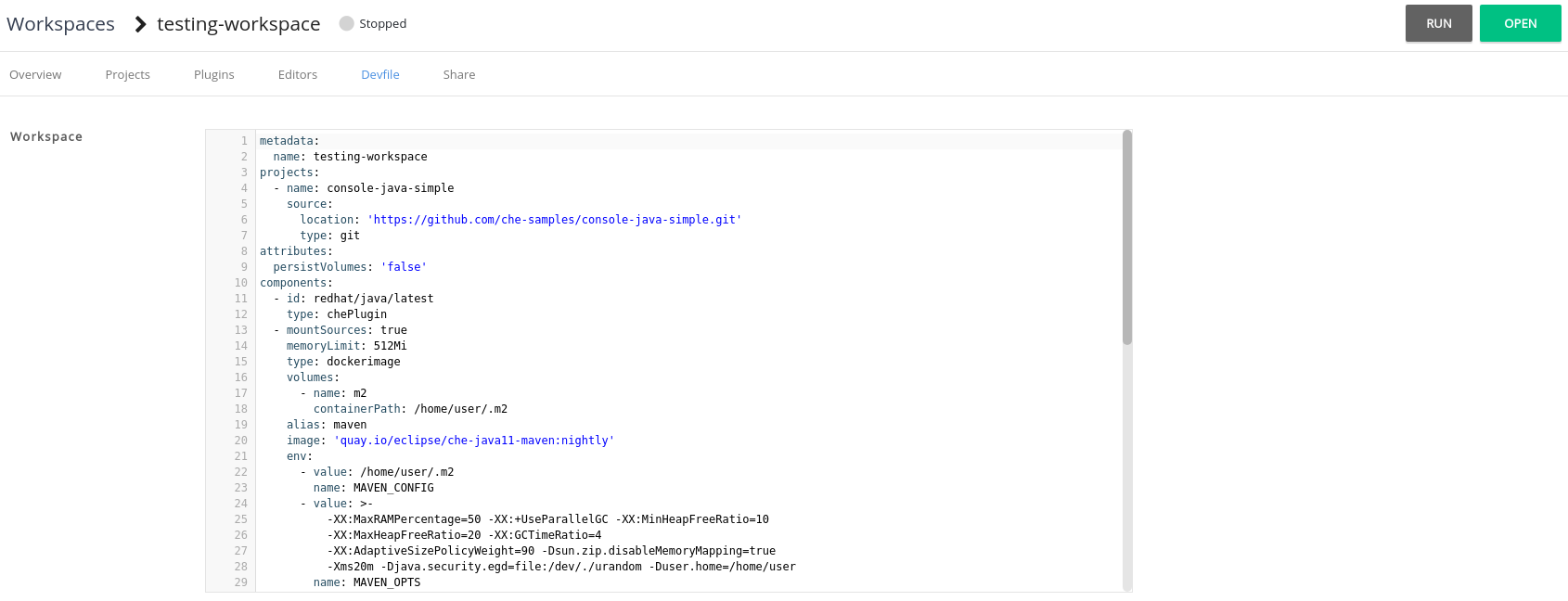
- Once the Devfile configuration is completed, click the button to start a newly created CodeReady Workspaces 2.x workspace.
3.3.3. Accessing a CodeReady Workspaces 1.x workspace configuration
CodeReady Workspaces 1.x workspace configuration is not supported in CodeReady Workspaces 2.x, but it can be accessed for converting it to a devfile.
Prerequisites
- A running instance of Red Hat CodeReady Workspaces. To install an instance of Red Hat CodeReady Workspaces, see the CodeReady Workspaces 2.1 Installation GuideCodeReady Workspaces 'quick-starts'.
- An existing workspace defined on this instance of Red Hat CodeReady Workspaces Creating a workspace from user dashboard.
Procedure
To access the CodeReady Workspaces 1.x workspace configuration:
- In the Dashboard, click the Workspaces menu to open the workspaces list and locate the workspace to migrate to CodeReady Workspaces 2.x.
In the Actions column, click the Configure workspace icon. The raw workspace configuration is available under the Config tab.

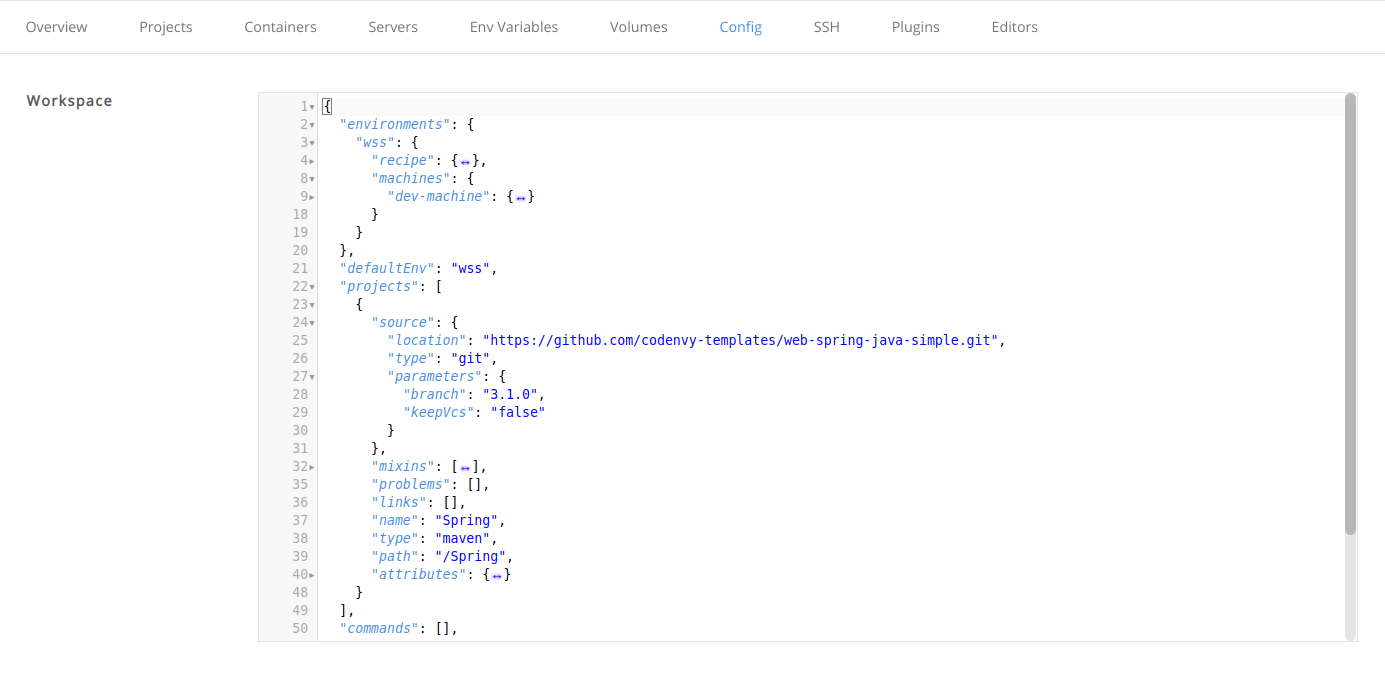
3.4. Creating and configuring a new CodeReady Workspaces 2.1 workspace
3.4.1. Creating a new workspace from the dashboard
This procedure describes how to create and edit a new CodeReady Workspaces devfile using the Dashboard.
Prerequisites
- A running instance of Red Hat CodeReady Workspaces. To install an instance of Red Hat CodeReady Workspaces, see the CodeReady Workspaces 2.1 Installation GuideCodeReady Workspaces 'quick-starts'.
Procedure
To edit the devfile:
- In the Workspaces window, click the button.
In the SELECT STACK list, select one of the default stacks.
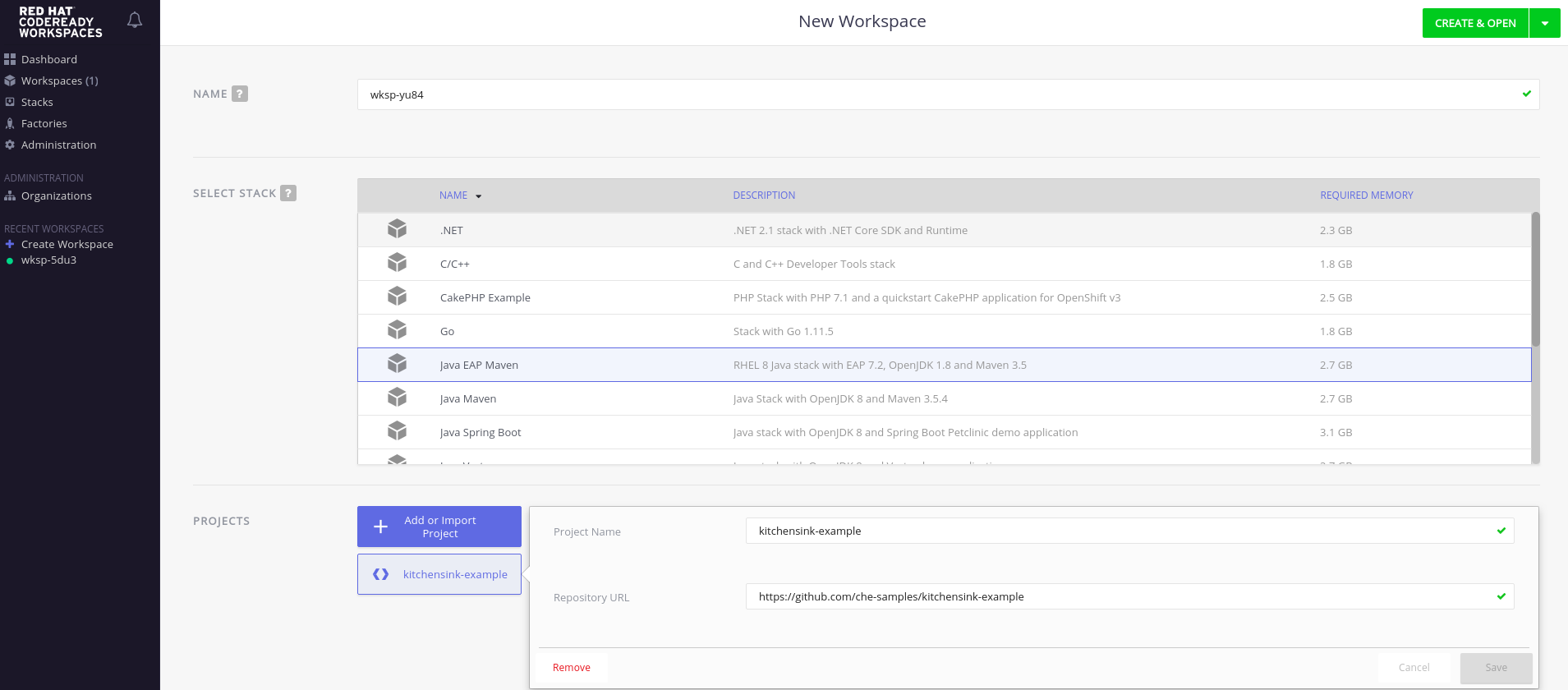
Click the button. The Workspaces → Configs page is shown.
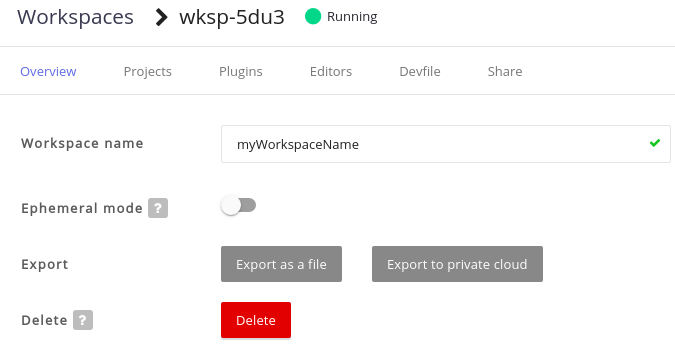
Change the workspace name and click the Devfile tab.
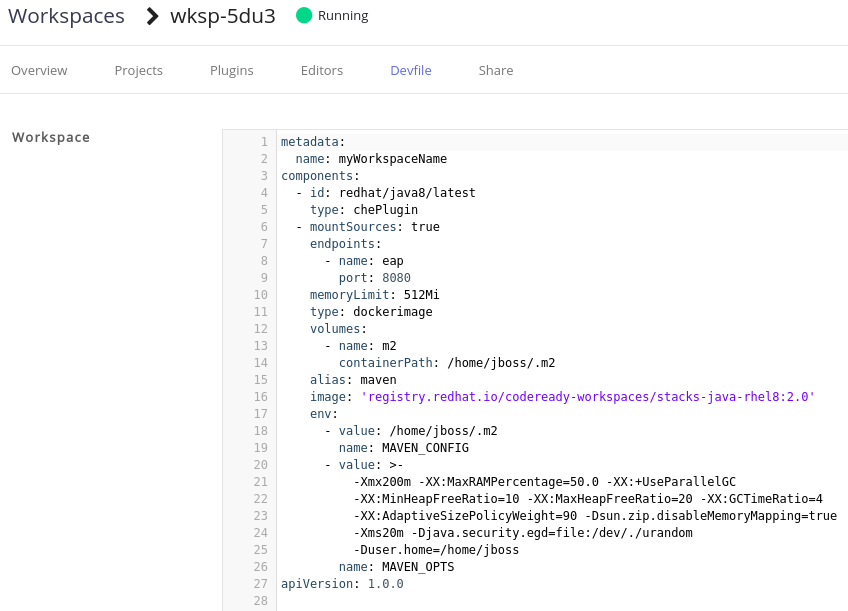
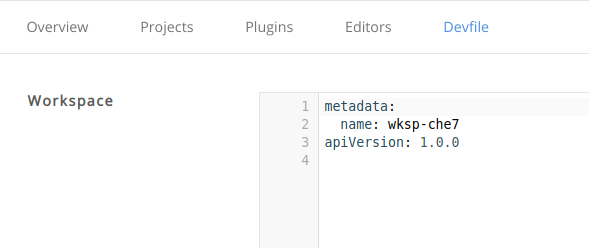
Delete all the components and commands in the devfile to get an empty devfile.
3.4.2. Adding projects to your workspace
Prerequisites
- A running instance of Red Hat CodeReady Workspaces. To install an instance of Red Hat CodeReady Workspaces, see the CodeReady Workspaces 2.1 Installation GuideCodeReady Workspaces 'quick-starts'.
- An existing workspace defined on this instance of Red Hat CodeReady Workspaces Creating a workspace from user dashboard.
Procedure
To add a project to your workspace:
- Click the Projects tab, and then click the button.
- Select the type of the project. Choose from: Samples, Blank, Git, GitHub, or Zip.
Specify the required details for the project type that you selected, and click the button.
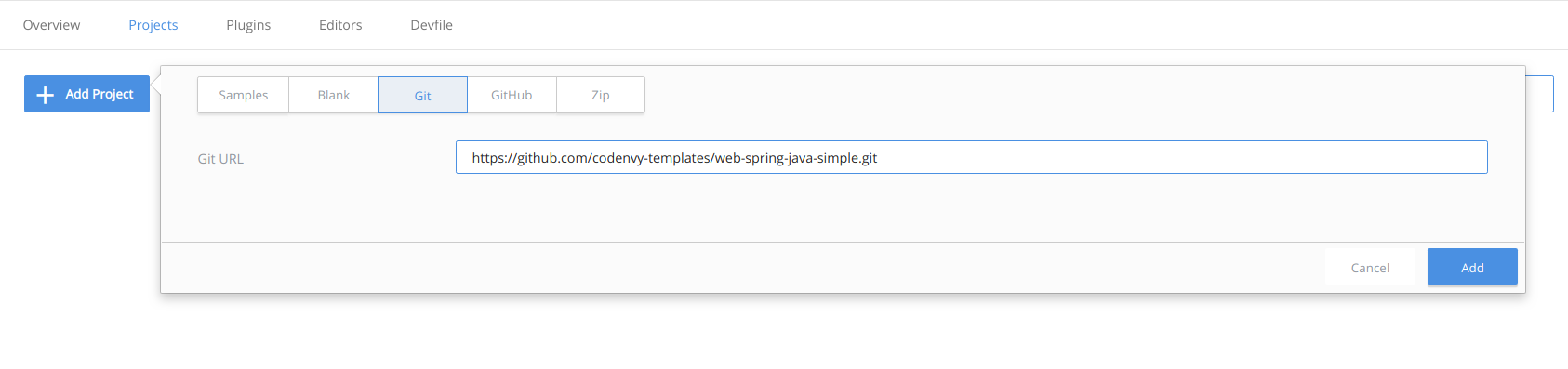
- To add another project to the workspace, click the button.
After configuring the project for the workspace, check the change in the devfile, which is the configuration file of the workspace, by opening the Devfile tab.
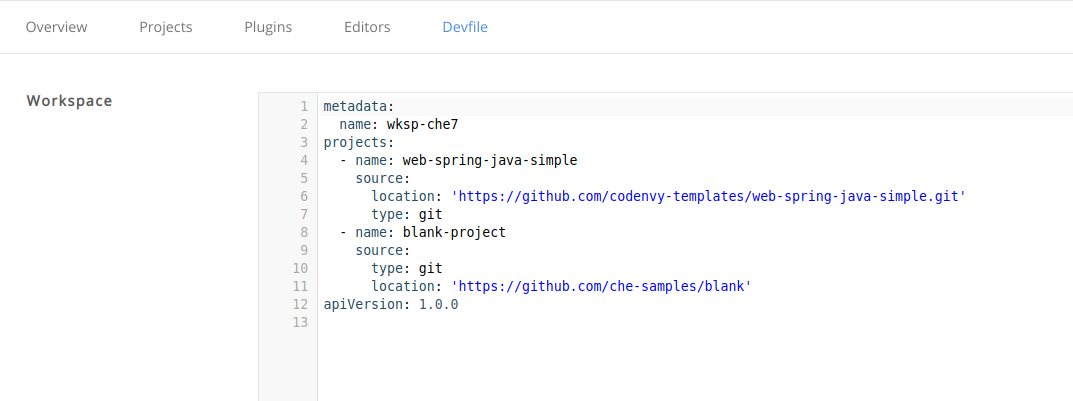
3.4.3. Configuring the workspace and adding tools
3.4.3.1. Adding plug-ins
CodeReady Workspaces 2.1 plug-ins replace CodeReady Workspaces 2.0 installers. The following table lists the CodeReady Workspaces 2.1 plug-ins that have replaced CodeReady Workspaces 2.0 installers.
| CodeReady Workspaces 2.0 installer | CodeReady Workspaces 2.1 plug-in |
|---|---|
| org.eclipse.che.ws-agent | Deprecated and not necessary |
| org.eclipse.che.terminal | Deprecated and not necessary anymore- |
| org.eclipse.che.exec | CodeReady Workspaces machine-exec Service |
| org.eclipse.che.ls.java | Language Support for Java |
Prerequisites
- A running instance of Red Hat CodeReady Workspaces. To install an instance of Red Hat CodeReady Workspaces, see the CodeReady Workspaces 2.1 Installation GuideCodeReady Workspaces 'quick-starts'.
- An existing workspace defined on this instance of Red Hat CodeReady Workspaces Creating a workspace from user dashboard.
Procedure
To add plug-ins to your workspace:
- Click the Plugins tab.
- Enable the plug-in that you want to add and click the button.
3.4.3.2. Defining the workspace editor
Prerequisites
- A running instance of Red Hat CodeReady Workspaces. To install an instance of Red Hat CodeReady Workspaces, see the CodeReady Workspaces 2.1 Installation GuideCodeReady Workspaces 'quick-starts'.
- An existing workspace defined on this instance of Red Hat CodeReady Workspaces Creating a workspace from user dashboard.
Procedure
To define the editor to use with the workspace:
Click the Editors tab.
NoteThe recommended editor for CodeReady Workspaces 2.1 is Che-Theia.
- Enable the editor to add and click the button.
Click the Devfile tab to view the changes.
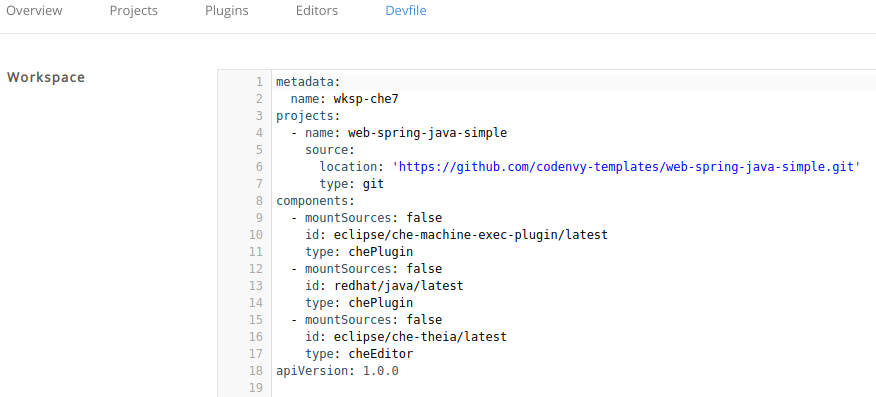
3.4.3.3. Defining specific container images
Procedure
To add a new container image:
Copy the following section from the devfile into components:
Copy to Clipboard Copied! Toggle word wrap Toggle overflow When using
type: kubernetesortype: openshift, you must:Use separate recipe files.
NoteTo use separate recipe files, the paths can be relative or absolute. For example:
...
    type: kubernetes
    reference: deploy_k8s.yaml
...
... type: kubernetes reference: deploy_k8s.yaml ...Copy to Clipboard Copied! Toggle word wrap Toggle overflow ... type: openshift reference: deploy_openshift.yaml ...... type: openshift reference: deploy_openshift.yaml ...Copy to Clipboard Copied! Toggle word wrap Toggle overflow Alternatively, add the content as
referenceContent(thereferenceContentfield replaces the CodeReady Workspaces 2.0 recipe content).
Add a CodeReady Workspaces 2.0 recipe content to the CodeReady Workspaces 2.1 devfile as
referenceContent:Click the Containers tab (Workspace → Details → Containers).
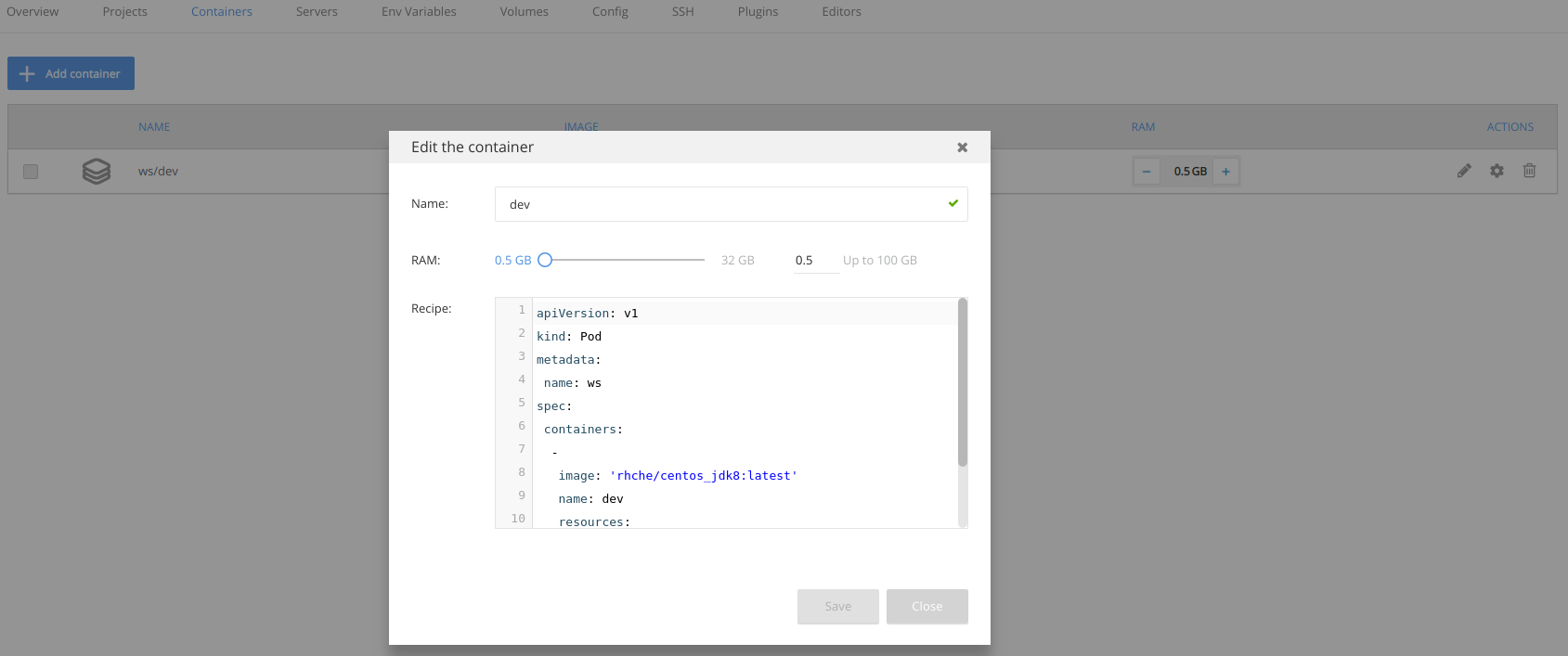
Copy the CodeReady Workspaces 2.0 recipe, and paste it into the separate CodeReady Workspaces 2.1 component as a referenceContent.
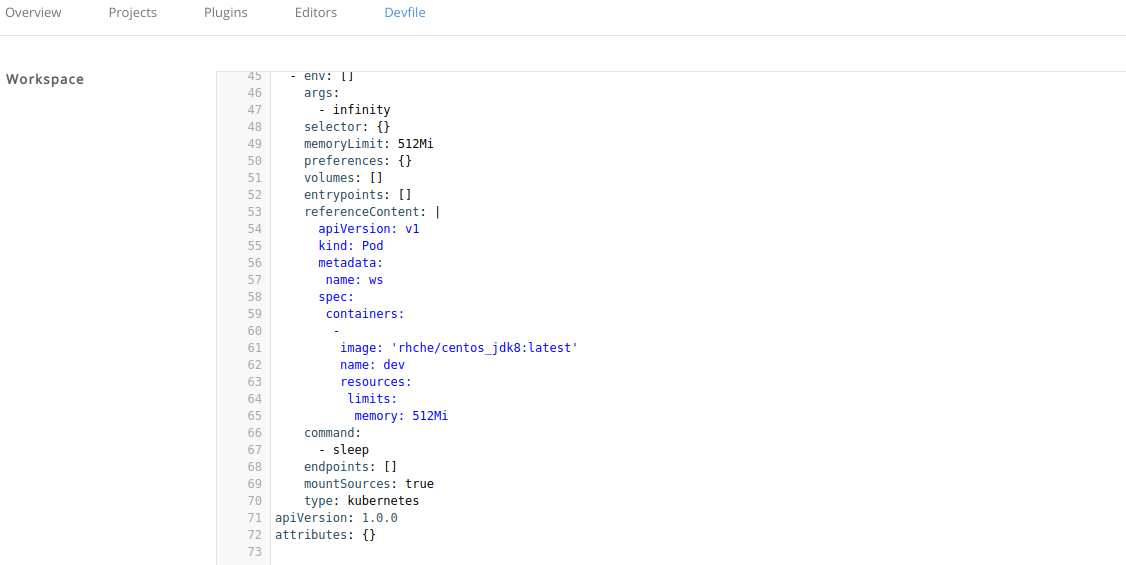
Set the type from the original CodeReady Workspaces 2.0 configuration. The following is an example of the resulting file:
Copy to Clipboard Copied! Toggle word wrap Toggle overflow
Copy the required fields from the old workspace (
image,volumes,endpoints). For example: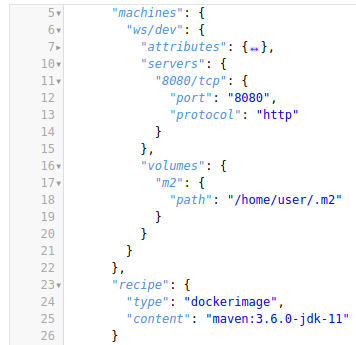
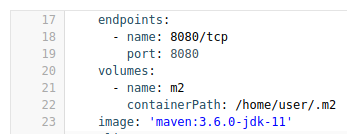
Expand Table 3.4. Сhe 6 and Сhe 7 equivalence table CodeReady Workspaces 2.0 workspace configuration CodeReady Workspaces 2.1 workspace devfile environments['defaultEnv'].machines['target'].serverscomponents[n].endpointsenvironments['defaultEnv'].machines['machineName'].volumescomponents[n].volumesenvironments['defaultEnv'].recipe.typecomponents[n].typeenvironments['defaultEnv'].recipe.contentcomponents[n].imageChange the
memoryLimitandaliasvariables, if needed. Here, the fieldaliasis used to set a name for the component. It is generated automatically from theimagefield, if not set.image: 'maven:3.6.0-jdk-11' alias: maven3-jdk11
image: 'maven:3.6.0-jdk-11' alias: maven3-jdk11Copy to Clipboard Copied! Toggle word wrap Toggle overflow Change the
memoryLimit,memoryRequest, or both fields to specify theRAMrequired for the component.alias: maven3-jdk11 memoryLimit: 256M memoryRequest: 128M
alias: maven3-jdk11 memoryLimit: 256M memoryRequest: 128MCopy to Clipboard Copied! Toggle word wrap Toggle overflow Open the Devfile tab to see the changes.
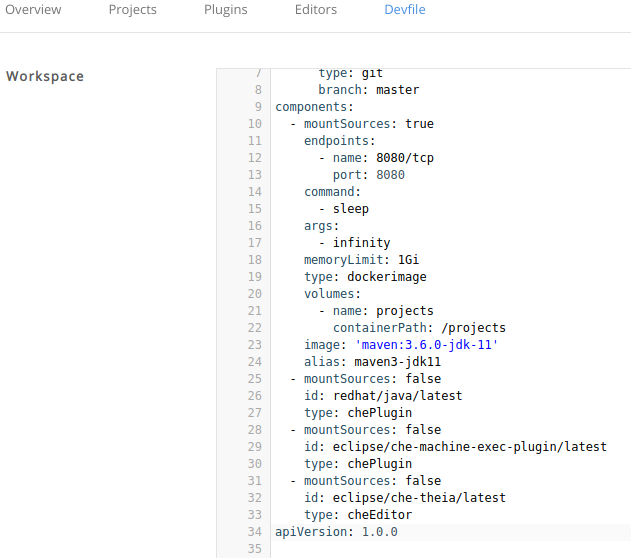
- Repeat the steps to add additional container images.
3.4.3.4. Adding commands to your workspace
The following is a comparison between workspace configuration commands in CodeReady Workspaces 2.0 (Figure 1) and CodeReady Workspaces 2.1 (Figure 2):
Figure 3.1. An example of the Workspace configuration commands in CodeReady Workspaces 2.0
Figure 3.2. An example of the Workspace configuration commands in CodeReady Workspaces 2.1
| CodeReady Workspaces 2.0 workspace configuration | CodeReady Workspaces 2.1 workspace devfile |
|---|---|
|
|
|
|
|
|
Procedure
To define commands to your workspace, edit the workspace devfile:
Add (or replace) the
commandssection with the first command. Change thenameand thecommandfields from the original workspace configuration (see the preceding equivalence table).commands: - name: build actions: - type: exec command: mvn clean installcommands: - name: build actions: - type: exec command: mvn clean installCopy to Clipboard Copied! Toggle word wrap Toggle overflow Copy the following YAML code into the
commandssection to add a new command. Change thenameand thecommandfields from the original workspace configuration (see the preceding equivalence table).- name: build and run actions: - type: exec command: mvn clean install && java -jar- name: build and run actions: - type: exec command: mvn clean install && java -jarCopy to Clipboard Copied! Toggle word wrap Toggle overflow -
Optionally, add the
componentfield intoactions. This indicates the component alias where the command will be performed. - Repeat step 2 to add more commands to the devfile.
Click the Devfile tab to view the changes.
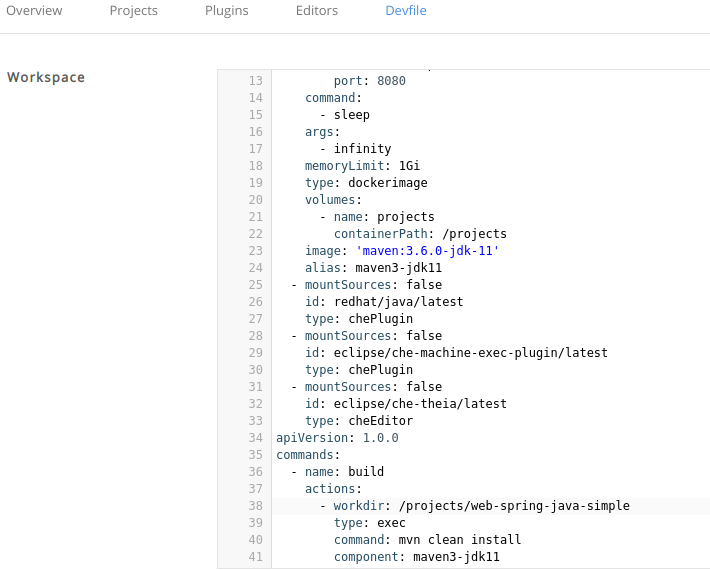
Save changes and start the new CodeReady Workspaces 2.1 workspace.
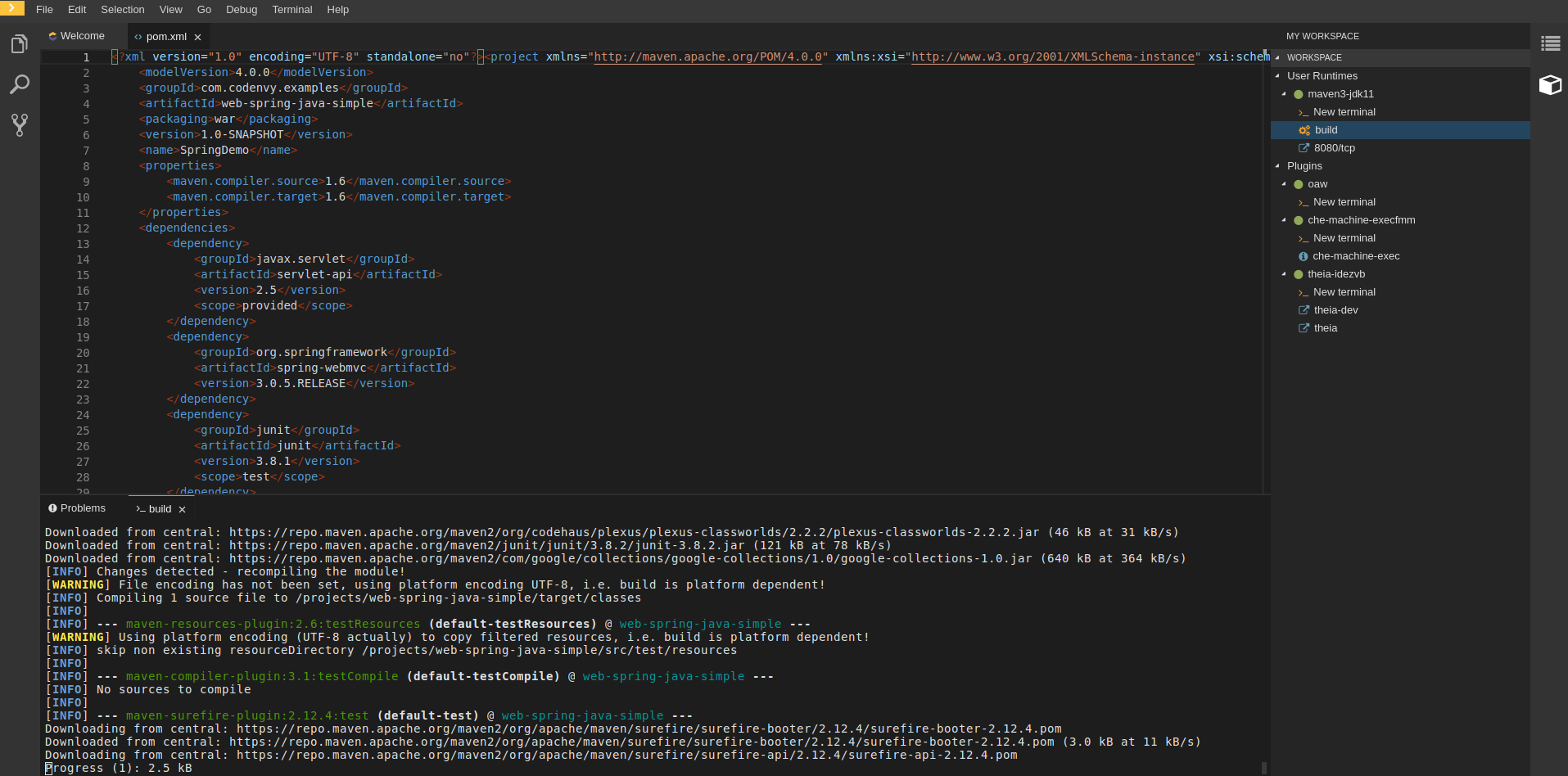
3.5. Importing a OpenShift application into a workspace
This section describes how to import a OpenShift application into a CodeReady Workspaces workspace.
For demonstration purposes, the section uses a sample OpenShift application having the following two Pods:
- A Node.js application specified by this nodejs-app.yaml
- A MongoDB Pod specified by this mongo-db.yaml
To run the application on a OpenShift cluster:
node=https://raw.githubusercontent.com/redhat-developer/devfile/master/samples/web-nodejs-with-db-sample/nodejs-app.yaml && \
mongo=https://raw.githubusercontent.com/redhat-developer/devfile/master/samples/web-nodejs-with-db-sample/mongo-db.yaml && \
oc apply -f ${mongo} && \
oc apply -f ${node}
$ node=https://raw.githubusercontent.com/redhat-developer/devfile/master/samples/web-nodejs-with-db-sample/nodejs-app.yaml && \
mongo=https://raw.githubusercontent.com/redhat-developer/devfile/master/samples/web-nodejs-with-db-sample/mongo-db.yaml && \
oc apply -f ${mongo} && \
oc apply -f ${node}To deploy a new instance of this application in a CodeReady Workspaces workspace, use one of the following three scenarios:
- Starting from scratch: Writing a new devfile
- Modifying an existing workspace: Using the Dashboard user interface
-
From a running application: Generating a devfile with
crwctl
3.5.1. Including a OpenShift application in a workspace devfile definition
This procedure demonstrates how to define the CodeReady Workspaces 2.1 workspace devfile by OpenShift application.
Prerequisites
- A running instance of Red Hat CodeReady Workspaces. To install an instance of Red Hat CodeReady Workspaces, see the CodeReady Workspaces 2.1 Installation GuideCodeReady Workspaces 'quick-starts'.
-
crwctlmanagement tool is installed. See the CodeReady Workspaces 2.1 Installation GuideInstalling thecrwctlmanagement tool
The devfile format is used to define a CodeReady Workspaces workspace, and its format is described in the Making a workspace portable using a devfile section. The following is an example of the simplest devfile:
apiVersion: 1.0.0
metadata:
 name: minimal-workspace
apiVersion: 1.0.0
metadata:
name: minimal-workspaceOnly the name (minimal-workspace) is specified. After the CodeReady Workspaces server processes this devfile, the devfile is converted to a minimal CodeReady Workspaces workspace that only has the default editor (Che-Theia) and the default editor plug-ins (example: the terminal).
Use the OpenShift type of components in the devfile to add OpenShift applications to a workspace.
For example, the user can embed the NodeJS-Mongo application in the minimal-workspace defined in this paragraph by adding a components section.
Note that the sleep infinity command is added as the entrypoint of the Node.js application. This prevents the application from starting at the workspace start phase. It allows the user to start it when needed for testing or debugging purposes.
To make it easier for a developer to test the application, add the commands in the devfile:
Use this devfile to create and start a workspace with the crwctl command:
crwctl worspace:start --devfile <devfile-path>
$ crwctl worspace:start --devfile <devfile-path>
The run command added to the devfile is available as a task in Che-Theia from the command palette. When executed, the command starts the Node.JS application.
3.5.2. Adding a OpenShift application to an existing workspace using the dashboard
This procedure demonstrates how to modify an existing workspace and import the OpenShift application using the newly created devfile.
Prerequisites
- A running instance of Red Hat CodeReady Workspaces. To install an instance of Red Hat CodeReady Workspaces, see the CodeReady Workspaces 2.1 Installation GuideCodeReady Workspaces 'quick-starts'.
- An existing workspace defined on this instance of Red Hat CodeReady Workspaces Creating a workspace from user dashboard.
Procedure
After the creation of a workspace, use the Workspace menu and then the Configure workspace icon to manage the workspace.

To modify the workspace details, use the Devfile tab. The workspace details are displayed in this tab in the devfile format.
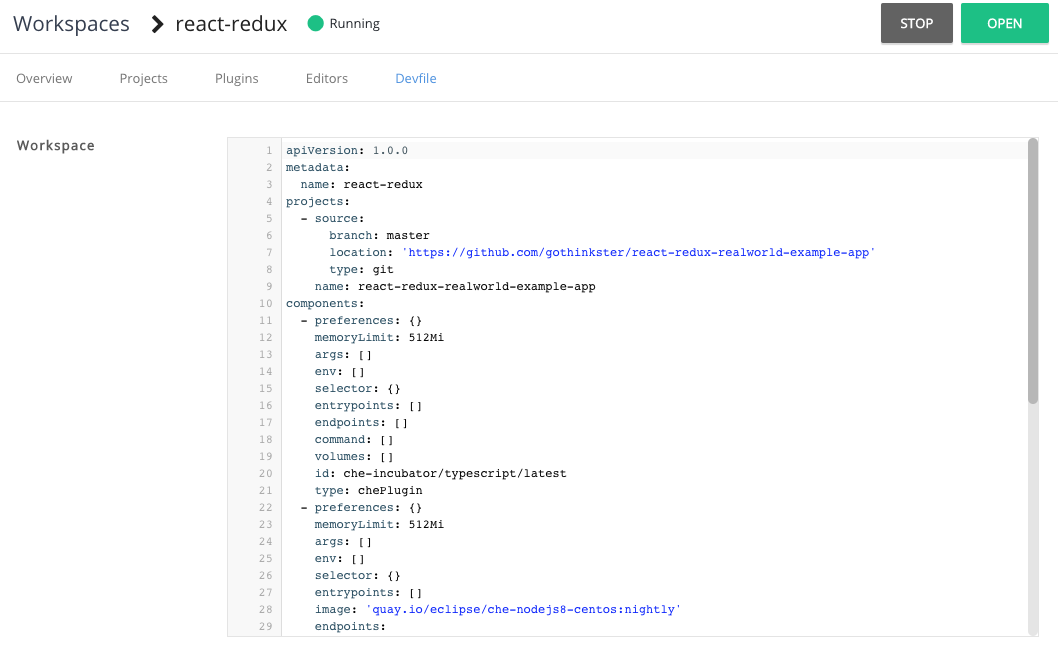
- To add a OpenShift component, use the Devfile editor on the dashboard.
- For the changes to take effect, save the devfile and restart the CodeReady Workspaces workspace.
3.5.3. Generating a devfile from an existing OpenShift application
This procedure demonstrates how to generate a devfile from an existing OpenShift application using the crwctl tool.
Prerequisites
- A running instance of Red Hat CodeReady Workspaces. To install an instance of Red Hat CodeReady Workspaces, see the CodeReady Workspaces 2.1 Installation GuideCodeReady Workspaces 'quick-starts'.
-
crwctlmanagement tool is installed. See the CodeReady Workspaces 2.1 Installation GuideInstalling thecrwctlmanagement tool
Procedure
Use the
crwctl devfile:generatecommand to generate a devfile:crwctl devfile:generate
$ crwctl devfile:generateCopy to Clipboard Copied! Toggle word wrap Toggle overflow The user can also use the
crwctl devfile:generatecommand to generate a devfile from, for example, theNodeJS-MongoDBapplication.The following example generates a devfile that includes the
NodeJScomponent:Copy to Clipboard Copied! Toggle word wrap Toggle overflow The Node.js application YAML definition is included in the devfile, inline, using the
referenceContentattribute.To include support for a language, use the
--languageparameter:Copy to Clipboard Copied! Toggle word wrap Toggle overflow
-
Use the generated devfile to start a CodeReady Workspaces workspace with
crwctl.
3.6. Remotely accessing workspaces
This section describes how to remotely access CodeReady Workspaces workspaces outside of the browser.
CodeReady Workspaces workspaces exist as containers and are, by default, modified from a browser window. In addition to this, there are the following methods of interacting with a CodeReady Workspaces workspace:
-
Opening a command line in the workspace container using the OpenShift command-line tool,
kubectl -
Uploading and downloading files using the
kubectltool
3.6.1. Remotely accessing workspaces using the OpenShift command-line tool
To access CodeReady Workspaces workspaces remotely using OpenShift command-line tool (kubectl), follow the instructions in this section.
The kubectl tool is used in this section to open a shell and manage files in a CodeReady Workspaces workspace. Alternatively, it is possible to use the oc OpenShift command-line tool.
Prerequisites
-
The
kubectlbinary file from the OpenShift website. Verify the installation of
kubectlusing theoc versioncommand:oc version Client Version: version.Info{Major:"1", Minor:"15", GitVersion:"v1.15.0", GitCommit:"e8462b5b5dc2584fdcd18e6bcfe9f1e4d970a529", GitTreeState:"clean", BuildDate:"2019-06-19T16:40:16Z", GoVersion:"go1.12.5", Compiler:"gc", Platform:"darwin/amd64"} Server Version: version.Info{Major:"1", Minor:"15", GitVersion:"v1.15.0", GitCommit:"e8462b5b5dc2584fdcd18e6bcfe9f1e4d970a529", GitTreeState:"clean", BuildDate:"2019-06-19T16:32:14Z", GoVersion:"go1.12.5", Compiler:"gc", Platform:"linux/amd64"}$ oc version Client Version: version.Info{Major:"1", Minor:"15", GitVersion:"v1.15.0", GitCommit:"e8462b5b5dc2584fdcd18e6bcfe9f1e4d970a529", GitTreeState:"clean", BuildDate:"2019-06-19T16:40:16Z", GoVersion:"go1.12.5", Compiler:"gc", Platform:"darwin/amd64"} Server Version: version.Info{Major:"1", Minor:"15", GitVersion:"v1.15.0", GitCommit:"e8462b5b5dc2584fdcd18e6bcfe9f1e4d970a529", GitTreeState:"clean", BuildDate:"2019-06-19T16:32:14Z", GoVersion:"go1.12.5", Compiler:"gc", Platform:"linux/amd64"}Copy to Clipboard Copied! Toggle word wrap Toggle overflow For versions 1.5.0 or higher, proceed with the steps in this section.
Procedure
-
Use the
execcommand to open a remote shell. To find the name of the OpenShift namespace and the Pod that runs the CodeReady Workspaces workspace:
oc get pod -l che.workspace_id --all-namespaces
NAMESPACE   NAME                                               READY   STATUS    RESTARTS   AGE
che         workspace7b2wemdf3hx7s3ln.maven-74885cf4d5-kf2q4   4/4     Running   0          6m4s
$ oc get pod -l che.workspace_id --all-namespaces
NAMESPACE   NAME                                               READY   STATUS    RESTARTS   AGE
che         workspace7b2wemdf3hx7s3ln.maven-74885cf4d5-kf2q4   4/4     Running   0          6m4s
Copy to Clipboard Copied! Toggle word wrap Toggle overflow
In the example above, the Pod name is workspace7b2wemdf3hx7s3ln.maven-74885cf4d5-kf2q4, and the namespace is codeready.
To find the name of the container:
NAMESPACE=che
POD=workspace7b2wemdf3hx7s3ln.maven-74885cf4d5-kf2q4
oc get pod ${POD} -o custom-columns=CONTAINERS:.spec.containers[*].name
CONTAINERS
maven,che-machine-execpau,theia-ide6dj,vscode-javaw92
$ NAMESPACE=che $ POD=workspace7b2wemdf3hx7s3ln.maven-74885cf4d5-kf2q4 $ oc get pod ${POD} -o custom-columns=CONTAINERS:.spec.containers[*].name CONTAINERS maven,che-machine-execpau,theia-ide6dj,vscode-javaw92Copy to Clipboard Copied! Toggle word wrap Toggle overflow When you have the namespace, pod name, and the name of the container, use the
kubectlcommand to open a remote shell:NAMESPACE=che POD=workspace7b2wemdf3hx7s3ln.maven-74885cf4d5-kf2q4 CONTAINER=maven oc exec -ti -n ${NAMESPACE} ${POD} -c ${CONTAINER} bash user@workspace7b2wemdf3hx7s3ln $$ NAMESPACE=che $ POD=workspace7b2wemdf3hx7s3ln.maven-74885cf4d5-kf2q4 $ CONTAINER=maven $ oc exec -ti -n ${NAMESPACE} ${POD} -c ${CONTAINER} bash user@workspace7b2wemdf3hx7s3ln $Copy to Clipboard Copied! Toggle word wrap Toggle overflow From the container, execute the
buildandruncommands (as if from the CodeReady Workspaces workspace terminal):user@workspace7b2wemdf3hx7s3ln $ mvn clean install [INFO] Scanning for projects... (...)
user@workspace7b2wemdf3hx7s3ln $ mvn clean install [INFO] Scanning for projects... (...)Copy to Clipboard Copied! Toggle word wrap Toggle overflow
Additional resources
-
For more about
kubectl, see the OpenShift documentation.
3.6.2. Downloading and uploading a file to a workspace using the command-line interface
This procedure describes how to use the kubectl tool to download or upload files remotely from or to an Red Hat CodeReady Workspaces workspace.
Prerequisites
- A running instance of Red Hat CodeReady Workspaces. To install an instance of Red Hat CodeReady Workspaces, see the CodeReady Workspaces 2.1 Installation GuideCodeReady Workspaces 'quick-starts'.
- Remote access to the CodeReady Workspaces workspace you intend to modify. For instructions see Section 3.6.1, “Remotely accessing workspaces using the OpenShift command-line tool”.
-
The
kubectlbinary file from the OpenShift website. -
Verify the installation of
kubectlusing theoc versioncommand:
Procedure
To download a local file named
downloadme.txtfrom a workspace container to the current home directory of the user, use the following in the CodeReady Workspaces remote shell.REMOTE_FILE_PATH=/projects/downloadme.txt NAMESPACE=che POD=workspace7b2wemdf3hx7s3ln.maven-74885cf4d5-kf2q4 CONTAINER=maven oc cp ${NAMESPACE}/${POD}:${REMOTE_FILE_PATH} ~/downloadme.txt -c ${CONTAINER}$ REMOTE_FILE_PATH=/projects/downloadme.txt $ NAMESPACE=che $ POD=workspace7b2wemdf3hx7s3ln.maven-74885cf4d5-kf2q4 $ CONTAINER=maven $ oc cp ${NAMESPACE}/${POD}:${REMOTE_FILE_PATH} ~/downloadme.txt -c ${CONTAINER}Copy to Clipboard Copied! Toggle word wrap Toggle overflow -
To upload a local file named
uploadme.txtto a workspace container in the/projectsdirectory:
LOCAL_FILE_PATH=./uploadme.txt
NAMESPACE=che
POD=workspace7b2wemdf3hx7s3ln.maven-74885cf4d5-kf2q4
CONTAINER=maven
oc cp ${LOCAL_FILE_PATH} ${NAMESPACE}/${POD}:/projects -c ${CONTAINER}
$ LOCAL_FILE_PATH=./uploadme.txt
$ NAMESPACE=che
$ POD=workspace7b2wemdf3hx7s3ln.maven-74885cf4d5-kf2q4
$ CONTAINER=maven
$ oc cp ${LOCAL_FILE_PATH} ${NAMESPACE}/${POD}:/projects -c ${CONTAINER}Using the preceding steps, the user can also download and upload directories.
3.7. Creating a workspace from code sample
Every stack includes a sample codebase, which is defined by the devfile of the stack. This section explains how to create a workspace from this code sample in a sequence of three procedures.
Creating a workspace from the user dashboard:
- Using the Get Started view.
- Using the Custom Workspace view.
- Changing the configuration of the workspace to add code sample.
- Running an existing workspace from the user dashboard.
For more information about devfiles, see Configuring a CodeReady Workspaces workspace using a devfile.
3.7.1. Creating a workspace from Get Started view of User Dashboard
This section describes how to create a workspace from the User Dashboard.
Prerequisites
- A running instance of Red Hat CodeReady Workspaces. To install an instance of Red Hat CodeReady Workspaces, see the CodeReady Workspaces 2.1 Installation GuideCodeReady Workspaces quick-starts
Procedure
- Navigate to the CodeReady Workspaces Dashboard. See Navigating CodeReady Workspaces using the Dashboard.
- In the left navigation panel, go to Get Started.
- Click the tab.
In the gallery, there is list of samples that may be used to build and run projects.
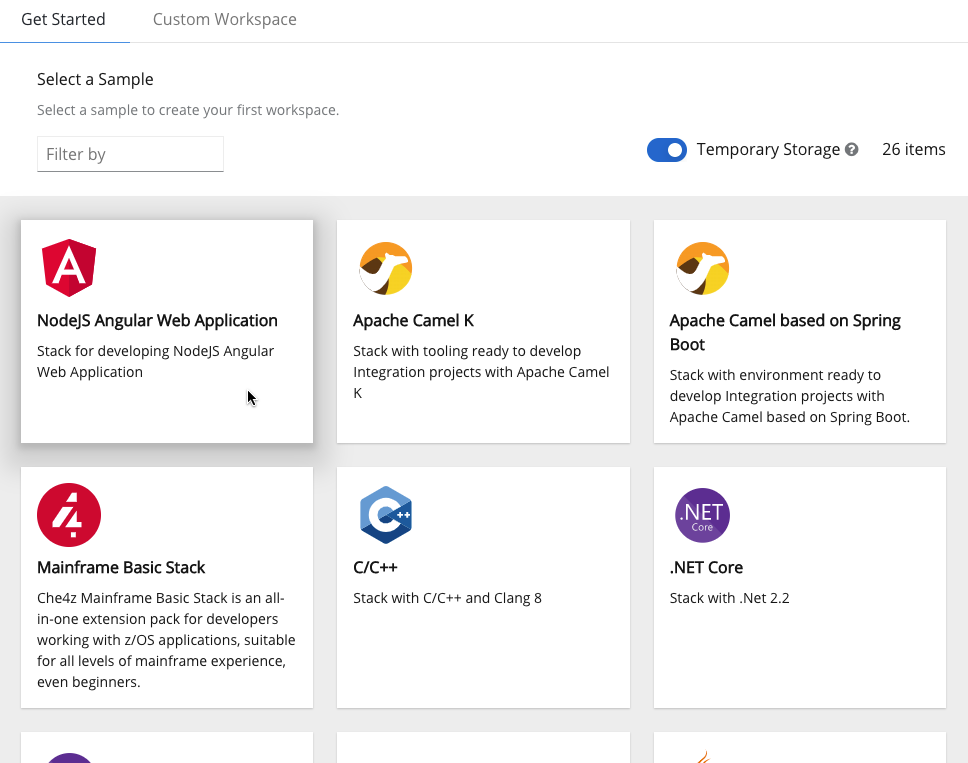 Changing resource limits
Changing the memory requirements is only possible from the devfile.
Start the workspace: click the chosen stack card.
Workspace name can be auto-generated based on the underlying devfile of the stack. Generated names always consist of the devfile metadata.generateName property as the prefix and four random characters.
3.7.2. Creating a workspace from Custom Workspace view of User Dashboard
This section describes how to create a workspace from the User Dashboard.
Prerequisites
- A running instance of Red Hat CodeReady Workspaces. To install an instance of Red Hat CodeReady Workspaces, see the CodeReady Workspaces 2.1 Installation GuideCodeReady Workspaces quick-starts
Procedure
- Navigate to the CodeReady Workspaces Dashboard. See Navigating CodeReady Workspaces using the Dashboard.
- In the left navigation panel, go to Get Started.
- Click the tab.
Define a Name for the workspace.
New workspace nameWorkspace name can be auto-generated based on the underlying devfile of the stack. Generated names always consist of the devfile
metadata.generateNameproperty as the prefix and four random characters.In the Devfile section, select the devfile template that will be used to build and run projects.
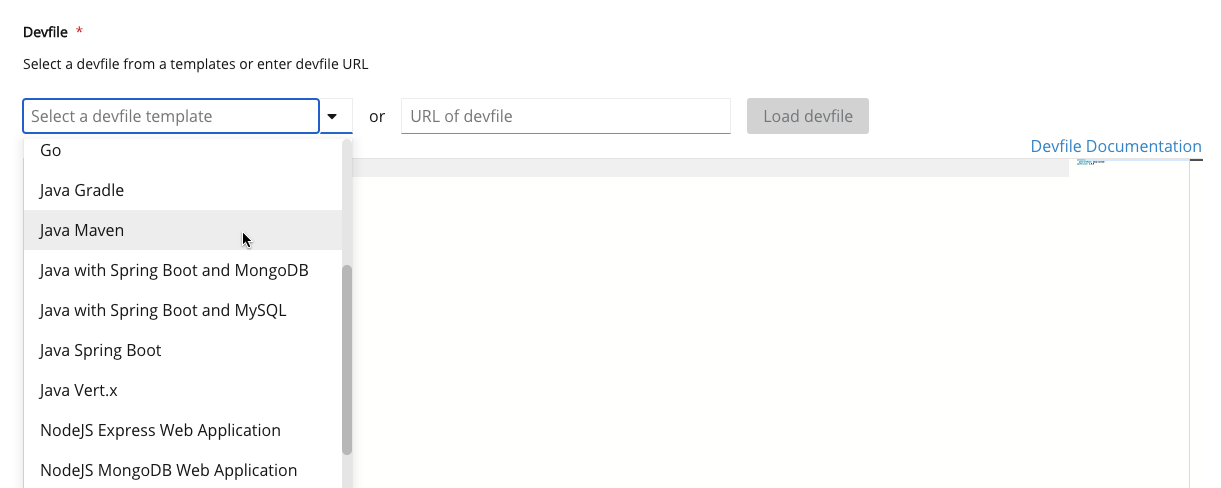 Changing resource limits
Changing the memory requirements is only possible from the devfile.
Start the workspace: click the button at the bottom of the form:

3.7.3. Changing the configuration of an existing workspace
This section describes how to change the configuration of an existing workspace from the User Dashboard.
Prerequisites
- A running instance of Red Hat CodeReady Workspaces. To install an instance of Red Hat CodeReady Workspaces, see the CodeReady Workspaces 2.1 Installation GuideCodeReady Workspaces 'quick-starts'.
- An existing workspace defined on this instance of Red Hat CodeReady Workspaces Creating a workspace from user dashboard.
Procedure
- Navigate to the CodeReady Workspaces Dashboard. See Navigating CodeReady Workspaces using the dashboard.
- In the left navigation panel, go to Workspaces.
- Click the name of a workspace to navigate to the configuration overview page.
Click the Overview tab and execute following actions:
- Change the Workspace name.
- Toggle Ephemeral mode.
- Export the workspace configuration to a file or private cloud.
Delete the workspace.
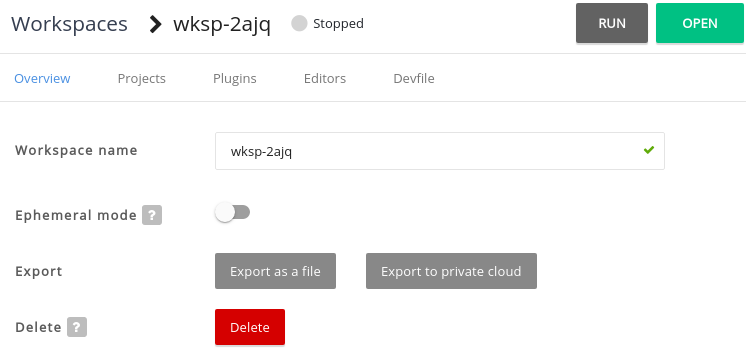
In the Projects section, choose the projects to integrate in the workspace.
Click the button and do one of the following:
Enter the project Git repository URL to integrate in the workspace:
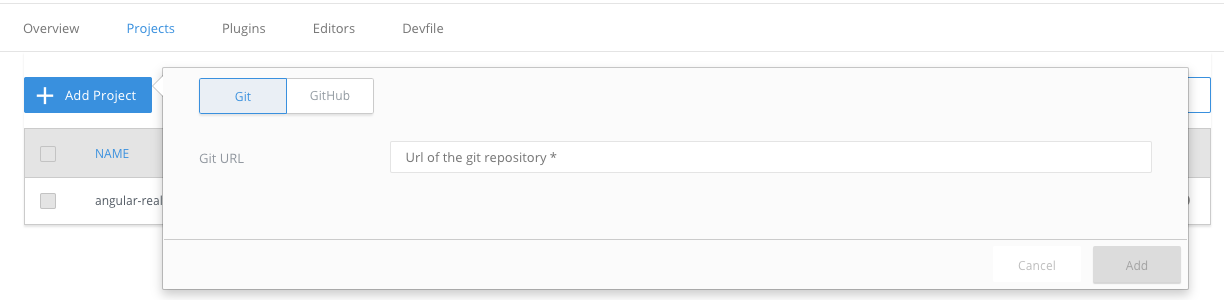
Connect your GitHub account and select projects to integrate:
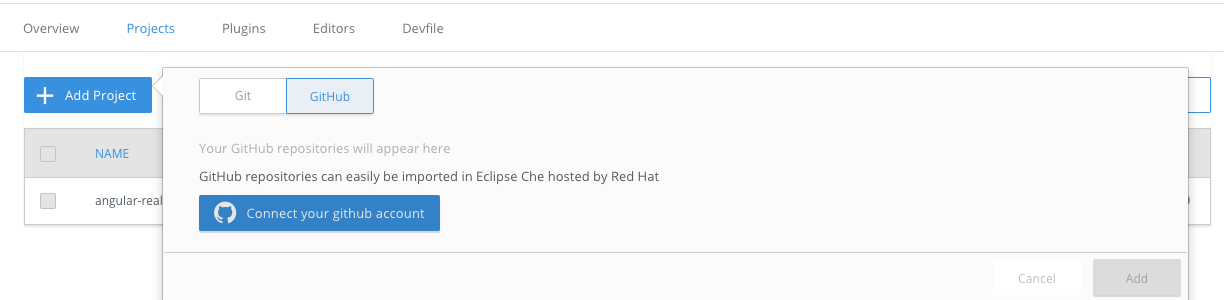
- Click the button.
In the Plugins section, choose the plug-ins to integrate in the workspace.
ExampleStart with a generic Java-based stack, then add support for Node.js or Python.
In the Editors section, choose the editors to integrate in the workspace. The CodeReady Workspaces 2.1 editor is based on Che-Theia.
Example: Switch to the CodeReady Workspaces 1.x editorTo switch to the CodeReady Workspaces 1.x editor, select the GWT IDE.
From the Devfile tab, edit YAML configuration of the workspace. See the Devfile reference.
Example: add commands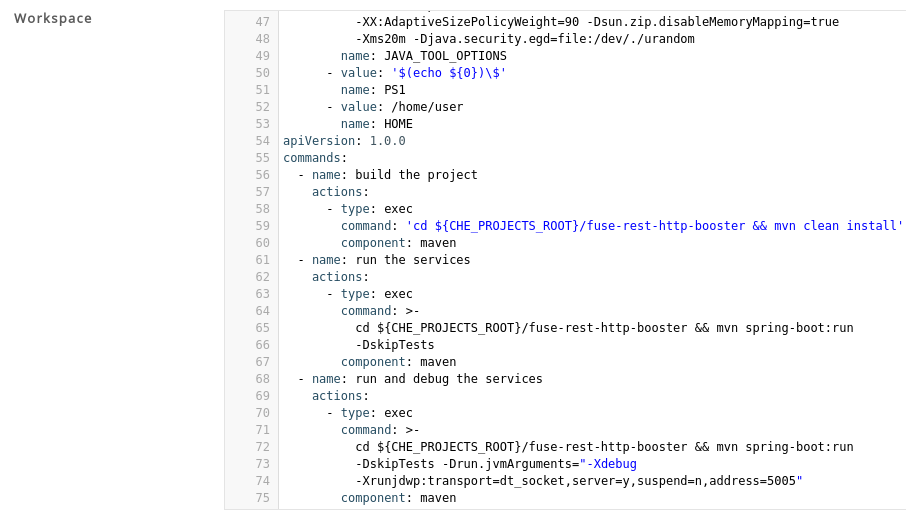 Example: add a project
To add a project into the workspace, add or edit the following section:
projects: - name: che source: type: git location: 'https://github.com/eclipse/che.git'projects: - name: che source: type: git location: 'https://github.com/eclipse/che.git'Copy to Clipboard Copied! Toggle word wrap Toggle overflow
3.7.4. Running an existing workspace from the User Dashboard
This section describes how to run an existing workspace from the User Dashboard.
3.7.4.1. Running an existing workspace from the User Dashboard with the Run button
This section describes how to run an existing workspace from the User Dashboard using the Run button.
Prerequisites
- A running instance of Red Hat CodeReady Workspaces. To install an instance of Red Hat CodeReady Workspaces, see the CodeReady Workspaces 2.1 Installation GuideCodeReady Workspaces 'quick-starts'.
- An existing workspace defined on this instance of Red Hat CodeReady Workspaces Creating a workspace from user dashboard.
Procedure
- Navigate to the CodeReady Workspaces Dashboard. See Navigating CodeReady Workspaces using the dashboard.
- In the left navigation panel, navigate to Workspaces.
- Click on the name of a non-running workspace to navigate to the overview page.
- Click on the button in the top right corner of the page.
- The workspace is started.
- The browser does not navigates to the workspace.
3.7.4.2. Running an existing workspace from the User Dashboard using the Open button
This section describes how to run an existing workspace from the User Dashboard using the Open button.
Prerequisites
- A running instance of Red Hat CodeReady Workspaces. To install an instance of Red Hat CodeReady Workspaces, see the CodeReady Workspaces 2.1 Installation GuideCodeReady Workspaces 'quick-starts'.
- An existing workspace defined on this instance of Red Hat CodeReady Workspaces Creating a workspace from user dashboard.
Procedure
- Navigate to the CodeReady Workspaces Dashboard. See Navigating CodeReady Workspaces using the dashboard.
- In the left navigation panel, navigate to Workspaces.
- Click on the name of a non-running workspace to navigate to the overview page.
- Click on the button in the top right corner of the page.
- The workspace is started.
- The browser navigates to the workspace.
3.7.4.3. Running an existing workspace from the User Dashboard using the Recent Workspaces
This section describes how to run an existing workspace from the User Dashboard using the Recent Workspaces.
Prerequisites
- A running instance of Red Hat CodeReady Workspaces. To install an instance of Red Hat CodeReady Workspaces, see the CodeReady Workspaces 2.1 Installation GuideCodeReady Workspaces 'quick-starts'.
- An existing workspace defined on this instance of Red Hat CodeReady Workspaces Creating a workspace from user dashboard.
Procedure
- Navigate to the CodeReady Workspaces Dashboard. See Navigating CodeReady Workspaces using the dashboard.
In the left navigation panel, in the Recent Workspaces section, right-click the name of a non-running workspace and click Run in the contextual menu to start it.
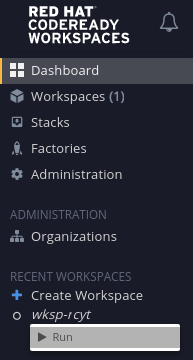
3.8. Creating a workspace by importing the source code of a project
This section describes how to create a new workspace to edit an existing codebase.
Prerequisites
- A running instance of Red Hat CodeReady Workspaces. To install an instance of Red Hat CodeReady Workspaces, see the CodeReady Workspaces 2.1 Installation GuideCodeReady Workspaces 'quick-starts'.
- An existing workspace with plug-ins related to your development environment defined on this instance of Red Hat CodeReady Workspaces Creating a workspace from user dashboard.
There are two ways to do that before starting a workspace:
To create a new workspace to edit an existing codebase, use one of the following three methods after you have started the workspace:
3.8.1. Importing from the Dashboard into an existing workspace
Import the project. There are at least two ways to import a project using the Dashboard.
- From the Dashboard, select Workspaces, then select your workspace by clicking on its name. This will link you to the workspace’s Overview tab.
- Or, use the gear icon. This will link to the Devfile tab where you can enter your own YAML configuration.
- Click the Projects tab.
- Click Add Project. You can then import project by a repository Git URL or from GitHub.
You can add a project to a non-running workspace, but you must start the workspace to delete it.
3.8.1.1. Editing an existing repository
To edit an existing repository:
Choose the Git project or zip file, and CodeReady Workspaces will load it into your workspace.
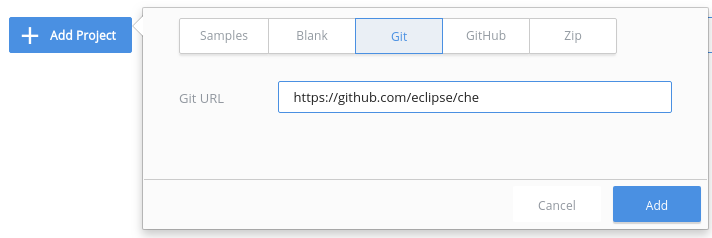
- To open the workspace, click the button.
3.8.1.2. Editing the commands after importing a project
After you have a project in your workspace, you can add commands to it. Adding commands to your projects allows you to run, debug, or launch your application in a browser.
To add commands to the project:
Open the workspace configuration in the Dashboard, then select the Devfile tab.
- Open the workspace.
To run a command, select Terminal > Run Task from the main menu.
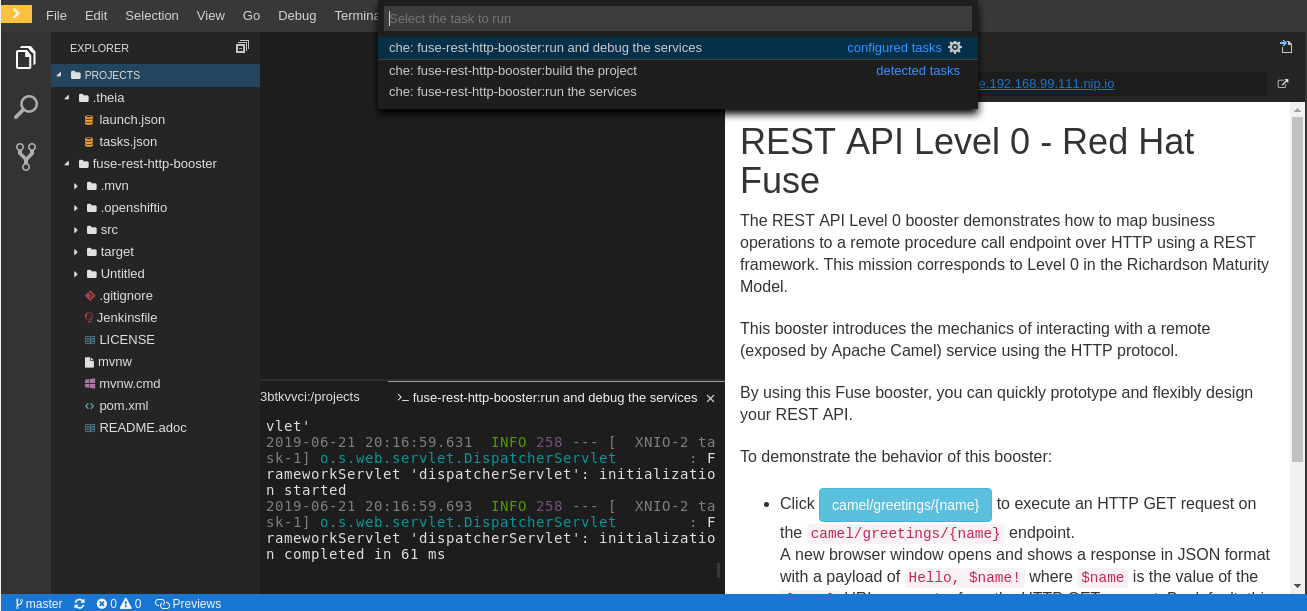
To configure commands, select Terminal > Configure Tasks from the main menu.
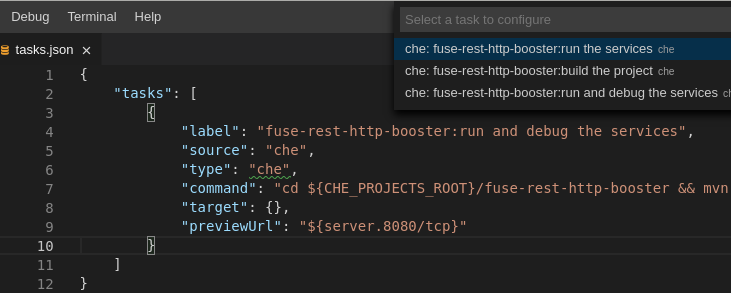
3.8.2. Importing to a running workspace using the Git: Clone command
To import to a running workspace using the Git: Clone command:
Start a workspace, then use the Git: Clone command from the command palette or the Welcome screen to import a project to a running workspace.
Open the command palette using
F1orCTRL-SHIFT-P, or from the link in the Welcome screen.
Enter the path to the project you want to clone.

3.8.3. Importing to a running workspace with git clone in a terminal
In addition to the approaches above, you can also start a workspace, open a Terminal, and type git clone to pull code.
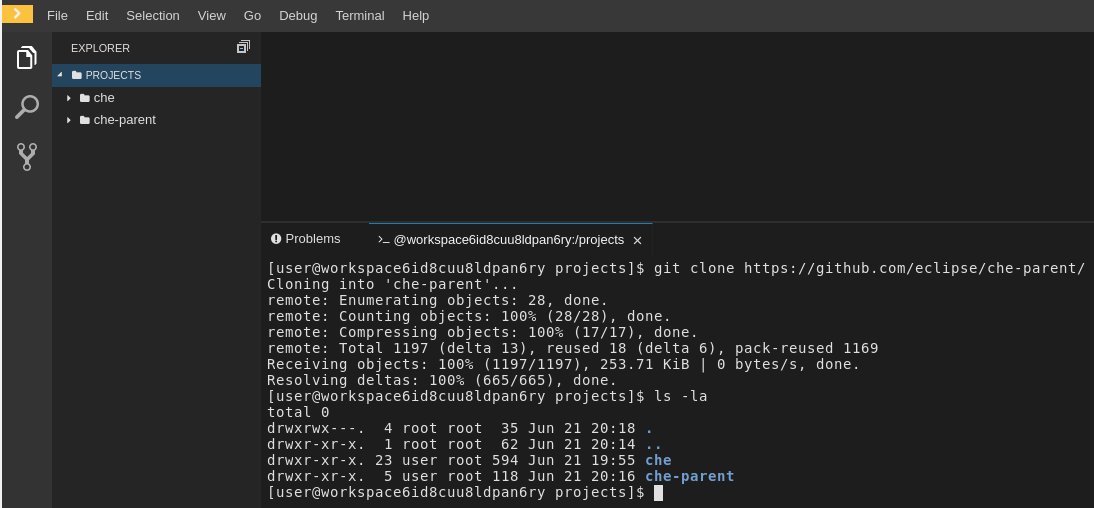
Importing or deleting workspace projects in the terminal does not update the workspace configuration, and the change is not reflected in the Project and Devfile tabs in the dashboard.
Similarly, if you add a project using the Dashboard, then delete it with rm -fr myproject, it may still appear in the Projects or Devfile tab.
3.9. Configuring workspace exposure strategies
The following section describes how to configure workspace exposure strategies of a CodeReady Workspaces server and ensure that applications running inside are not vulnerable to outside attacks.
The workspace exposure strategy is configured per CodeReady Workspaces server, using the che.infra.kubernetes.server_strategy configuration property or the CHE_INFRA_KUBERNETES_SERVER__STRATEGY environment variable.
The supported values for che.infra.kubernetes.server_strategy are:
-
multi-host
For the multi-host strategy, set the che.infra.kubernetes.ingress.domain (or the CHE_INFRA_KUBERNETES_INGRESS_DOMAIN environment variable) configuration property to the domain name that will host workspace component subdomains.
3.9.1. Workspace exposure strategies
Specific components of workspaces need to be made accessible outside of the OpenShift cluster. This is typically the user interface of the workspace’s IDE, but it can also be the web UI of the application being developed. This enables developers to interact with the application during the development process.
CodeReady Workspaces supports three ways to make workspace components available to the users, also referred to as strategies:
- multi-host strategy
The strategies define whether new subdomains are created for components of the workspace, and what hosts these components are available on.
3.9.1.1. Multi-host strategy
With this strategy, each workspace component is assigned a new subdomain of the main domain configured for the CodeReady Workspaces server. On OpenShift, this is the only possible strategy, and manual configuration of the workspace exposure strategy is therefore always ignored.
This strategy is the easiest to understand from the perspective of component deployment because any paths present in the URL to the component are received as they are by the component.
On a CodeReady Workspaces server secured using the Transport Layer Security (TLS) protocol, creating new subdomains for each component of each workspace requires a wildcard certificate to be available for all such subdomains for the CodeReady Workspaces deployment to be practical.
3.9.2. Security considerations
This section explains the security impact of using different CodeReady Workspaces workspace exposure strategies.
All the security-related considerations in this section are only applicable to CodeReady Workspaces in multiuser mode. The single user mode does not impose any security restrictions.
3.9.2.1. JSON web token (JWT) proxy
All CodeReady Workspaces plug-ins, editors, and components can require authentication of the user accessing them. This authentication is performed using a JSON web token (JWT) proxy that functions as a reverse proxy of the corresponding component, based on its configuration, and performs the authentication on behalf of the component.
The authentication uses a redirect to a special page on the CodeReady Workspaces server that propagates the workspace and user-specific authentication token (workspace access token) back to the originally requested page.
The JWT proxy accepts the workspace access token from the following places in the incoming requests, in the following order:
- The token query parameter
- The Authorization header in the bearer-token format
-
The
access_tokencookie
3.9.2.2. Secured plug-ins and editors
CodeReady Workspaces users do not need to secure workspace plug-ins and workspace editors (such as Che-Theia). This is because the JWT proxy authentication is transparent to the user and is governed by the plug-in or editor definition in their meta.yaml descriptors.
3.9.2.3. Secured container-image components
Container-image components can define custom endpoints for which the devfile author can require CodeReady Workspaces-provided authentication, if needed. This authentication is configured using two optional attributes of the endpoint:
-
secure- A boolean attribute that instructs the CodeReady Workspaces server to put the JWT proxy in front of the endpoint. Such endpoints have to be provided with the workspace access token in one of the several ways explained in Section 3.9.2.1, “JSON web token (JWT) proxy”. The default value of the attribute isfalse. -
cookiesAuthEnabled- A boolean attribute that instructs the CodeReady Workspaces server to automatically redirect the unauthenticated requests for current user authentication as described in Section 3.9.2.1, “JSON web token (JWT) proxy”. Setting this attribute totruehas security consequences because it makes Cross-site request forgery (CSRF) attacks possible. The default value of the attribute isfalse.
3.9.2.4. Cross-site request forgery attacks
Cookie-based authentication can make an application secured by a JWT proxy prone to Cross-site request forgery (CSRF) attacks. See the Cross-site request forgery Wikipedia page and other resources to ensure your application is not vulnerable.
3.9.2.5. Phishing attacks
An attacker who is able to create an Ingress or route inside the cluster with the workspace that shares the host with some services behind a JWT proxy, the attacker may be able to create a service and a specially forged Ingress object. When such a service or Ingress is accessed by a legitimate user that was previously authenticated with a workspace, it can lead to the attacker stealing the workspace access token from the cookies sent by the legitimate user’s browser to the forged URL. To eliminate this attack vector, configure OpenShift to disallow setting the host of an Ingress.
3.10. Mounting a secret as a file or an environment variable into a workspace container
Secrets are OpenShift objects that store sensitive data such as user names, passwords, authentication tokens, and configurations in an encrypted form.
Users can mount a secret that contains sensitive data in a workspace container. This reapplies the stored data from the secret automatically for every newly created workspace. As a result, the user does not have to provide these credentials and configuration settings manually.
The following section describes how to automatically mount a OpenShift secret in a workspace container and create permanent mount points for components such as:
-
Maven configuration, the
settings.xmlfile - SSH key pairs
- AWS authorization tokens
A OpenShift secret can be mounted into a workspace container as:
- A file - This creates automatically mounted Maven settings that will be applied to every new workspace with Maven capabilities.
An environment variable - This uses SSH key pairs and AWS authorization tokens for automatic authentication.
NoteSSH key pairs can also be mounted as a file, but this format is primarily aimed at the settings of the Maven configuration.
The mounting process uses the standard OpenShift mounting mechanism, but it requires additional annotations and labeling for a proper bound of a secret with the required CodeReady Workspaces workspace container.
3.10.1. Mounting a secret as a file into a workspace container
Red Hat CodeReady Workspaces uses OpenShift VolumeMount subPath feature to mount files into containers. This is supported and enabled by default since OpenShift v1.15 and OpenShift 4.
This section describes how to mount a secret from the user’s namespace as a file in single-workspace or multiple-workspace containers of CodeReady Workspaces.
Prerequisites
- A running instance of Red Hat CodeReady Workspaces. To install an instance of Red Hat CodeReady Workspaces, see the CodeReady Workspaces 2.1 Installation GuideCodeReady Workspaces 'quick-starts'.
Procedure
Create a new OpenShift secret in the OpenShift namespace where a CodeReady Workspaces workspace will be created.
-
The labels of the secret that is about to be created must match the set of labels configured in
che.workspace.provision.secret.labelsproperty of CodeReady Workspaces. The default labels are: -
app.kubernetes.io/part-of: che.eclipse.org app.kubernetes.io/component: workspace-secret:NoteNote that the following example describes variations in the usage of the
target-containerannotation in versions 2.1 and 2.2 of Red Hat CodeReady Workspaces.Example:
Copy to Clipboard Copied! Toggle word wrap Toggle overflow Annotations must indicate the given secret is mounted as a file, provide the mount path, and, optionally, specify the name of the container in which the secret is mounted. If there is no target-container annotation, the secret will be mounted into all user containers of the CodeReady Workspaces workspace, but this is applicable only for the CodeReady Workspaces version 2.1.
Copy to Clipboard Copied! Toggle word wrap Toggle overflow Since the CodeReady Workspaces version 2.2, the
target-containerannotation is deprecated andautomount-workspace-secretannotation with Boolean values is introduced. Its purpose is to define the default secret mounting behavior, with the ability to be overridden in a devfile. Thetruevalue enables the automatic mounting into all workspace containers. In contrast, thefalsevalue disables the mounting process until it is explicitly requested in a devfile component using theautomountWorkspaceSecrets:trueproperty.Copy to Clipboard Copied! Toggle word wrap Toggle overflow Data of the Kubernetes secret may contain several items, whose names must match the desired file name mounted into the container.
Copy to Clipboard Copied! Toggle word wrap Toggle overflow This results in a file named
settings.xmlbeing mounted at the/home/user/.m2/path of all workspace containers.The secret-s mount path can be overridden for specific components of the workspace using devfile. To change mount path, an additional volume should be declared in a component of the devfile, with name matching overridden secret name, and desired mount path.
Copy to Clipboard Copied! Toggle word wrap Toggle overflow Note that for this kind of overrides, components must declare an alias to be able to distinguish containers which belong to them and apply override path exclusively for those containers.
-
The labels of the secret that is about to be created must match the set of labels configured in
3.10.2. Mounting a secret as an environment variable into a workspace container
The following section describes how to mount a OpenShift secret from the user’s namespace as an environment variable, or variables, into single-workspace or multiple-workspace containers of CodeReady Workspaces.
Prerequisites
- A running instance of Red Hat CodeReady Workspaces. To install an instance of Red Hat CodeReady Workspaces, see the CodeReady Workspaces 2.1 Installation GuideCodeReady Workspaces 'quick-starts'.
Procedure
Create a new OpenShift secret in the k8s namespace where a CodeReady Workspaces workspace will be created.
-
The labels of the secret that is about to be created must match the set of labels configured in
che.workspace.provision.secret.labelsproperty of CodeReady Workspaces. By default, it is a set of two labels: -
app.kubernetes.io/part-of: che.eclipse.org app.kubernetes.io/component: workspace-secret:NoteNote that the following example describes variations in the usage of the
target-containerannotation in versions 2.1 and 2.2 of Red Hat CodeReady Workspaces.Example:
Copy to Clipboard Copied! Toggle word wrap Toggle overflow Annotations must indicate the given secret is mounted as a file, provide the mount path, and, optionally, specify the name of the container in which the secret is mounted. If there is no target-container annotation, the secret will be mounted into all user containers of the CodeReady Workspaces workspace, but this is applicable only for the CodeReady Workspaces version 2.1.
Copy to Clipboard Copied! Toggle word wrap Toggle overflow Since the CodeReady Workspaces version 2.2, the
target-containerannotation is deprecated andautomount-workspace-secretannotation with Boolean values is introduced. Its purpose is to define the default secret mounting behavior, with the ability to be overridden in a devfile. Thetruevalue enables the automatic mounting into all workspace containers. In contrast, thefalsevalue disables the mounting process until it is explicitly requested in a devfile component using theautomountWorkspaceSecrets:trueproperty.Copy to Clipboard Copied! Toggle word wrap Toggle overflow Data of the Kubernetes secret may contain several items, whose names must match the desired file name mounted into the container.
Copy to Clipboard Copied! Toggle word wrap Toggle overflow This results in a file named
settings.xmlbeing mounted at the/home/user/.m2/path of all workspace containers.The secret-s mount path can be overridden for specific components of the workspace using devfile. To change mount path, an additional volume should be declared in a component of the devfile, with name matching overridden secret name, and desired mount path.
Copy to Clipboard Copied! Toggle word wrap Toggle overflow Note that for this kind of overrides, components must declare an alias to be able to distinguish containers which belong to them and apply override path exclusively for those containers.
-
The labels of the secret that is about to be created must match the set of labels configured in
3.10.3. The use of annotations in the process of mounting a secret into a workspace container
OpenShift annotations and labels are tools used by libraries, tools, and other clients, to attach arbitrary non-identifying metadata to OpenShift native objects.
Labels select objects and connect them to a collection that satisfies certain conditions, where annotations are used for non-identifying information that is not used by OpenShift objects internally.
This section describes OpenShift annotation values used in the process of OpenShift secret mounting in a CodeReady Workspaces workspace.
Annotations must contain items that help identify the proper mounting configuration. These items are:
-
che.eclipse.org/target-container: Valid till the version 2.1. The name of the mounting container. If the name is not defined, the secret mounts into all user’s containers of the CodeReady Workspaces workspace. -
che.eclipse.org/automount-workspace-secret: Introduced in the version 2.2.. The main mount selector. When set totrue, the secret mounts into all user’s containers of the CodeReady Workspaces workspace. When set tofalse, the secret does not mount into containers by default. The value of this attribute can be overridden in devfile components, using theautomountWorkspaceSecretsboolean property that gives more flexibility to workspace owners. This property requires analiasto be defined for the component that uses it. -
che.eclipse.org/env-name: The name of the environment variable that is used to mount a secret. -
che.eclipse.org/mount-as: This item describes if a secret will be mounted as an environmental variable or a file. Options:envorfile. -
che.eclipse.org/<mykeyName>-env-name: FOO_ENV: The name of the environment variable used when data contains multiple items.mykeyNameis used as an example.
Chapter 4. Customizing developer environments
Red Hat CodeReady Workspaces is an extensible and customizable developer-workspaces platform.
There are three different ways to extend Red Hat CodeReady Workspaces:
- Alternative IDEs provide specialized tools for Red Hat CodeReady Workspaces. For example, a Jupyter notebook for data analysis. Alternate IDEs can be based on Eclipse Theia or any other web IDE. The default IDE in Red Hat CodeReady Workspaces is Che-Theia.
- Che-Theia plug-ins add capabilities to the Che-Theia IDE. They rely on plug-in APIs that are compatible with Visual Studio Code. The plug-ins are isolated from the IDE itself. They can be packaged as files or as containers to provide their own dependencies.
- Stacks are pre-configured CodeReady Workspaces workspaces with a dedicated set of tools, which cover different developer personas. For example, it is possible to pre-configure a workbench for a tester with only the tools needed for their purposes.
Figure 4.1. CodeReady Workspaces extensibility
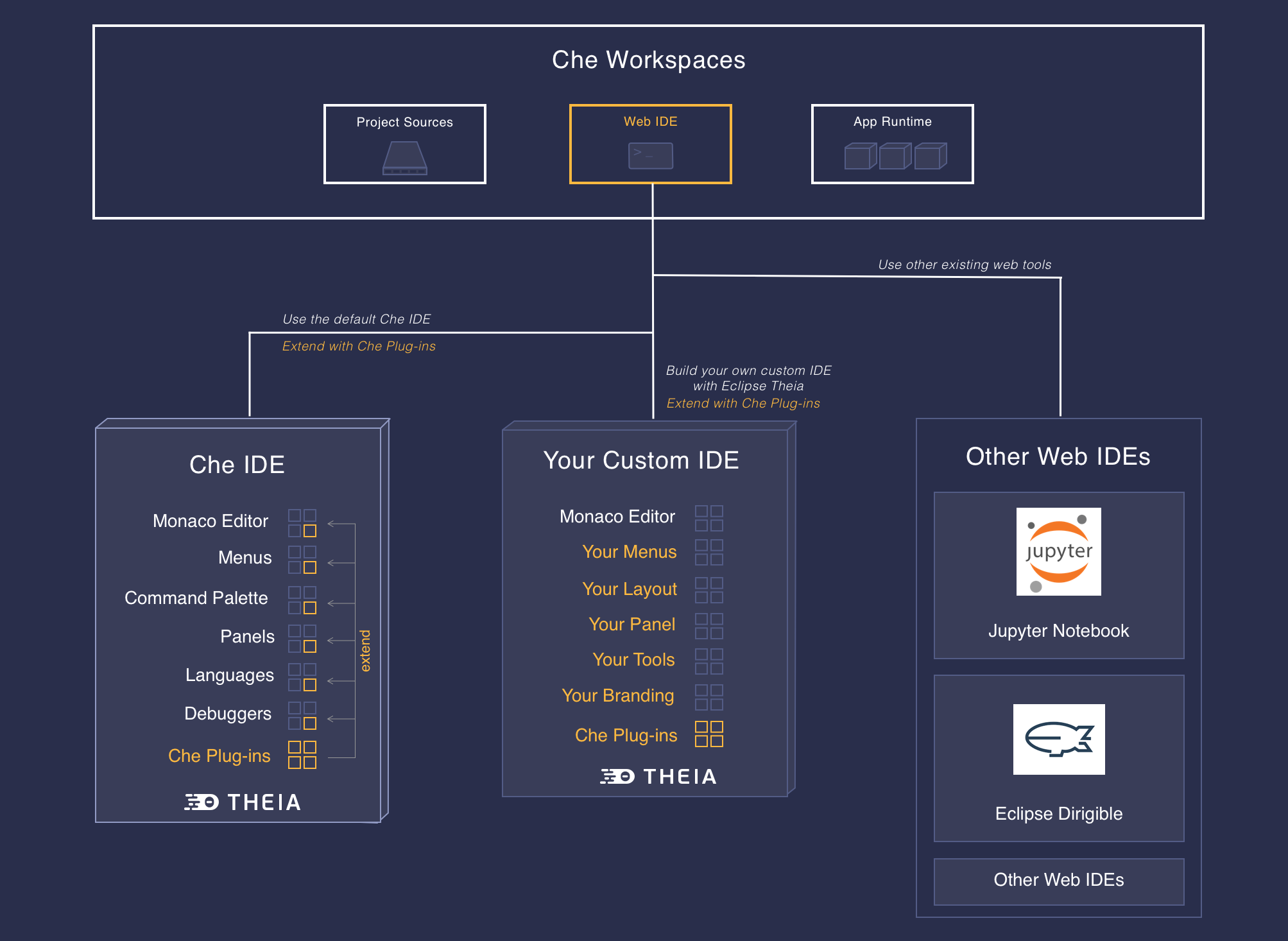
Extending Red Hat CodeReady Workspaces can be done entirely using Red Hat CodeReady Workspaces. Since version 7, Red Hat CodeReady Workspaces provides a self-hosting mode.
4.1. What is a Che-Theia plug-in
A Che-Theia plug-in is an extension of the development environment isolated from the IDE. Plug-ins can be packaged as files or containers to provide their own dependencies.
Extending Che-Theia using plug-ins can enable the following capabilities:
- Language support: Extend the supported languages by relying on the Language Server Protocol.
- Debuggers: Extend debugging capabilities with the Debug Adapter Protocol.
- Development Tools: Integrate your favorite linters, and as testing and performance tools.
- Menus, panels, and commands: Add your own items to the IDE components.
- Themes: Build custom themes, extend the UI, or customize icon themes.
- Snippets, formatters, and syntax highlighting: Enhance comfort of use with supported programming languages.
- Keybindings: Add new keymaps and popular keybindings to make the environment feel natural.
4.1.1. Features and benefits of Che-Theia plug-ins
| Features | Description | Benefits |
|---|---|---|
| Fast Loading | Plug-ins are loaded at runtime and are already compiled. IDE is loading the plug-in code. | Avoid any compilation time. Avoid post-installation steps. |
| Secure Loading | Plug-ins are loaded separately from the IDE. The IDE stays always in a usable state. | Plug-ins do not break the whole IDE if it has bugs. Handle network issue. |
| Tools Dependencies | Dependencies for the plug-in are packaged with the plug-in in its own container. | No-installation for tools. Dependencies running into container. |
| Code Isolation | Guarantee that plug-ins cannot block the main functions of the IDE like opening a file or typing | Plug-ins are running into separate threads. Avoid dependencies mismatch. |
| VS Code Extension Compatibility | Extend the capabilities of the IDE with existing VS Code Extensions. | Target multiple platform. Allow easy discovery of Visual Studio Code Extension with required installation. |
4.1.2. Che-Theia plug-in concept in detail
Red Hat CodeReady Workspaces provides a default web IDE for workspaces: Che-Theia. It is based on Eclipse Theia. It is a slightly different version than the plain Eclipse Theia one because there are functionalities that have been added based on the nature of the Red Hat CodeReady Workspaces workspaces. This version of Eclipse Theia for CodeReady Workspaces is called Che-Theia.
You can extend the IDE provided with Red Hat CodeReady Workspaces by building a Che-Theia plug-in. Che-Theia plug-ins are compatible with any other Eclipse Theia-based IDE.
4.1.2.1. Client-side and server-side Che-Theia plug-ins
The Che-Theia editor plug-ins let you add languages, debuggers, and tools to your installation to support your development workflow. Plug-ins run when the editor completes loading. If a Che-Theia plug-in fails, the main Che-Theia editor continues to work.
Che-Theia plug-ins run either on the client side or on the server side. This is a scheme of the client and server-side plug-in concept:
Figure 4.2. Client and server-side Che-Theia plug-ins
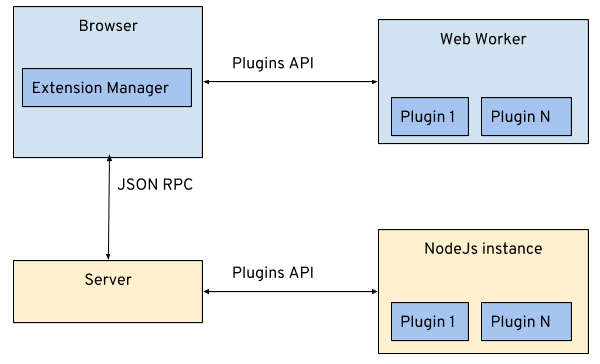
The same Che-Theia plug-in API is exposed to plug-ins running on the client side (Web Worker) or the server side (Node.js).
4.1.2.2. Che-Theia plug-in APIs
For the purpose of providing tool isolation and easy extensibility in Red Hat CodeReady Workspaces, the Che-Theia IDE has a set of plug-in APIs. The APIs are compatible with Visual Studio Code extension APIs. Usually, Che-Theia can run VS Code extensions as its own plug-ins.
When developing a plug-in that depends on or interacts with components of CodeReady Workspaces workspaces (containers, preferences, factories), use the CodeReady Workspaces APIs embedded in Che-Theia.
4.1.2.3. Che-Theia plug-in capabilities
Che-Theia plug-ins have the following capabilities:
| Plug-in | Description | Repository |
|---|---|---|
| CodeReady Workspaces Extended Tasks | Handles the CodeReady Workspaces commands and provides the ability to start those into a specific container of the workspace. | |
| CodeReady Workspaces Extended Terminal | Allows to provide terminal for any of the containers of the workspace. | |
| CodeReady Workspaces Factory | Handles the Red Hat CodeReady Workspaces Factories | |
| CodeReady Workspaces Container | Provides a container view that shows all the containers that are running in the workspace and allows to interact with them. | |
| Dashboard | Integrates the IDE with the Dashboard and facilitate the navigation. | |
| CodeReady Workspaces APIs | Extends the IDE APIs to allow interacting with CodeReady Workspaces-specific components (workspaces, preferences). |
4.1.2.4. VS Code extensions and Eclipse Theia plug-ins
A Che-Theia plug-in can be based on a VS Code extension or an Eclipse Theia plug-in.
- A Visual Studio Code extension
- To repackage a VS Code extension as a Che-Theia plug-in with its own set of dependencies, package the dependencies into a container. This ensures that Red Hat CodeReady Workspaces users do not need to install the dependencies when using the extension. See Using a Visual Studio Code extension in CodeReady Workspaces.
- An Eclipse Theia plug-in
- You can build a Che-Theia plug-in by implementing an Eclipse Theia plug-in and packaging it to Red Hat CodeReady Workspaces.
Additional resources
4.1.3. Che-Theia plug-in metadata
Che-Theia plug-in metadata is information about individual plug-ins for the plug-in registry.
The Che-Theia plug-in metadata, for each specific plug-in, is defined in a meta.yaml file.
The che-plugin-registry repository contains .
|
| API version (`v2`and higher) |
|
|
Available: |
|
| Description (a phrase) |
|
| Display name |
|
|
Date in the form |
|
| URL of an SVG icon |
|
| Name (no spaces allowed) |
|
| Name of the publisher |
|
| URL of the source repository |
|
| Title (long) |
|
|
|
|
|
Version information, for example: |
|
| Specifications (see underneath) |
|
| Plug-in endpoints |
|
|
Sidecar containers for the plug-in. |
|
| Sidecar init containers for the plug-in |
|
| Environment variables for the workspace |
|
|
Optional attribute required for VS Code and Che-Theia plug-ins. A list of URLs to plug-in artefacts, such as |
|
| Sidecar container name |
|
| Absolute or relative container image URL |
|
|
OpenShift memory limit string, for example |
|
|
OpenShift memory request string, for example |
|
|
OpenShift CPU limit string, for example |
|
|
OpenShift CPU request string, for example |
|
| List of environment variables to set in the sidecar |
|
| String array definition of the root process command in the container |
|
| String array arguments for the root process command in the container |
|
| Volumes required by the plug-in |
|
| Ports exposed by the plug-in (on the container) |
|
| Development commands available to the plug-in container |
|
|
Boolean flag to bound volume with source code |
|
| Environment variable name |
|
| Environment variable value |
|
| Path to the volume in the container |
|
| Volume name |
|
| If true, the volume is ephemeral, otherwise the volume is persisted |
|
| Exposed port |
|
| Command name |
|
| Command working directory |
|
| String array that defines the development command |
|
| Name (no spaces allowed) |
|
|
|
|
| Target port |
|
| Endpoint attributes |
|
|
Protocol, example: |
|
|
|
|
|
|
|
|
|
|
|
|
Example meta.yaml for a Che-Theia plug-in: the CodeReady Workspaces machine-exec Service
Example meta.yaml for a VisualStudio Code extension: the AsciiDoc support extension
4.1.4. Che-Theia plug-in lifecycle
When a user is starting a workspace, the following procedure is followed:
- CodeReady Workspaces master checks for plug-ins to start from the workspace definition.
- Plug-in metadata is retrieved, and the type of each plug-in is recognized.
- A broker is selected according to the plug-in type.
- The broker processes the installation and deployment of the plug-in (the installation process is different for each broker).
Different types of plug-ins exist. A broker ensures all installation requirements are met for a plug-in to deploy correctly.
Figure 4.3. Che-Theia plug-in lifecycle
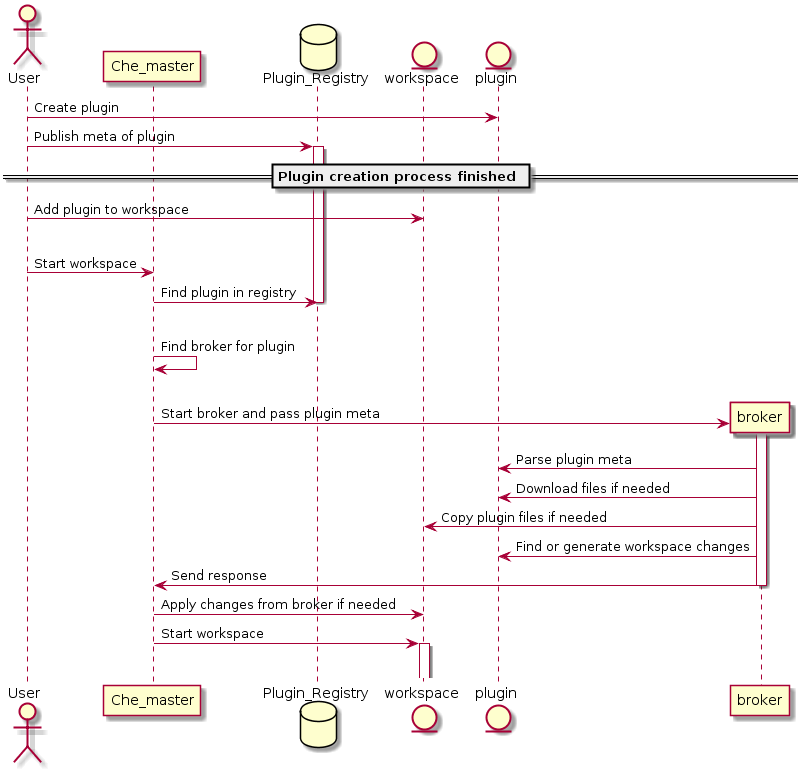
Before a CodeReady Workspaces workspace is launched, CodeReady Workspaces master starts containers for the workspace:
-
The Che-Theia plug-in broker extracts the plug-in (from the
.theiafile) to get the sidecar containers that the plug-in needs. - The broker sends the appropriate container information to CodeReady Workspaces master.
- The broker copies the Che-Theia plug-in to a volume to have it available for the Che-Theia editor container.
- CodeReady Workspaces workspace master then starts all the containers of the workspace.
- Che-Theia is started in its own container and checks the correct folder to load the plug-ins.
Che-Theia plug-in lifecycle:
-
When a user is opening a browser tab or window with Che-Theia, Che-Theia starts a new plug-in session (browser or remote TODO: 'what is remote in this context?'). Every Che-Theia plug-in is notified that a new session has been started (the
start()function of the plug-in triggered). - A Che-Theia plug-in session is running and interacting with the Che-Theia back end and frontend.
-
When the user is closing the browser tab or there is a timeout, every plug-in is notified (the
stop()function of the plug-in triggered).
4.1.5. Embedded and remote Che-Theia plug-ins
Developer workspaces in Red Hat CodeReady Workspaces provide all dependencies needed to work on a project. The application includes the dependencies needed by all the tools and plug-ins used.
There are two different ways a Che-Theia plug-in can run. This is based on the dependencies that are needed for the plug-in: embedded (or local) and remote.
4.1.5.1. Embedded (or local) plug-ins
The plug-in does not have specific dependencies - it only uses a Node.js runtime, and it runs in the same container as the IDE. The plug-in is injected into the IDE.
Examples:
- Code linting
- New set of commands
- New UI components
To include a Che-Theia plug-in as embedded, define a URL to the plug-in binary file (the .theia archive) in the meta.yaml file. In the case of a VS Code extension, provide the extension ID from the Visual Studio Code marketplace (see Using a Visual Studio Code extension in CodeReady Workspaces).
When starting a workspace, CodeReady Workspaces downloads and unpacks the plug-in binaries and includes them in the Che-Theia editor container. The Che-Theia editor initializes the plug-ins when it starts.
Figure 4.4. Local Che-Theia plug-in
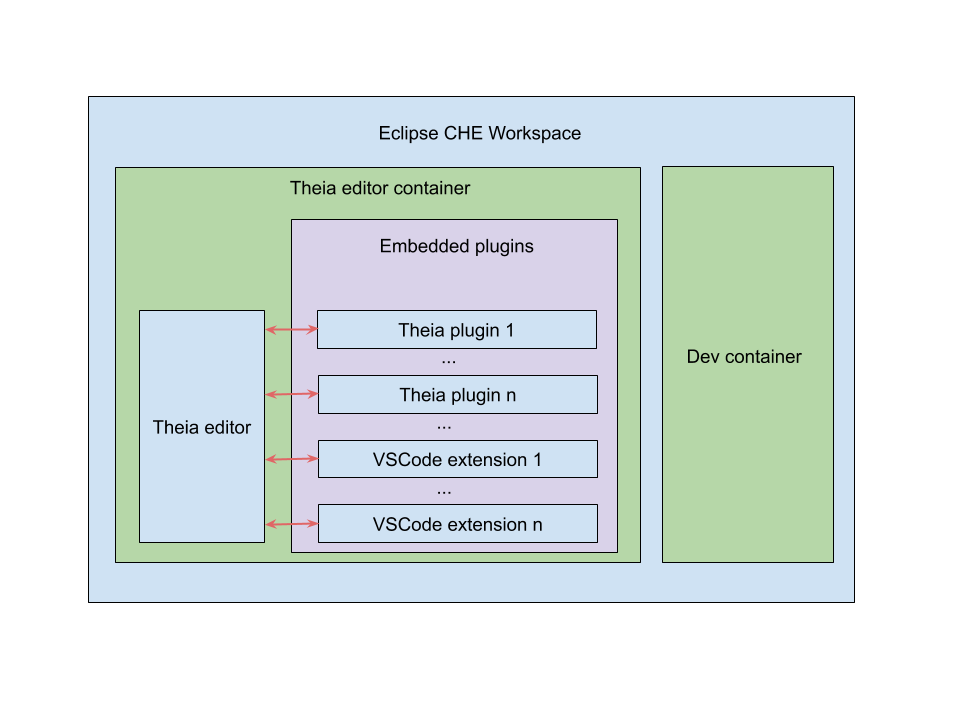
4.1.5.2. Remote plug-ins
The plug-in relies on dependencies or it has a back end. It runs in its own sidecar container, and all dependencies are packaged in the container.
A remote Che-Theia plug-in consist of two parts:
-
Che-Theia plug-in or VS Code extension binaries. The definition in the
meta.yamlfile is the same as for embedded plug-ins. -
Container image definition, for example,
eclipse/che-theia-dev:nightly. From this image, CodeReady Workspaces creates a separate container inside a workspace.
Examples:
- Java Language Server
- Python Language Server
When starting a workspace, CodeReady Workspaces creates a container from the plug-in image, downloads and unpacks the plug-in binaries, and includes them in the created container. The Che-Theia editor connects to the remote plug-ins when it starts.
Figure 4.5. Remote Che-Theia plug-in
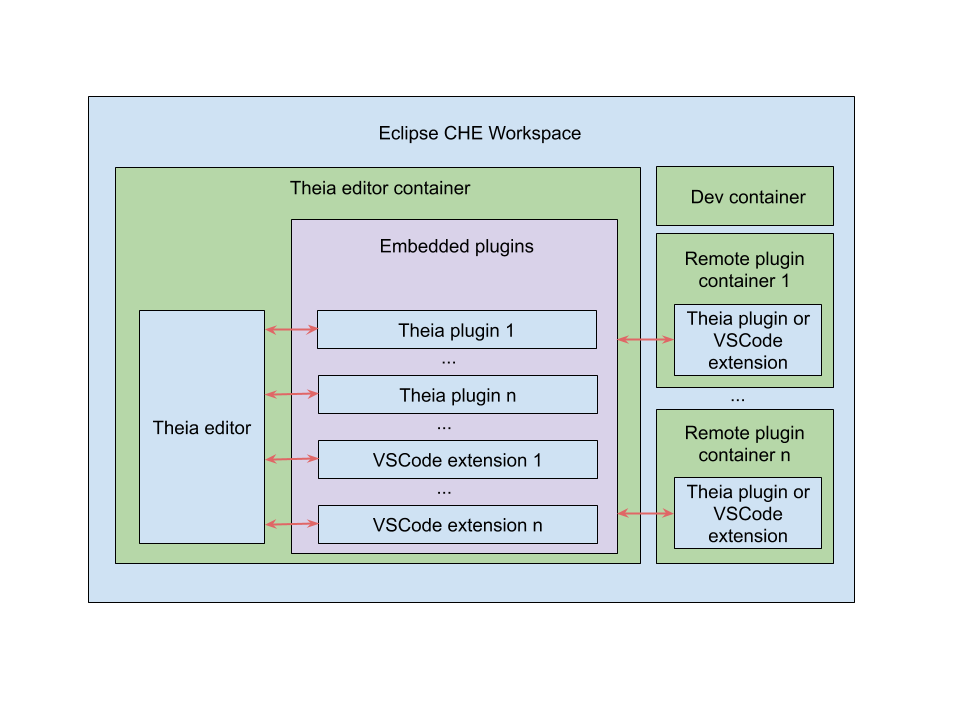
4.1.5.3. Comparison matrix
When a Che-Theia plug-in (or a VS Code extension) does not need extra dependencies inside its container, it is an embedded plug-in. A container with extra dependencies that includes a plug-in is a remote plug-in.
| Configure RAM per plug-in | Environment dependencies | Create separated container | |
|---|---|---|---|
| Remote | TRUE | Plug-in uses dependencies defined in the remote container. | TRUE |
| Embedded | FALSE (users can configure RAM for the whole editor container, but not per plug-in) | Plug-in uses dependencies from the editor container; if container does not include these dependencies, the plug-in fails or does not function as expected. | FALSE |
Depending on your use case and the capabilities provided by your plug-in, select one of the described running modes.
4.1.6. Remote plug-in endpoint
Red Hat CodeReady Workspaces has a remote plug-in endpoint service to start VS Code Extensions and Che-Theia plug-ins in separate containers. Red Hat CodeReady Workspaces injects the remote plug-in endpoint binaries into each remote plug-in container. This service starts remote extensions and plug-ins defined in the plug-in meta.yaml file and connects them to the Che-Theia editor container.
The remote plug-in endpoint creates a plug-in API proxy between the remote plug-in container and the Che-Theia editor container. The remote plug-in endpoint is also an interceptor for some plug-in API parts, which it launches inside a remote sidecar container rather than an editor container. Examples: terminal API, debug API.
The remote plug-in endpoint executable command is stored in the environment variable of the remote plug-in container: PLUGIN_REMOTE_ENDPOINT_EXECUTABLE.
Red Hat CodeReady Workspaces provides two ways to start the remote plug-in endpoint with a sidecar image:
- Defining a launch remote plug-in endpoint using a Dockerfile. To use this method, patch an original image and rebuild it.
-
Defining a launch remote plug-in endpoint in the plug-in
meta.yamlfile. Use this method to avoid patching an original image.
4.1.6.1. Defining a launch remote plug-in endpoint using Dockerfile
To start a remote plug-in endpoint, use the PLUGIN_REMOTE_ENDPOINT_EXECUTABLE environment variable in the Dockerfile.
Procedure
Start a remote plug-in endpoint using the
CMDcommand in the Dockerfile:Dockerfile example
Copy to Clipboard Copied! Toggle word wrap Toggle overflow Start a remote plug-in endpoint using the
ENTRYPOINTcommand in the Dockerfile:Dockerfile example
Copy to Clipboard Copied! Toggle word wrap Toggle overflow
4.1.6.1.1. Using a wrapper script
Some images use a wrapper script to configure permissions. The script is defined it in the ENTRYPOINT command of the Dockerfile to configure permissions inside the container, and it script executes a main process defined in the CMD command of the Dockerfile.
Red Hat CodeReady Workspaces uses such images with a wrapper script to provide permission configurations on different infrastructures with advanced security, for example on OpenShift.
Example of a wrapper script:
Copy to Clipboard Copied! Toggle word wrap Toggle overflow Example of a Dockerfile with a wrapper script:
Dockerfile example
Copy to Clipboard Copied! Toggle word wrap Toggle overflow In this example, the container launches the
/entrypoint.shscript defined in theENTRYPOINTcommand of the Dockerfile. The script configures the permissions and executes the command usingexec $@.CMDis the argument forENTRYPOINT, and theexec $@command calls${PLUGIN_REMOTE_ENDPOINT_EXECUTABLE}. A remote plug-in endpoint then starts in the container after permission configuration.
4.1.6.2. Defining a launch remote plug-in endpoint in a meta.yaml file
Use this method to re-use images to start remote a plug-in endpoint without modifications.
Procedure
Modify the plug-in meta.yaml file properties command and args:
-
command- Red Hat CodeReady Workspaces uses to overrideDockerfile#ENTRYPOINT. -
args- Red Hat CodeReady Workspaces uses to overrideDockerfile#CMD. Example of a YAML file with the
commandandargsproperties modified:Copy to Clipboard Copied! Toggle word wrap Toggle overflow Modify
argsinstead ofcommandto use an image with a wrapper script pattern and to keep a call of theentrypoint.shscript:Copy to Clipboard Copied! Toggle word wrap Toggle overflow Red Hat CodeReady Workspaces calls the
entrypoint.shwrapper script defined in theENTRYPOINTcommand of the Dockerfile. The script executes[ ‘sh’, ‘-c”, ‘ ${PLUGIN_REMOTE_ENDPOINT_EXECUTABLE}’ ]using theexec “$@”command.
To execute a service when starting the container and also to start a remote plug-in endpoint, use meta.yaml with modified command and args properties. Start the service, detach the process, and start the remote plug-in endpoint, and they then work in parallel.
4.2. Using alternative IDEs in CodeReady Workspaces
Extending Red Hat CodeReady Workspaces developer workspaces using different IDEs (integrated development environments) enables:
- Re-purposing the environment for different use cases.
- Providing a dedicated custom IDE for specific tools.
- Providing different perspectives for individual users or groups of users.
Red Hat CodeReady Workspaces provides a default web IDE to be used with the developer workspaces. This IDE is completely decoupled. You can bring your own custom IDE for Red Hat CodeReady Workspaces:
- Built from Eclipse Theia, which is a framework to build web IDEs. Example: Sirius on the web.
- Completely different web IDEs, such as Jupyter, Eclipse Dirigible, or others. Example: Jupyter in Red Hat CodeReady Workspaces workspaces.
Bringing custom IDE built from Eclipse Theia
- Creating your own custom IDE based on Eclipse Theia.
- Adding CodeReady Workspaces-specific tools to your custom IDE.
- Packaging your custom IDE into the available editors for CodeReady Workspaces.
Bringing your completely different web IDE into CodeReady Workspaces
- Packaging your custom IDE into the available editors for CodeReady Workspaces.
4.3. Using a Visual Studio Code extension in CodeReady Workspaces
Starting with Red Hat CodeReady Workspaces 2.1, Visual Studio Code (VS Code) extensions can be installed to extend the functionality of a CodeReady Workspaces workspace. VS Code extensions can run in the Che-Theia editor container, or they can be packaged in their own isolated and pre-configured containers with their prerequisites.
This document describes:
- Use of a VS Code extension in CodeReady Workspaces with workspaces.
- CodeReady Workspaces Plug-ins panel.
How to publish a VS Code extension in the CodeReady Workspaces plug-in registry (to share the extension with other CodeReady Workspaces users).
- The extension-hosting sidecar container and the use of the extension in a devfile are optional for this.
- How to review the compatibility of the VS Code extensions to be informed whether a specific API is supported or has not been implemented yet.
4.3.1. Publishing a VS Code extension into the CodeReady Workspaces plug-in registry
The user of CodeReady Workspaces can use a workspace devfile to use any plug-in, also known as Visual Studio Code (VS Code) extension. This plug-in can be added to the plug-in registry, then easily reused by anyone in the same organization with access to that workspaces installation.
Some plug-ins need a runtime dedicated container for code compilation. This fact makes those plug-ins a combination of a runtime sidecar container and a VS Code extension.
The following section describes the portability of a plug-in configuration and associating an extension with a runtime container that the plug-in needs.
4.3.1.1. Writing a meta.yaml file and adding it to a plug-in registry
The plug-in meta information is required to publish a VS Code extension in an Red Hat CodeReady Workspaces plug-in registry. This meta information is provided as a meta.yaml file. This section describes how to create a meta.yaml file for an extension.
Procedure
-
Create a
meta.yamlfile in the following plug-in registry directory:<apiVersion>/plugins/<publisher>/<plug-inName>/<plug-inVersion>/. Edit the
meta.yamlfile and provide the necessary information. The configuration file must adhere to the following structure:Copy to Clipboard Copied! Toggle word wrap Toggle overflow - 1
- Version of the file structure.
- 2
- Name of the plug-in publisher. Must be the same as the publisher in the path.
- 3
- Name of the plug-in. Must be the same as in path.
- 4
- Version of the plug-in. Must be the same as in path.
- 5
- Type of the plug-in. Possible values:
Che Plugin,Che Editor,Theia plugin,VS Code extension. - 6
- A short name of the plug-in.
- 7
- Title of the plug-in.
- 8
- A brief explanation of the plug-in and what it does.
- 9
- The link to the plug-in logo.
- 10
- Optional. The link to the source-code repository of the plug-in.
- 11
- Defines the category that this plug-in belongs to. Should be one of the following:
Editor,Debugger,Formatter,Language,Linter,Snippet,Theme, orOther. - 12
- If this section is omitted, the VS Code extension is added into the Che-Theia IDE container.
- 13
- The Docker image from which the sidecar container will be started. Example:
eclipse/che-theia-endpoint-runtime:next. - 14
- The maximum RAM which is available for the sidecar container. Example: "512Mi". This value might be overridden by the user in the component configuration.
- 15
- The RAM which is given for the sidecar container by default. Example: "256Mi". This value might be overridden by the user in the component configuration.
- 16
- The maximum CPU amount in cores or millicores (suffixed with "m") which is available for the sidecar container. Examples: "500m", "2". This value might be overridden by the user in the component configuration.
- 17
- The CPU amount in cores or millicores (suffixed with "m") which is given for the sidecar container by default. Example: "125m". This value might be overridden by the user in the component configuration.
- 18
- A list of VS Code extensions run in this sidecar container.
4.3.2. Adding a plug-in registry VS Code extension to a workspace
When the required VS Code extension is added into a CodeReady Workspaces plug-in registry, the user can add it into the workspace through the CodeReady Workspaces Plugins panel or through the workspace configuration.
4.3.2.1. Adding a VS Code extension using the CodeReady Workspaces Plugins panel
Prerequisites
- A running instance of Red Hat CodeReady Workspaces. To install an instance of Red Hat CodeReady Workspaces, see the CodeReady Workspaces 2.1 Installation GuideCodeReady Workspaces quick-starts
Procedure
To add a VS Code extension using the CodeReady Workspaces Plugins panel:
-
Open the CodeReady Workspaces Plugins panel by pressing
CTRL+SHIFT+Jor navigate to View/Plugins. - Change the current registry to the registry in which the VS Code extension was added.
In the search bar, click the Menu button and then click Change Registry to choose the registry from the list. If the required registry is not in the list, add it using the Add Registry menu option. The registry link points to the
pluginssegment of the registry, for example:https://my-registry.com/v3/plugins/index.json.
- Search for the required plug-in using the filter, and then click the button.
- Restart the workspace for the changes to take effect.
4.3.2.2. Adding a VS Code extension using the workspace configuration
Prerequisites
- A running instance of Red Hat CodeReady Workspaces. To install an instance of Red Hat CodeReady Workspaces, see the CodeReady Workspaces 2.1 Installation GuideCodeReady Workspaces 'quick-starts'.
- An existing workspace defined on this instance of Red Hat CodeReady Workspaces Creating a workspace from user dashboard.
Procedure
To add a VS Code extension using the workspace configuration:
- Click the Workspaces tab on the Dashboard and select the workspace in which you want to add the plug-in. The Workspace <workspace-name> window is opened showing the details of the workspace.
- Click the devfile tab.
Locate the components section, and add a new entry with the following structure:
 - type: chePlugin
   id:
 - type: chePlugin
   id:
1 Copy to Clipboard Copied! Toggle word wrap Toggle overflow - 1
- Link to the
meta.yamlfile in your registry, for example,https://my-plug-in-registry/v3/plugins/<publisher>/<plug-inName>/<plug-inVersion>/meta.yaml
CodeReady Workspaces automatically adds the other fields to the new component.
Alternatively, you can link to a
meta.yamlfile hosted on GitHub, using the dedicated reference field.- type: chePlugin reference:
- type: chePlugin reference:1 Copy to Clipboard Copied! Toggle word wrap Toggle overflow - 1
https://raw.githubusercontent.com/<username>/<registryRepository>/v3/plugins/<publisher>/<plug-inName>/<plug-inVersion>/meta.yaml
- Restart the workspace for the changes to take effect.
4.3.3. Choosing the sidecar image
CodeReady Workspaces plug-ins are special services that extend the CodeReady Workspaces workspace capabilities. CodeReady Workspaces plug-ins are packaged as containers. The containers that the plug-ins are packaged into run as sidecars of the CodeReady Workspaces workspace editor and augment its capabilities.
Prerequisites
- A running instance of Red Hat CodeReady Workspaces. To install an instance of Red Hat CodeReady Workspaces, see the CodeReady Workspaces 2.1 Installation GuideCodeReady Workspaces 'quick-starts'.
Procedure
To choose a sidecar image:
If the VS Code extension does not have any external dependencies, use
eclipse/che-theia-endpoint-runtime: nextas a sidecar container image for the extension.NoteIn addition to the
eclipse/che-theia-endpoint-runtime:nextbase image, the following ready-to-use sidecar images that include language-specific dependencies are available:- eclipse/che-remote-plugin-runner-java8
- eclipse/che-remote-plugin-runner-java11
- eclipse/che-remote-plugin-go-1.10.7
- eclipse/che-remote-plugin-python-3.7.3
- eclipse/che-remote-plugin-dotnet-2.2.105
- eclipse/che-remote-plugin-php7
- eclipse/che-remote-plugin-kubernetes-tooling-1.0.0
- eclipse/che-remote-plugin-kubernetes-tooling-0.1.17
- eclipse/che-remote-plugin-openshift-connector-0.0.17
- eclipse/che-remote-plugin-openshift-connector-0.0.21
For a VS Code extension with external dependencies not found in one of the ready-to-use images, use a container image based on the eclipse/che-theia-endpoint-runtime:next image that contains the dependencies.
Example
Base the FROM directive on FROM eclipse/che-theia-endpoint-runtime:next. This is required because the base image contains tools for running the remote VS Code extension and for communicating between the sidecar and the Che-Theia editor. This way, the VS Code extension operates as if it was not remote.
4.3.4. Verifying the VS Code extension API compatibility level
Che-Theia does not fully support the VS Code extensions API. The vscode-theia-comparator is used to analyze the compatibility between the Che-Theia plug-in API and the VS Code extension API. This tool runs in a nightly cycle, and the results are published on the vscode-theia-comparator GitHub page.
Prerequisites
- Personal GitHub access token. For information about creating a personal access token for the command line see Creating a personal access token for the command line. A GitHub access token is required to increase the GitHub download limit for your IP address.
Procedure
To run the vscode-theia comparator manually:
-
Clone the vscode-theia-comparator repository, and build it using the
yarncommand. -
Set the
GITHUB_TOKENenvironment variable to your token. -
Execute the
yarn run generatecommand to generate a report. -
Open the
out/status.htmlfile to view the report.
4.4. Adding tools to CodeReady Workspaces after creating a workspace
When installed in the workspace, CodeReady Workspaces plug-ins bring new capabilities to the CodeReady Workspaces. Plug-ins consist of a Che-Theia plug-in, metadata, and a hosting container. These plug-ins may provide the following capabilities:
- Integrating with other systems, including OpenShift and OpenShift.
- Automating some developer tasks, such as formatting, refactoring, and running automated tests.
- Communicating with multiple databases directly from the IDE.
- Enhanced code navigation, auto-completion and error highlighting.
This chapter provides basic information about CodeReady Workspaces plug-ins installation, enabling, and use in CodeReady Workspaces workspaces.
4.4.1. Additional tools in the CodeReady Workspaces workspace
CodeReady Workspaces plug-ins are extensions to the Che-Theia IDE that come bundled with a container image that contains their native prerequisites (for example, the OpenShift Connector plug-in needs the oc command installed). A Che Plugin is a list of Che-Theia plug-ins together about a Linux container that the plug-in requires to run in. It can also include metadata to define the description, categorization tags, and an icon. CodeReady Workspaces provides a registry of plug-ins available for installation into the user’s workspace.
Because many VS Code extensions can run inside the Che-Theia IDE, they can be packaged as CodeReady Workspaces plug-ins by combining them with a runtime or a sidecar container. Users can choose from many more plug-ins that are provided out of the box.
From the Dashboard, plug-ins in the registry can be added from the Plugin tab or by adding them into a devfile. The devfile can also be used for further configuration of the plug-in, such as to define memory or CPU usage. Alternatively, plug-ins can be installed from CodeReady Workspaces by pressing Ctrl+Shift+J or by navigating to View → Plugins.
Additional resources
4.4.2. Adding language support plug-in to the CodeReady Workspaces workspace
This procedure describes adding a tool to an already existing workspace, by enabling a dedicated plug-in from the Dashboard.
To add tools that are available as plug-ins into a CodeReady Workspaces workspace, use one of the following methods:
This procedure uses the Java language support plug-in as an example.
Prerequisites
- A running instance of Red Hat CodeReady Workspaces. To install an instance of Red Hat CodeReady Workspaces, see the CodeReady Workspaces 2.1 Installation GuideCodeReady Workspaces 'quick-starts'.
An existing workspace defined in this instance of Red Hat CodeReady Workspaces; see:
The workspace must be in a
stoppedstate. To do so:- Navigate to the CodeReady Workspaces Dashboard. See Navigating CodeReady Workspaces using the Dashboard.
- In the Dashboard, click the Workspaces menu to open the workspaces list and locate the workspace.
- On the same row with the displayed workspace, on the right side of the screen, click the button to stop the workspace.
- Wait a few seconds for the workspace to stop, then configure the workspace by clicking on it.
Procedure
To add the plug-in from the Plug-in registry to an already existing CodeReady Workspaces workspace, use one of the following methods:
Installing the plug-in from the Plugin tab.
Navigate to the Plugin tab.
The list of plug-ins, installed or possible to install, is displayed.
Enable the desired plug-in, for example, the Language Support for Java 11, by using the * Enable* slide-toggle.
The plug-in source code is added to the workspace devfile, and the plug-in is now enabled.
- On the bottom right side of the screen, save the changes by clicking the button. + Once the changes are saved, the workspace is restarted.
Installing the plug-in by adding content to the devfile.
Navigate to the Devfile tab.
The devfile structure is displayed.
Locate the
componentsection of the devfile and add the following lines to add the Java language v8 in to the workspace:- id: redhat/java8/latest type: chePlugin
- id: redhat/java8/latest type: chePluginCopy to Clipboard Copied! Toggle word wrap Toggle overflow See the example of the final result:
Copy to Clipboard Copied! Toggle word wrap Toggle overflow
Additional resources
Chapter 5. Configuring OAuth authorization
This section describes how to connect Red Hat CodeReady Workspaces as an OAuth application to supported OAuth providers.
5.1. Configuring GitHub OAuth
OAuth for GitHub allows for automatic SSH key upload to GitHub.
Procedure
Set up the GitHub OAuth client. The Authorization callback URL is filled in the next steps.
- Go to the RH-SSO administration console and select the Identity Providers tab.
- Select the GitHub identity provider in the drop-down list.
- Paste the Redirect URI to the Authorization callback URL of the GitHub OAuth application.
- Fill the Client ID and Client Secret from the GitHub oauth app.
- Enable Store Tokens.
Save the changes of the Github Identity provider and click Register application in the GitHub oauth app page.
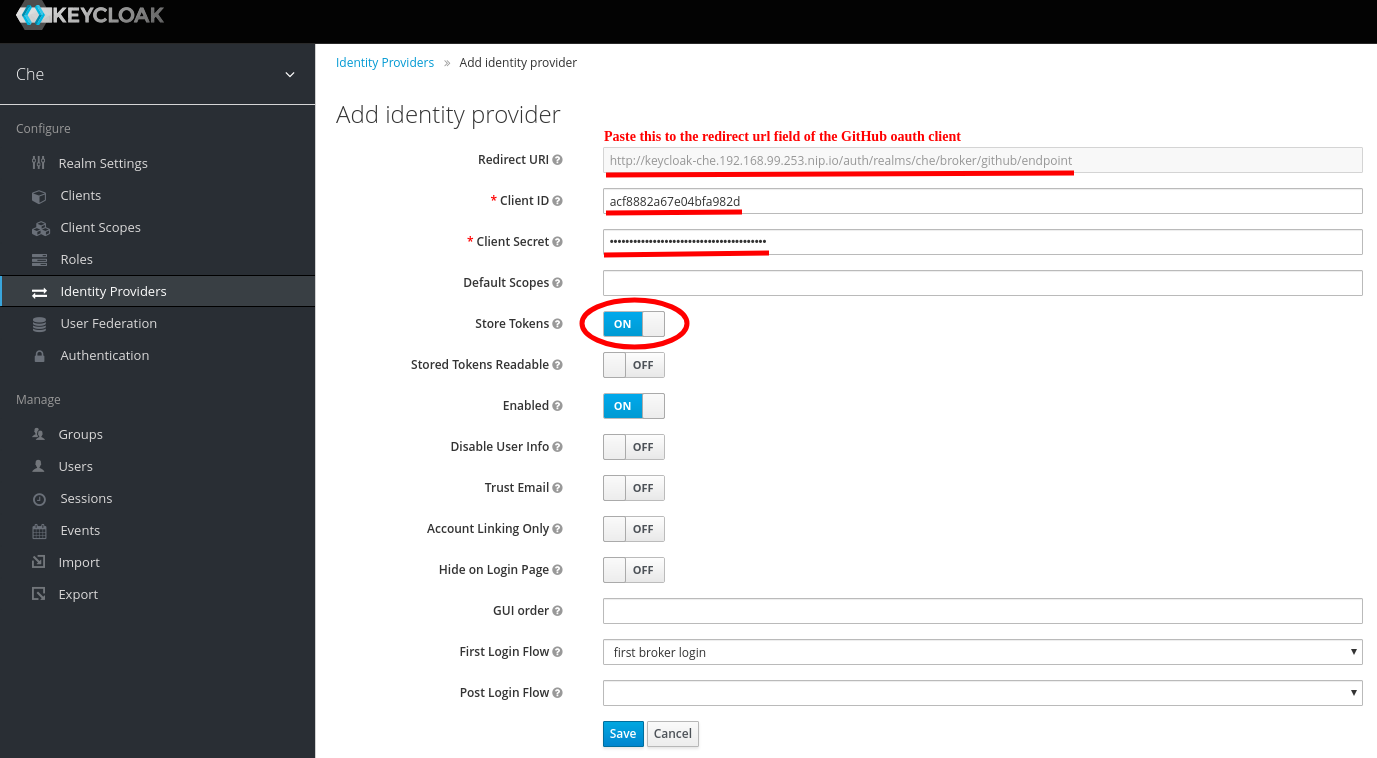
5.2. Configuring OpenShift OAuth
For users to interact with OpenShift, they must first authenticate to the OpenShift cluster. OpenShift OAuth is a process in which users prove themselves to a cluster through an API with obtained OAuth access tokens.
Authentication with the OpenShift connector plugin is a possible way for CodeReady Workspaces users to authenticate with an OpenShift cluster.
The following section describes the OpenShift OAuth configuration options and its use with a CodeReady Workspaces.
Prerequisites
-
The OpenShift command-line tool,
ocis installed.
Procedure
To enable OpenShift OAuth automatically, deployed CodeReady Workspaces using the crwctl with the --os-oauth option. See the crwctl server:start specification chapter.
For CodeReady Workspaces deployed in single-user mode:
Register CodeReady Workspaces OAuth client in OpenShift. See the Register an OAuth client in OpenShift chapter.
Copy to Clipboard Copied! Toggle word wrap Toggle overflow Add the OpenShift SSL certificate to the CodeReady Workspaces Java trust store.
Update the OpenShift deployment configuration.
CHE_OAUTH_OPENSHIFT_CLIENTID: <client-ID> CHE_OAUTH_OPENSHIFT_CLIENTSECRET: <openshift-secret> CHE_OAUTH_OPENSHIFT_OAUTH__ENDPOINT: <oauth-endpoint> CHE_OAUTH_OPENSHIFT_VERIFY__TOKEN__URL: <verify-token-url>
CHE_OAUTH_OPENSHIFT_CLIENTID: <client-ID> CHE_OAUTH_OPENSHIFT_CLIENTSECRET: <openshift-secret> CHE_OAUTH_OPENSHIFT_OAUTH__ENDPOINT: <oauth-endpoint> CHE_OAUTH_OPENSHIFT_VERIFY__TOKEN__URL: <verify-token-url>Copy to Clipboard Copied! Toggle word wrap Toggle overflow -
<client-ID>a name specified in the OpenShift OAuthClient. -
<openshift-secret>a secret specified in the OpenShift OAuthClient. <oauth-endpoint>the URL of the OpenShift OAuth service:- For OpenShift 3 specify the OpenShift master URL.
-
For OpenShift 4 specify the
oauth-openshiftroute.
-
<verify-token-url>request URL that is used to verify the token.<OpenShift master url>/apican be used for OpenShift 3 and 4. - See CodeReady Workspaces configMaps and their behavior.
-
Chapter 6. Using artifact repositories in a restricted environment
This section describes how to manually configure various technology stacks to work with artifacts from in-house repositories using self-signed certificates.
6.1. Using Maven artifact repositories
Maven downloads artifacts that are defined in two locations:
-
Artifact repositories defined in a
pom.xmlfile of the project. Configuring repositories inpom.xmlis not specific to Red Hat CodeReady Workspaces. For more information, see the Maven documentation about the POM. -
Artifact repositories defined in a
settings.xmlfile. By default,settings.xmlis located at`~/.m2/settings.xml.
6.1.1. Defining repositories in settings.xml
To specify your own artifact repositories at example.server.org, use the settings.xml file. To do that, ensure, that settings.xml is present in all the containers that use Maven tools, in particular the Maven container and the Java plug-in container.
By default, settings.xml is located at the <home dir>/.m2 directory which is already on persistent volume in Maven and Java plug-in containers and you don’t need to re-create the file each time you restart the workspace if it isn’t in ephemeral mode.
In case you have another container that uses Maven tools and you want to share <home dir>/.m2 folder with this container, you have to specify the custom volume for this specific component in the devfile:
Procedure
Configure your
settings.xmlfile to use artifact repositories atexample.server.org:Copy to Clipboard Copied! Toggle word wrap Toggle overflow
6.1.2. Defining Maven settings.xml file across workspaces
To use your own settings.xml file across all your workspaces, create a Secret object (with a name of your choice) in the same namespace as the workspace. Put the contents of the required settings.xml in the data section of the Secret (possibly along with other files that should reside in the same directory). Labelling and annotating this Secret according to Mounting a secret as a file or an environment variable into a workspace container ensures that the contents of the Secret is mounted into the workspace Pod. Note that you need to restart any previously running workspaces for them to use this Secret.
Prerequisites
This is required to set your private credentials to a Maven repository. See the Maven documentation Settings.xml#Servers for additional information.
To mount this settings.xml:
Procedure
Convert
settings.xmlto base64:cat settings.xml | base64
$ cat settings.xml | base64Copy to Clipboard Copied! Toggle word wrap Toggle overflow Copy the output to a new file,
secret.yaml, which also defines needed annotations and labels:Copy to Clipboard Copied! Toggle word wrap Toggle overflow
As of {7-15-2-2} version of CodeReady Workspaces, the target container annotation has been deprecated. An example of the updated annotation looks as follows:
+
Create this secret in the cluster:
oc apply -f secret.yaml
$ oc apply -f secret.yamlCopy to Clipboard Copied! Toggle word wrap Toggle overflow -
Start a new workspace. You will see
/home/user/.m2/settings.xmlwith your original content in themavencontainer.
6.1.3. Using self-signed certificates in Java projects
Internal artifact repositories often do not have a certificate signed by an authority that is trusted by default in Java. They are usually signed by an internal company authority or are self-signed. Configure your tools to accept these certificates by adding them to the Java truststore.
Procedure
Obtain a server certificate file from the repository server. It is often a file named
tls.crt.Create a Java truststore file:
Copy to Clipboard Copied! Toggle word wrap Toggle overflow -
Upload the truststore file to
/projects/maven/truststore.jksto make it available for all containers.
Add the truststore file.
In the Maven container:
Add the
javax.net.sslsystem property to theMAVEN_OPTSenvironment variable:Copy to Clipboard Copied! Toggle word wrap Toggle overflow - Restart the workspace.
In the Java plug-in container:
In the devfile, add the
javax.net.sslsystem property for the Java language server:Copy to Clipboard Copied! Toggle word wrap Toggle overflow
6.2. Using Gradle artifact repositories
6.2.1. Downloading different versions of Gradle
The recommended way to download any version of Gradle is by using the Gradle Wrapper script. If your project does not have a gradle/wrapper directory, run $ gradle wrapper to configure the Wrapper.
Prerequisites
- The Gradle Wrapper is present in your project.
Procedure
To download a Gradle version from a non-standard location, change your Wrapper settings in /projects/<your_project>/gradle/wrapper/gradle-wrapper.properties:
Change the
distributionUrlproperty to point to a URL of the Gradle distribution ZIP file:properties distributionUrl=http://<url_to_gradle>/gradle-6.1-bin.zip
properties distributionUrl=http://<url_to_gradle>/gradle-6.1-bin.zipCopy to Clipboard Copied! Toggle word wrap Toggle overflow
Alternatively, you may place a Gradle distribution zip file locally in /project/gradle in your workspace.
Change the
distributionUrlproperty to point to a local address of the Gradle distribution zip file:properties distributionUrl=file\:/projects/gradle/gradle-6.1-bin.zip
properties distributionUrl=file\:/projects/gradle/gradle-6.1-bin.zipCopy to Clipboard Copied! Toggle word wrap Toggle overflow
6.2.2. Configuring global Gradle repositories
Use an initialization script to configure global repositories for the workspace. Gradle performs extra configuration before projects are evaluated, and this configuration is used in each Gradle project from the workspace.
Procedure
To set global repositories for Gradle that could be used in each Gradle project in the workspace, create an init.gradle script in the ~/.gradle/ directory:
This file configures Gradle to use a local Maven repository with the given credentials.
The ~/.gradle directory does not persist in the current Java plug-in versions, so you must create the init.gradle script at each workspace start in the Java plug-in sidecar container.
6.2.3. Using self-signed certificates in Java projects
Internal artifact repositories often do not have a certificate signed by an authority that is trusted by default in Java. They are usually signed by an internal company authority or are self-signed. Configure your tools to accept these certificates by adding them to the Java truststore.
Procedure
Obtain a server certificate file from the repository server. It is often a file named
tls.crt.Create a Java truststore file:
Copy to Clipboard Copied! Toggle word wrap Toggle overflow -
Upload the truststore file to
/projects/gradle/truststore.jksto make it available for all containers.
Add the truststore file in the Gradle container.
Add the
javax.net.sslsystem property to theJAVA_OPTSenvironment variable:Copy to Clipboard Copied! Toggle word wrap Toggle overflow
Additional resources
6.3. Using Python artifact repositories
6.3.1. Configuring Python to use a non-standard registry
To specify a non-standard repository for use by the Python pip tool, set the PIP_INDEX_URL environment variable.
Procedure
In your devfile, configure the
PIP_INDEX_URLenvironment variable for the language support and for the development container components:Copy to Clipboard Copied! Toggle word wrap Toggle overflow
6.3.2. Using self-signed certificates in Python projects
Internal artifact repositories often do not have a self-signed (SSL) certificate signed by an authority that is trusted by default. They are usually signed by an internal company authority or are self-signed. Configure your tools to accept these certificates.
Python uses certificates from a file defined in the PIP_CERT environment variable.
Procedure
Obtain the certificate from the non-standard repository and place the certificate file in the
/projects/sslfile to make it accessible from all your containers.Notepip accepts certificates in the Privacy-Enhanced Mail (PEM) format only. Convert the certificate to the PEM format using OpenSSL if necessary.
Configure the devfile:
Copy to Clipboard Copied! Toggle word wrap Toggle overflow
6.4. Using Go artifact repositories
To configure Go in a restricted environment, use the GOPROXY environment variable and the Athens module datastore and proxy.
6.4.1. Configuring Go to use a non-standard-registry
Athens is a Go module datastore and proxy with many configuration options. It can be configured to act only as a module datastore and not as a proxy. An administrator can upload their Go modules to the Athens datastore and have them available across their Go projects. If a project tries to access a Go module that is not in the Athens datastore, the Go build fails.
To work with Athens, configure the
GOPROXYenvironment variable in the devfile of your CLI container:Copy to Clipboard Copied! Toggle word wrap Toggle overflow
6.4.2. Using self-signed certificates in Go projects
Internal artifact repositories often do not have a self-signed (SSL) certificate signed by an authority that is trusted by default. They are usually signed by an internal company authority or are self-signed. Configure your tools to accept these certificates.
Go uses certificates from a file defined in the SSL_CERT_FILE environment variable.
Procedure
-
Obtain the certificate used by the Athens server in the Privacy-Enhanced Mail (PEM) format and place it in the
/projects/sslfile to make it accessible from all your containers. -
Right-click the project explorer and select Upload files to upload the
rootCA.crtcertificate file to your Red Hat CodeReady Workspaces workspace. Add the appropriate environment variables to your devfile:
Copy to Clipboard Copied! Toggle word wrap Toggle overflow
Additional resources
6.5. Using NuGet artifact repositories
To configure NuGet in a restricted environment, modify the nuget.config file and use the SSL_CERT_FILE environment variable in the devfile to add self-signed certificates.
6.5.1. Configuring NuGet to use a non-standard artifact repository
NuGet searches for configuration files anywhere between the solution directory and the driver root directory. If you put the nuget.config file in the /projects directory, the nuget.config file defines NuGet behavior for all projects in /projects.
Procedure
Create and place the
nuget.configfile in the/projectsdirectory.Example
nuget.configwith a Nexus repository hosted atnexus.example.org:Copy to Clipboard Copied! Toggle word wrap Toggle overflow
6.5.2. Using self-signed certificates in NuGet projects
Internal artifact repositories often do not have a self-signed (SSL) certificate signed by an authority that is trusted by default. They are usually signed by an internal company authority or are self-signed. Configure your tools to accept these certificates.
Procedure
-
Obtain the certificate file of a non-standard repository and place it in the
/projects/sslfile to make it accessible from all your containers. Specify the location of the certificate file in the
SSL_CERT_FILEenvironment variable in your devfile for the OmniSharp plug-in and for the .NET container.Example of the devfile:
Copy to Clipboard Copied! Toggle word wrap Toggle overflow
6.6. Using npm artifact repositories
npm is usually configured using the npm config command, writing values to the .npmrc files. However, configuration values can also be set using the environment variables beginning with NPM_CONFIG_.
The Javascript/Typescript plug-in used in Red Hat CodeReady Workspaces does not download any artifacts. It is enough to configure npm in the dev-machine component.
Use the following environment variables for configuration:
-
The URL for the artifact repository:
NPM_CONFIG_REGISTRY -
For using a certificate from a file:
NODE_EXTRA_CA_CERTS
To be able to reference the certificate in a devfile, get a copy of the certificate of the npm repository server and put it inside the /project folder.
An example configuration for the use of an internal repository with a self-signed certificate:
Copy to Clipboard Copied! Toggle word wrap Toggle overflow
Chapter 7. Troubleshooting for CodeReady Workspaces end users
7.1. Restarting a CodeReady Workspaces workspace in debug mode after start failure
This section describes how to restart the Red Hat CodeReady Workspaces workspace in debug mode after a failure during workspace start.
Prerequisites
- A running instance of Red Hat CodeReady Workspaces. To install an instance of Red Hat CodeReady Workspaces, see the CodeReady Workspaces 2.1 Installation GuideCodeReady Workspaces 'quick-starts'.
- An existing workspace that failed to start.
Procedure
Find the target workspace from the recent workspaces. Click on the target workspace to see the logs.

- Click the link for restarting in debug mode.
Download full logs after start fail with the Download logs link.
7.2. Starting a CodeReady Workspaces workspace in debug mode
This section describes how to start the Red Hat CodeReady Workspaces workspace in debug mode.
Prerequisites
- A running instance of Red Hat CodeReady Workspaces. To install an instance of Red Hat CodeReady Workspaces, see the CodeReady Workspaces 2.1 Installation GuideCodeReady Workspaces quick-starts.
- An existing workspace defined on this instance of Red Hat CodeReady Workspaces. See Creating a new workspace.
Procedure
Find the target workspace from the recent workspaces. Right-click the workspace name to open a context menu. Select the Run in debug mode item.
- Click the target workspace to see the logs.
The workspace logs are displayed.

Chapter 8. OpenShift Connector overview
OpenShift Connector, also referred to as Visual Studio Code OpenShift Connector for Red Hat OpenShift, is a plug-in for CodeReady Workspaces that provides a method for interacting with Red Hat OpenShift 3 or 4 clusters.
OpenShift Connector makes it possible to create, build, and debug applications in the CodeReady Workspaces IDE and then deploy the applications directly to a running OpenShift cluster.
OpenShift Connector is a GUI for the OpenShift Do (odo) utility, which aggregates OpenShift CLI (oc) commands into compact units. As such, OpenShift Connector helps new developers who do not have OpenShift background with creating applications and running them on the cloud. Instead of using several oc commands, the user creates a new component or service by selecting a preconfigured template, such as a Project, an Application, or a Service, and then deploys it as an OpenShift Component to their cluster.
This section provides information about installing, enabling, and basic use of the OpenShift Connector plug-in.
- Features of OpenShift Connector
- Installing OpenShift Connector in Red Hat CodeReady Workspaces
- Authenticating with OpenShift Connector from Red Hat CodeReady Workspaces
- Creating Components with OpenShift Connector in Red Hat CodeReady Workspaces
- Connecting source code from GitHub to an OpenShift Component using OpenShift Connector
8.1. Features of OpenShift Connector
The OpenShift Connector plug-in enables the user create, deploy, and push OpenShift Components to an OpenShift Cluster in a GUI.
When used in CodeReady Workspaces, the OpenShift Connector GUI provides the following benefits to its users:
Cluster management
- Logging in to clusters using tokens and username and password combinations.
-
Switching contexts between different
.kube/configentries directly from the extension view. - Viewing and managing OpenShift resources as build and deployment. configurations from the Explorer view.
Development
- Connecting to a local or hosted OpenShift cluster directly from CodeReady Workspaces.
- Quickly updating the cluster with your changes.
- Creating Components, Services, and Routes on the connected cluster.
- Adding storage directly to a component from the extension itself.
Deployment
- Deploying to OpenShift clusters with a single click directly from CodeReady Workspaces.
- Navigating to the multiple Routes, created to access the deployed application.
- Deploying multiple interlinked Components and Services directly on the cluster.
- Pushing and watching component changes from the CodeReady Workspaces IDE.
- Streaming logs directly on the integrated terminal view of CodeReady Workspaces.
Monitoring
- Working with OpenShift resources directly from the CodeReady Workspaces IDE.
- Starting and resuming build and deployment configurations.
- Viewing and following logs for deployments, pods, and containers.
8.2. Installing OpenShift Connector in CodeReady Workspaces
OpenShift Connector is a plug-in designed to create basic OpenShift Components, using CodeReady Workspaces as the editor, and to deploy the Component to an OpenShift cluster. To visually verify that the plug-in is available in your instance, see whether the OpenShift icon is displayed in the CodeReady Workspaces left menu.
To install and enable OpenShift Connector in a CodeReady Workspaces instance, use instructions in this section.
Prerequisites
- A running instance of Red Hat CodeReady Workspaces. To install an instance of Red Hat CodeReady Workspaces, see the CodeReady Workspaces 2.1 Installation GuideCodeReady Workspaces quick-starts.
Procedure
Install OpenShift Connector in CodeReady Workspaces by adding it as an extension in the CodeReady Workspaces Plugins panel.
- Open the CodeReady Workspaces Plugins panel by pressing Ctrl+Shift+J or by navigating to View → Plugins.
- Search for vscode-openshift-connector, and click the button.
- Restart the workspace for the changes to take effect.
- The dedicated OpenShift Application Explorer icon is added to the left panel.
8.3. Authenticating with OpenShift Connector from CodeReady Workspaces
Before the user can develop and push Components from CodeReady Workspaces, they need to authenticate with an OpenShift cluster.
OpenShift Connector offers the following methods for logging in to the OpenShift Cluster from the CodeReady Workspaces instance:
- Using the notification that asks to log in to the OpenShift cluster where CodeReady Workspaces is deployed to.
- Using the button.
- Using the Command Palette.
In CodeReady Workspaces 2.1, Openshift Connector plug-in requires manual connecting to the target cluster
By default, the Openshift Connector plug-in logs into the cluster as inClusterUser, which may not have the manage project permission. This causes an error message to be displayed when a new project is being created using Openshift Application Explorer:
Failed to create Project with error 'Error: Command failed: "/tmp/vscode-unpacked/redhat.vscode-openshift -connector.latest.qvkozqtkba.openshift-connector-0.1.4-523.vsix/extension/out/tools/linux/odo" project create test-project ✗ projectrequests.project.openshift.io is forbidden
Failed to create Project with error 'Error: Command failed: "/tmp/vscode-unpacked/redhat.vscode-openshift -connector.latest.qvkozqtkba.openshift-connector-0.1.4-523.vsix/extension/out/tools/linux/odo" project create test-project ✗ projectrequests.project.openshift.io is forbiddenTo work around this temporary issue, log out from the local cluster and relog in to OpenShift cluster using the OpenShift user’s credentials.
When using a local instance of OpenShift (such as CodeReady Containers or Minishift), the user’s credentials are stored in the workspace ~/.kube/config file, and may be used for automatic authentication in subsequent logins. In the context of CodeReady Workspaces, the ~/.kube/config is stored as a part of the plug-in sidecar container.
Prerequisites
- A running instance of CodeReady Workspaces. To install an instance of CodeReady Workspaces, see the CodeReady Workspaces 2.1 Installation GuideCodeReady Workspaces quick-starts.
- A CodeReady Workspaces workspace has been created.
- The OpenShift Connector plug-in is installed.
- The OpenShift OAuth provider is configured (only for the auto-login to the OpenShift cluster where CodeReady Workspaces is deployed. See Section 5.2, “Configuring OpenShift OAuth”).
Procedure
In the left panel, select the OpenShift Application Explorer icon.
The OpenShift Connector panel is displayed.
Log in using the OpenShift Application Explorer. Use one of the following methods:
- Click the button in the top left corner of the pane.
Press F1 to open the Command Palette, or navigate to View → Find Command in the top menu.
Search for OpenShift: Log in to cluster and press Enter.
If a You are already logged in a cluster. message appears, click Yes.
A selection whether to log in using Credentials or Token is displayed at the top of the screen.
Select the method to log in to the cluster and follow the login instructions.
NoteFor authenticating with a token, the required token information is in the top right corner of the main OpenShift Container Platform screen, under <User name> → Copy Login Command.
8.4. Creating Components with OpenShift Connector in CodeReady Workspaces
In the context of OpenShift, Components and Services are basic structures that need to be stored in Application, which is a part of the OpenShift project that organizes deployables into virtual folders for better readability.
This chapter describes how to create OpenShift Components in the CodeReady Workspaces using the OpenShift Connector plug-in and push them to an OpenShift cluster.
Prerequisites
- A running instance of CodeReady Workspaces. To install an instance of CodeReady Workspaces, see the CodeReady Workspaces 2.1 Installation GuideCodeReady Workspaces quick-starts.
- The user is logged in to an OpenShift cluster using the OpenShift Connector plug-in.
Procedure
- In the OpenShift Connector panel, right-click the row with the red OpenShift icon and select New Project.
- Enter a name for your project.
- Right-click the created project and select New Component.
When prompted, enter the name for a new OpenShift Application in which the component can be stored.
The following options of source for your component are displayed:
Git Repository
This prompts you to specify a Git repository URL and select the intended revision of the runtime.
Binary File
This prompts you to select a file from the file explorer.
Workspace Directory
This prompts you to select a folder from the file explorer.
- Enter the name for the component.
- Select the component type.
- Select the component type version.
- The component is created. Right-click the component, select New URL, and enter a name of your choice.
The component is ready to be pushed to the OpenShift cluster. To do so, right-click the component and select Push.
The component is now deployed to the cluster. Right-click for selecting additional actions, such as debugging and opening in a browser (requires port
8080to be exposed).
8.5. Connecting source code from GitHub to an OpenShift Component using OpenShift Connector
When the user has a Git-stored source code that is wanted for further development, it is more efficient to deploy it directly from the Git repository into the OpenShift Connector Component.
This chapter describes how to obtain the content from the Git repository and connect it with a CodeReady Workspaces-developed OpenShift Component.
Prerequisites
- Have a running CodeReady Workspaces workspace.
- Be logged in to the OpenShift cluster using the OpenShift Connector.
Procedure
To make changes to your GitHub component, clone the repository into CodeReady Workspaces to obtain this source code:
- In the CodeReady Workspaces main screen, open the Command Palette by pressing F1.
-
Type the
Git Clonecommand in the Command Palette and press Enter. - Provide the GitHub URL and select the destination for the deployment.
- Add source-code files to your Project by clicking the button.
For additional information about cloning Git repository, see: Accessing a Git repository via HTTPS.

'%20d='M201.5%20305.5c-13.8%200-24.9-11.1-24.9-24.6%200-13.8%2011.1-24.9%2024.9-24.9%2013.6%200%2024.6%2011.1%2024.6%2024.9%200%2013.6-11.1%2024.6-24.6%2024.6zM504%20256c0%20137-111%20248-248%20248S8%20393%208%20256%20119%208%20256%208s248%20111%20248%20248zm-132.3-41.2c-9.4%200-17.7%203.9-23.8%2010-22.4-15.5-52.6-25.5-86.1-26.6l17.4-78.3%2055.4%2012.5c0%2013.6%2011.1%2024.6%2024.6%2024.6%2013.8%200%2024.9-11.3%2024.9-24.9s-11.1-24.9-24.9-24.9c-9.7%200-18%205.8-22.1%2013.8l-61.2-13.6c-3-.8-6.1%201.4-6.9%204.4l-19.1%2086.4c-33.2%201.4-63.1%2011.3-85.5%2026.8-6.1-6.4-14.7-10.2-24.1-10.2-34.9%200-46.3%2046.9-14.4%2062.8-1.1%205-1.7%2010.2-1.7%2015.5%200%2052.6%2059.2%2095.2%20132%2095.2%2073.1%200%20132.3-42.6%20132.3-95.2%200-5.3-.6-10.8-1.9-15.8%2031.3-16%2019.8-62.5-14.9-62.5zM302.8%20331c-18.2%2018.2-76.1%2017.9-93.6%200-2.2-2.2-6.1-2.2-8.3%200-2.5%202.5-2.5%206.4%200%208.6%2022.8%2022.8%2087.3%2022.8%20110.2%200%202.5-2.2%202.5-6.1%200-8.6-2.2-2.2-6.1-2.2-8.3%200zm7.7-75c-13.6%200-24.6%2011.1-24.6%2024.9%200%2013.6%2011.1%2024.6%2024.6%2024.6%2013.8%200%2024.9-11.1%2024.9-24.6%200-13.8-11-24.9-24.9-24.9z'/%3e%3c/svg%3e)