 Red Hat Summit
Release notes
Release Notes for Red Hat Lightspeed
Abstract
Chapter 1. About Red Hat Lightspeed
Red Hat Lightspeed is a Software-as-a-Service (SaaS) application included with almost every subscription to Red Hat Enterprise Linux, OpenShift Container Platform, and Ansible Automation Platform.
Powered by predictive analytics, Red Hat Lightspeed gets smarter with every additional piece of intelligence and data. It can automatically discover relevant insights, recommend tailored, proactive, next actions, and even automate tasks. Using Red Hat Lightspeed, customers can benefit from the experience and technical knowledge of Red Hat Certified Engineers, making it easier to identify, prioritize and resolve issues before business operations are affected.
As a SaaS offering, located at Red Hat Hybrid Cloud Console, Red Hat Lightspeed is regularly updated. Regular updates expand the Red Hat Lightspeed knowledge archive in real time to reflect new IT challenges that can impact the stability of mission-critical systems.
Chapter 2. November 2025
2.1. Product-wide updates
Red Hat Insights is now Red Hat Lightspeed
Red Hat Insights is now Red Hat Lightspeed, reflecting the addition of AI-powered management to Red Hat platforms. With Red Hat Lightspeed, you can continue using the same workflows, console entry points, and integrations that you rely on. There is no action required for users.
The Red Hat Hybrid Cloud Console and tools like Red Hat Satellite have updates including the new name, updated navigation and iconography, and user interface adjustments designed to surface AI-driven insights and recommendations more intuitively. The changes will continue gradually through the end of 2025 and into 2026. Our goal is to make the evolution seamless while continuously improving the performance, usability, and intelligence of the experience.
For more information, see Red Hat Insights is now Red Hat Lightspeed: Accelerating AI-powered management.
Published blogs and resources
- Video: Incident detection in Red Hat OpenShift (November 3, 2025)
- Blog: Red Hat Insights is now Red Hat Lightspeed to accelerate AI-powered management (November 4, 2025)
- Blog: Integrating Red Hat Lightspeed in 2025: From observability to actionable automation by Jerome Marc (November 20, 2025)
- Blog: How I used Red Hat Lightspeed image builder to create CIS (and more) compliant images by John Spinks (November 24, 2025)
- Cheat sheet update: Red Hat Lightspeed API cheat sheet by Jerome Marc (November 20, 2025)
- Blog: Tracking event-driven automation with Red Hat Lightspeed and Red Hat Ansible Automation Platform 2.6 by Jerome Marc (November 26, 2025)
2.2. Red Hat Enterprise Linux updates
2.2.1. General
Red Hat Lightspeed advisor in Red Hat Satellite (GA)
The advisor service is now generally available for disconnected environments in Satellite 6.18. This service offers broad assessments of RHEL infrastructure health across availability, stability, performance, and security. Users can now view risk levels, affected systems, and remediation playbooks directly within the Satellite console.
Red Hat Lightspeed advisor in Satellite (Tech Preview)
The vulnerability service is now available as a technology preview for on-premise use. This service provides a security-focused view for identifying systems at risk. You can view detailed CVE information, such as severity and CVSS scores, to enable more effective risk triage compared to traditional errata views.
Red Hat Content Delivery Network (CDN) and Entitlement Network Modernization
On January 14, 2026, Red Hat will update its CDN and entitlement networks. This affects customers who use RHEL 7.3 or earlier and customers who use specific IP allowlists. These network updates directly impact the insights-client. After the hostname is updated to the legacy endpoint, insights-client will stop reporting to Red Hat Lightspeed services on RHEL 6 and RHEL 7. To maintain Red Hat Lightspeed functionality on these legacy versions, you must register your systems to a Satellite server.
If you maintain systems running Red Hat Enterprise Linux 7.3 or earlier, or if you configure your firewall to allowlist particular IP addresses to connect to Red Hat networks, you must make configuration changes before January 14th, 2026 to avoid losing access to content.
For more information, see Red Hat Content Delivery Network (CDN) & Entitlement Network Modernization.
Red Hat Lightspeed API Cheat Sheet update
The Red Hat Lightspeed API cheat sheet has the following updates:
- A new section about troubleshooting common failures
- Improved instructions for service account creation and usage
- Status values and build times for image builder APIs
- Documentation on workspaces for inventory management
- Examples for retrieving supported RHEL versions and EOL dates
- Removal of the policies service section due to its upcoming decommission in December 2025
Updated certified Red Hat Lightspeed Splunk application
A new version of the certified Splunk application (v0.22.202511251015) is now available on Splunkbase. This release includes enhancements for eventHandles and links in the Vulnerability dashboard widget. The deprecated Drift functionality was also removed. This update includes mandatory Splunk Cloud recertification to maintain compliance and availability.
2.2.2. Inventory
UI fixes and improvements
The following updates and fixes have been made for Inventory:
- Workspace name validation now checks all pages to prevent duplicate names
- Modals that are opened from table components in the System Details page have a consistent design
- The workspace filter now uses lazy loading to improve performance when users load workspace options
- The delete modal bug on the Systems page is fixed
- Changes to Display Name and Ansible Hostname update without a page refresh
- The tag filter bug is fixed and filters systems correctly
2.2.3. Advisor
New recommendations released
The Red Hat Lightspeed advisor service now detects and recommends solutions for the following issues:
- The Rsyslog outputs old messages when imjournal cannot find the cursor of the last visited journal entry due to journal log rotation
- The system experiences decreased security due to an important security vulnerability in System Security Services Daemon
- The use of non-knet transport in Corosync is unsupported by Red Hat
- The EFI system cannot boot because it fails to mount /boot/efi during boot when specific filesystem types are disabled
- Kernel panic will occur on edge computing systems after reboot when loading the 3rd-party modules
- Performance degradation will occur on the edge computing system after reboot when running Oracle Database on systems with high CPU counts
- The udevadm-triggered watchdog causes the system to abruptly restart or panic
- Commands fail due to python3-libs library error
- Yum update fails when /sbin directory has incorrect ownership
- Kernel panic will occur after boot on the edge computing system when accessing the sysfs paths of a qede network device during its reset
2.2.4. Policies
Policies decommissioning is set for December 12, 2025
The Red Hat Lightspeed policies service will be decommissioned on December 12, 2025. Customers should use inventory APIs or Ansible Automation Platform (AAP) to standardize system profiles and report use cases.
The Red Hat Lightspeed compliance service, which evaluates systems against OpenSCAP policies for security compliance, is not impacted.
2.2.5. Patch / Content
Advisory tables can now be filtered by severity
You can now sort and filter Advisory tables by severity.
2.2.6. Planning
Expanded lifecycle support and RHEL 10 readiness
The Planning team expanded the following capabilities to support long-term planning:
- Added RHEL 10 Application Streams to the Lifecycle tab to enable early preparation (RSPEED-1815).
- System lifecycle views now correctly identify and display SAP, EUS, and ELS statuses to provide a clearer view of your environment (RSPEED-1889).
- Roadmap recommendations now strictly match your installed RHEL version to prevent warnings for versions that customers do not use
- RHEL release dates are aligned to the standard May and November windows. The Planning team also fixed filtering in the AppStream All view (RSPEED-1871, RSPEED-1767)
Enhanced visualization and user experience
The Lifecycle tab was updated to PatternFly 6 standards to improve usability. Planning also resolved data crowding issues in the RHEL Lifecycle chart and replaced generic roadmap failure notifications with descriptive messages.
Insights MCP Server expanded with Planning capabilities
The Planning team published their first tool (get_upcoming_changes) to the Developer Preview of the Insights MCP Server. Future work is planned for get_rhel_lifecycle and get_appstreams_lifecycle to further enhance developer workflows.
Chapter 3. October 2025
3.1. Product-wide updates
Red Hat Insights is now Red Hat Lightspeed
Red Hat Insights is now Red Hat Lightspeed, reflecting the addition of AI-powered management to Red Hat platforms. With Red Hat Lightspeed, you can continue using the same workflows, console entry points, and integrations that you rely on. There is no action required for users.
The Red Hat Hybrid Cloud Console and tools like Red Hat Satellite have updates including the new name, updated navigation and iconography, and user interface adjustments designed to surface AI-driven insights and recommendations more intuitively. The changes will continue gradually through the end of 2025 and into 2026. Our goal is to make the evolution seamless while continuously improving the performance, usability, and intelligence of the experience.
For more information, see Red Hat Insights is now Red Hat Lightspeed: Accelerating AI-powered management.
Published blogs and resources
- Blog post: Integrate incident detection with OpenShift Lightspeed via MCP by Alberto Falossi and Tomas Remes (Oct 9, 2025).
- Blog post: Using AI agents with Red Hat Lightspeed by Sean O’Keeffe (Oct 13, 2025).
3.2. Red Hat Enterprise Linux updates
3.2.1. General
Red Hat Lightspeed: Model Context Protocol (MCP)
The Developer Preview of insights-mcp is live. The insights-mcp utility is a new, lightweight tool from Red Hat that enables you to explore and integrate Red Hat Lightspeed services with large language models (LLMs) through an MCP server.
Built and maintained by Red Hat, the insights-mcp utility is a self-hosted Model Context Protocol (MCP) server that exposes core Red Hat Lightspeed services like Advisor, Vulnerability, Inventory, and Image Builder. It enables seamless interaction with the preceding services through a standardized MCP interface. You can connect LLM-based agents, for example Claude Desktop, VSCode, or other MCP-compatible tools to interact with your Red Hat environment. This integration enables you to explore read-only workflows and use AI to better understand your system health without the risk of autonomous AI decision making.
To learn more, see the following resources:
Enhanced Insights automation with AAP 2.6
Red Hat Ansible Automation Platform 2.6 introduced automatic job labeling for Red Hat Lightspeed-triggered automation. This enhancement brings EDA and AAP closer together, making event-driven operations more transparent and easier to manage at scale.
This update includes the following benefits for Event-Driven Ansible (EDA) users working with Red Hat Lightspeed:
- Identify jobs that Red Hat Lightspeed initiated in the AAP job history.
- Automatically attach context-rich labels like source application, event type, or affected system.
- Improve your ability to audit, troubleshoot, and report automated remediations.
- Use Red Hat Lightspeed events to drive controller-managed automation, not only local playbooks.
- EDA rule books can trigger AAP Job Templates with dynamic labels based on the originating Red Hat Lightspeed event to improve traceability and operational visibility across automation runs.
3.2.2. Remediations
Enhanced AAP integration: now supports Service Account authentication
Red Hat Lightspeed now supports Service Account authentication for playbook retrieval by Ansible Automation Platform (AAP). This enhancement creates a more secure, scalable, and automation-friendly integration between the platforms.
To enable this integration, assign the following permissions to a service account:
-
inventory:hosts:readwhich is included in the Inventory Hosts viewer role -
remediations:remediation:readandplaybook-dispatcher:run:readwhich are included in the Remediations User role
Depreciation Notice
Basic authentication with a username and password is deprecated. Transition to Service Account authentication to maintain compatibility and improve security posture.
For help with setup and configuration, see to the following resources:
- The KBase article, Support for token-based authentication via Service Account for Red Hat Lightspeed (Insights) in Ansible Automation Platform
- The official AAP documentation, Setting up Red Hat Lightspeed Remediations
UI fixes and improvements
The following changes and fixes are now available:
- Host connection types now correctly display in Execution History for a remediation plan.
- A contextual tooltip appears for the disabled Plan remediation button.
- Performance is improved when users create large remediation plans.
-
The messaging is improved when a user checks the connectivity status of a remediation plan when the RHC Manager or
config-managerpermission is absent.
3.2.3. Inventory
Fixes and improvements
Inventory has the following updates that improve usability, consistency, filtering capability, and host lifecycle management:
- Extended default retention to 30 days to match Red Hat Subscription Management (RHSM), ensuring better data continuity
- Improved custom staleness reset logic; resetting now properly removes custom values and returns to default settings
- Added Last Seen and Workspaces filters to filter consistently across Red Hat Lightspeed applications
- Fixed the Delete workspace button refresh issue
- Disabled the Export button during downloads to prevent duplicate exports
- Refined workspace actions and modals for consistency and usability
- Updated system action names like Edit display name and Delete from inventory
- Created a new notification alert when you delete systems
-
Updated the client setup instructions to use
dnfinstead ofyumfor compatibility with RHEL 8 and later
3.2.4. Advisor
UI fixes and improvements
Advisor recommendations that conflict with active compliance policies are now flagged with a note under Steps to resolve. To find flagged recommendations, expand the → → drop-down in the Red Hat Hybrid Cloud Console.
New recommendations
The Red Hat Lightspeed Advisor service now detects and recommends solutions for the following issues:
- The CIFS filesystem is at risk of hanging on reconnecting when the server is shutdown abruptly
- Kernel panic occurs when NFS unlinking or renaming over a file
- The Rsyslog client stopped forwarding logs to the remote server over TCP due to network connectivity issues
- Services using "PrivateUsers=yes" are not able to start when setting the kernel parameter "max_user_namespaces" as "0"
- Commands fail due to glibc library error
- Kernel panic will occur when rebooting the host on AMD Turin Zen 5 CPUs
- The system experiences decreased security due to an important security vulnerability in VMWare open-vm-tools
- The rpm database is broken
- The host fails to reboot when the SELinux context of the /etc/fstab file is incorrect
3.2.5. Vulnerability
New security rule released
A new security rule is now available for CVE-2025-41244 - Vulnerability of open-vm-tools. Product Security identified this CVE because it had public visibility and multiple customer inquiries.
3.2.6. Policies
Policies decommissioning is set for December 12, 2025
The Red Hat Lightspeed policies service will be decommissioned on December 12, 2025. Customers should use inventory APIs or Ansible Automation Platform (AAP) to standardize system profiles and report use cases.
The Red Hat Lightspeed compliance service, which evaluates systems against OpenSCAP policies for security compliance, is not impacted.
3.2.7. Patch / Content
The Community EPEL is available in production
The Community Extra Packages for Enterprise Linux (EPEL) is available in production for all users. With this update, users do not need to wait for EPEL to create a snapshot. For more information, see How to use Extra Packages for Enterprise Linux (EPEL).
3.2.8. Subscriptions Service
Daily digest is available for errata notifications
Users can now choose to receive daily digests of security, bugfix, and enhancement errata that affect the organization’s subscriptions.
3.2.9. Image builder
Improved configuration options
Image builder added configuration improvements for the following options:
- Users
- Timezone
- Locale
- Firewall
- Systemd services
Registration to Red Hat Satellite
The registration step now includes the option to register to a Satellite server. Registering to a server adds you to its inventory and provides ongoing management.
Callbacks to Ansible Automation Platform
A new configuration option enables a system that is launched from an image to automatically call back to Ansible Automation Platform. This process adds the system to the inventory and provides further provisioning automation.
Enable FIPS mode
When applying OpenSCAP security policy profiles, a checkbox is now available to enable FIPS mode. FIPS mode is automatically enabled when you select the DISA STIG profile. You can also manually enable it with other profiles.
Integration with Red Hat Lightspeed Compliance - Preview
Preview mode now enables you to apply a custom security policy defined by Insights Compliance service. This feature is currently available only in Preview.
Build images using Red Hat Lightspeed Content Templates - Preview
Image builder can now build images using content from the Content Templates feature. You can select the Content Template in Repeatable build in the image builder workflow. This feature is currently available only in Preview.
Build images using the community EPEL repositories - Preview
Image builder can now build images using the new community EPEL repositories provided by Red Hat Lightspeed Content. This feature is currently available only in Preview and can be selected from either the Custom repositories or by using Content Templates.
3.3. OpenShift Container Platform
3.3.1. Advisor
Incident detection via MCP External
Incident detection, a Red Hat Lightspeed technology that identifies cluster incidents, was introduced as Technology preview during September 2025. The tool is now available in the MCP server. For more information, see Integrate incident detection with OpenShift Lightspeed via MCP.
Incident detection is also now generally availabile. For more information, see Incident detection overview.
Chapter 4. September 2025
4.1. Product-wide updates
4.1.1. Published blogs and resources
- Video: 3 essential things to know about Red Hat Lightspeed planning by Scott McCarty (Sept 9, 2025).
- Resource Update: Red Hat Lightspeed API cheat sheet update by Jerome Marc (Sept 2025).
4.2. Red Hat Enterprise Linux updates
4.2.1. General
Red Hat Lightspeed API cheat sheet updated
The Red Hat Lightspeed API Cheatsheet has been updated with expanded coverage, improved clarity, and new resources to help you make the most of the Red Hat Lightspeed API. Important changes include:
- Added example for retrieving a list of affected hosts in a compliance report (Compliance section).
- Clarified support for using multiple filter queries when working with hosts.
- Added a note about the 15-minute expiration for authentication access tokens.
- Highlighted the base endpoint (previously only mentioned in the introduction).
- Introduced a Verify your setup section after authentication.
- Added an example for filtering inventory by tag(s).
- Renamed the Patch section to Content advisories.
- Updated Python and Ansible examples to use access token authentication (service accounts).
- Added section covering for RHEL Application Streams lifecycle.
- Added section for Runtimes Inventory.
4.2.2. Remediations
UI fixes and improvements
Hostnames of RHC-connected systems no longer populate as localhost in the Execution History tab of the Remediation Plan details.
4.2.3. Inventory
UI fixes and improvements
Several updates and fixes have been implemented to improve Inventory, including:
- Fixed a bug where RHSM display name updates incorrectly overridden names set by the user, insights-client, or API.
-
Improved clarity of the tags filter documentation for the
/hostsendpoint. - Removed the uniqueness restriction on inventory workspaces.
- Updated staleness settings to follow conventional standards for all host types.
- Fixed an issue to ensure that the correct system name displays when opening the window for a system tag.
- Completed PatternFly 6 migration.
4.2.4. Advisor
UI fixes and improvements
Advisor recommendations that conflict with active compliance policies are now flagged with a note under Steps to resolve. To find the flagged recommendations, expand the → → drop-down in the Red Hat Hybrid Cloud Console.
New recommendations
The Red Hat Lightspeed Advisor service now detects and recommends solutions for the following issues:
- Samba authentication fails after Microsoft Windows security update 2025 is applied when Samba is configured as an Active Directory Domain Member with `idmap_ad`mapping
- Kernel panic with list corruption occurs when large folio migration is performed
-
Leappupgrade is inhibited when RSA/SHA-1 packages are installed on RHEL 9 - Cluster instability occurs when SAP HANA file systems are mounted on NFS shares
-
The GFS2 slabs
dlm_lkbandgfs2_glockconsume high memory due to a known bug in the kernel -
NetworkManager service fails to start when
/var/runis not a soft link -
RHC client cannot execute playbooks from console when proxy is defined in
rhcdconfiguration - The watchdog fails to perform a hard reboot because the large number of shared devices causes a timeout
Chapter 5. August 2025
5.1. Product-wide updates
5.1.1. Published blogs and resources
- Video: Optimize RHEL: Red Hat Lightspeed planning in 60 Seconds by Scott McCarty (August 19, 2025)
- Blog: Simplify Linux management across your systems’ lifecycles with Red Hat Lightspeed by Mary Mackey & McKibbin Brady (August 27, 2025)
- KB article: How to query the Red Hat Lightspeed API for Red Hat Enterprise Linux Application Streams life cycle information
5.2. Red Hat Enterprise Linux updates
5.2.1. Remediations
Fixes and enhancements
On the Remediation Plans page, you can now filter and sort the remediation plan table by execution status to help organize your remediation efforts.
5.2.2. Inventory
UI fixes and improvements
Red Hat Lightspeed implemented several updates and fixes to improve inventory, including:
- Usage, role, and SLA information are now correctly displayed in the Subscriptions section of the system details page.
- Filtering for package-based and image-based types has been enhanced for more accurate and consistent results.
- Fixed an issue that caused a 500 error when deleting a workspace.
5.2.3. Advisor
New recommendations
The Red Hat Lightspeed advisor service now detects and recommends solutions for the following issues:
- RPM database gets corrupted when duplicate packages are installed
-
System fails to boot when multipath devices are configured using UUID or LABEL in
/etc/fstab -
The
leappupgrade fails when the Remi packages are installed on RHEL 7 -
The
leappupgrade fails when thehpe-auto-configservice is enabled -
The
leappupgrade fails due to conflict when thealsa-sof-firmwarepackage is installed on RHEL 9 -
The
leappupgrade fails when the Resilient Storage Add-On components are used on RHEL 9 - System experiences memory pressure when Multi-Gen LRU (MGLRU) is enabled
5.2.4. Malware detection
New malware signatures released
The Red Hat Lightspeed malware detection service now scans and detects for the following issues:
- XFTI_BERT_Linux_Ransomware: A ransomware variant that targets Linux systems, encrypting files and demanding a ransom.
- XFTI_CCMiner: A command-line cryptocurrency mining application that uses a computer’s GPU to mine various cryptocurrencies.
- XFTI_Chaos_RAT: A remote access trojan (RAT) that allows an attacker to remotely control a compromised system.
- XFTI_Koske_Rootkit: A Linux rootkit designed to hide malicious processes, files, and network connections from system administrators.
- XFTI_LuckyVolunteer: A trojan that can steal information and deploy additional malware on a compromised system.
- XFTI_Plague: A modular malware loader that can download and execute other malicious payloads.
- XFTI_Termux: A legitimate Android application that provides a Linux command-line environment on a mobile device.
- XFTI_VShell: A legitimate, secure file transfer and remote access server software.
- XFTI_XMRig_Starter_Linuxsys: A script or dropper used to install the XMRig cryptocurrency miner on Linux systems.
5.2.5. Planning
Clearer system display names and increased roadmap items
The Red Hat Lightspeed Planning applications have been enhanced to provide clearer and more detailed information for both Life cycle and the Digital Roadmap. Now, instead of listed systems displaying their unique IDs (UUIDs), the Planning apps display the actual hostname. This makes it easier to identify and manage your systems. In addition, the number of items on the Digital Roadmap has increased from 16 to 24, which provides a more comprehensive view of upcoming tasks and features for Red Hat Enterprise Linux (RHEL).
5.3. OpenShift Container Platform updates
5.3.1. Cost Management
Cost Management Metrics Operator 4.0 and 4.1
The Red Hat Lightspeed cost management service processes the data gathered by the Red Hat OpenShift agent, the Cost Management Metrics Operator. Two new versions of the operator have been released within a short period of time.
CMMO 4.0 brings FIPS compliance and enhancements for chargeback of Red Hat OpenShift Virtualization.
FIPS 140-3 compliance External
The Federal Information Processing Standard 140-3 (FIPS 140-3) is a US Government computer security standard for cryptographic modules. It is mandatory for the protection of sensitive and/or valuable data in Federal systems.
Red Hat has been shipping FIPS 140-3 compliant modules since OpenShift Container Platform 4.11, but the Cost Management Metrics Operator still used a RHEL 8 base container image that only provided FIPS 140-2 compliance.
Since the release of Cost Management Metrics Operator 4.0, the operator now uses a RHEL 9 base container image that provides FIPS 140-3 compliance. In addition, the operator is now built with FIPS 140-3 compliance. This change is transparent to all users, whether or not FIPS is enabled in your OpenShift Container Platform clusters.
For more information about FIPS, refer to:
Hourly chargeback of Red Hat OpenShift Virtualization
Since December 2024, Red Hat Lightspeed cost management supports the chargeback of OpenShift Virtualization virtual machines, regardless of operating system version. Find all the details in the March 2025 blog post Charge back the cost of OpenShift Virtualization cost management.
To offer more precise calculation for OpenShift Virtualization costs, Cost Management and Virtualization now provide and consume metrics that allow for hourly chargeback. This change requires you to install the Cost Management Metrics Operator 4.0 and OpenShift Container Platform 4.19.
Chapter 6. July 2025
6.1. Product-wide updates
6.1.1. Published blogs and resources
- Red Hat TV: Roadmap: Red Hat Lightspeed by Brent Midwood, Rich Jerrido, and Megan Meza
New Splunk application update on Splunkbase marketplace
The Red Hat Lightspeed for Splunk application is re-certified for Splunk version 10 compatibility, and includes additional inventory events on the Event table.
ServiceNow application update on the ServiceNow Store
The Flow Templates for Red Hat Lightspeed application is re-certified for ServiceNow’s Xanadu and Yokohama releases.
6.2. Red Hat Enterprise Linux updates
6.2.1. General
New simplified Red Hat Enterprise Linux (RHEL) roles
Red Hat Lightspeed improved user access for Red Hat Lightspeed services by introducing three consolidated service roles that simplify User Access, strengthen security, and boost operational efficiency. They include:
- RHEL administrator (Read, write access)
- RHEL operator (Read, limited read and write access)
- RHEL viewer (Read, Create and use activation keys)
The three roles are ready for you to access and use them at:
To learn more, refer to the following:
6.2.2. Inventory
Immutable systems now displayed in inventory
Inventory unifies all system types into a single, streamlined view through the following updates:
- Inventory now displays RPM, Image Mode and OSTree-based systems.
- Inventory, Workspaces, and Custom staleness and deletion pages no longer contain the Immutable systems tabs.
This change simplifies system management and supports the upcoming Red Hat Edge Management decommissioning.
UI fixes and improvements
Red Hat Lightspeed made several UI enhancements and fixes:
- Confirmation modals (for example, add/remove system): Follow consistent design guidelines and improved verbiage.
- Staleness & Deletion window: Minor alignment issues (e.g. drop-downs) resolved.
- Alert notifications for deleted systems: Updated to match other alerts in styling (text, icon, Close button).
- System type filter: Updated to include: Package-based system and Image-based system, to align with the new unified view for OSTree-based systems.
- Workspace details page: Removed the unnecessary Update action from the UI.
6.2.3. Advisor
Red Hat Lightspeedadvisor in Satellite 6.17.2
With the Satellite 6.17.2 release, you can download and install a new container image for Red Hat Lightspeedadvisor in Satellite that includes new and updated rules published through the end of June.
Red Hat Lightspeed advisor is fully open source
The Red Hat Lightspeed advisor service is now open source. Previously, only the advisor engine (backend) was open source. Now all of the service is open source and can be distributed to our customers through Satellite under open source license. This adds more value to advisor users, especially disconnected Satellite users.
New advisor service recommendations
The Red Hat Lightspeed advisor service detects and recommends solutions for the following issues:
- AWS instances are intermittently going into a hung state when ena network driver is being used on edge computing systems
-
Unexpected system reboots occur when running the
ethtool -dcommand on the NICs that use the qede driver - Performance degradation and incomplete uploads occur when the lftp-4.8.4-4.el8_10 package is installed
- XFS V4 has been deprecated since RHEL 9 and support has been removed since RHEL 10
- Notify customers that Red Hat provides leapp utility to support upgrade from RHEL 9 to RHEL 10
- The non-gfs2 filesystem fails to unmount due to insufficient timeout to unmount it
- Kernel panic will occur after reboot when using Xen HVM on intel CPU
- Kernel panic occurs on Intel® Core™ 13th and 14th Gen desktop processors due to Vmin Shift Instability issue
- The system hang occurs when the maildrop directory under /var/spool/postfix is missing
6.2.4. Vulnerability
Cross-linking between advisor and vulnerability for high-visibility security rules
When Red Hat identifies a high-visibility vulnerability, Red Hat Lightspeed creates a security rule and cross-links the security rule between the advisor rule and the CVE in vulnerability. This helps you to tailor your response based on additional information.
Filter by operating system versions in CVE lists
You can now filter by operating system version in CVE Lists to help you prioritize your remediation efforts.
New “Report by operating system versions”
The new Report by operating system versions vulnerability report addresses the level of exposure in out-of-the-box versions of RHEL. This new capability allows Red Hat Lightspeed to more effectively assess the security posture (from a CVE perspective) of your RHEL instances. By understanding the potential vulnerabilities and risks present in default configurations, you can make more informed decisions about upgrades and prioritize them more strategically.
6.2.5. Compliance
Upcoming compliance APIv1 deprecation notice
The Red Hat Lightspeed compliance APIv1 will be deprecated on August 8, 2025, and switched off on September 5, 2025. The new version of the API is available at Detail of Cloud Services for RHEL Compliance API v2.
6.2.6. Tasks
New troubleshooting tasks
The following two new tasks are available to help you troubleshoot your RHEL systems and the tasks execution framework that Red Hat Lightspeed uses:
-
ping- executes a ping command on the system to prove the execution framework is working without attempting any changes on the system -
insights-client- initiates an insights-client check-in immediately, rather than waiting for the next scheduled collection
6.2.7. Patch/Content
Content templates support layered products
When defining content that you want to install and patch with content templates, you can include the following layered products, in addition to RHEL, EPEL, and custom repositories:
- High Availability Add-on
- OpenShift Container Platform
6.2.8. Image Builder
Improvements to Microsoft Windows Subsystem for Linux (WSL) images
The configuration for RHEL images for WSL has been improved. After downloading WSL, the WSL images will now display the correct Microsoft icon for WSL images. Additionally, the image has cloud-init pre-installed.
Improvements to configuration options
The following configuration options are now more clearly explained and easier to use, such as with drop-down lists to select valid responses:
- Systemd services
- Firewall
- Timezone
- Locale (keyboard)
- Users
Automatic registration to Satellite is now in production
When building an image, Register with Satellite is now an option to pre-configure in the image. This will ensure that when you provision systems from a template image, the systems automatically register back to the Satellite server.
New features available for testing in Preview
The following features are available to test in Preview:
- Selection of custom security compliance policies defined in Red Hat Lightspeed compliance
- Selection of Red Hat Lightspeed content templates to better control which sets of repositories and RPM content snapshots flows into the build.
Upcoming decommission of Launch service in Image Builder
As of August 31, 2025, the Image Builder Launch service will be discontinued. You will no longer be able to launch instances directly from custom images by using this service. After this date, you must launch your custom images by following the cloud provider’s, Red Hat Ansible Automation Platform, or Red Hat Satellite standard procedures.
6.3. OpenShift Container Platform updates
6.3.1. Cost Management
Project-based costs
Red Hat Lightspeed cost management now has project costs, which allow you to set prices per OpenShift Container Platform project. To avoid human mistakes (for example, setting an additional charge for control plane projects), this rate is tag-based: you must set the tag key (and optionally, the value) you want to charge based on. It is possible to define many project-based charges. For example, you might want to set a minimum charge for the privilege of having a project in some cluster and then also an additional charge per SLA.
Quota-based pricing was already possible at the cluster, node, and physical volume claim (PVC) level. With cost management, you can create price lists for on-premise OpenShift Container Platform clusters, or for additional cloud charges, based on many metrics: cluster, node, storage, CPU, memory, and others.
Czech Koruna (CZK) currency support
Red Hat Lightspeed supports the Czech Koruna in cost models, cost explorer, API and some reports, and other areas of cost management.
Chapter 7. June 2025
7.1. Product-wide updates
7.1.1. Published blogs and resources
- Blog: Red Hat Lightspeed planning for Red Hat Enterprise Linux is now generally available by Brinan Smith (June 6, 2025)
- Blog: What’s new in Red Hat Enterprise Linux 9.6? by Gil Cattelain (June 13, 2025)
- Blog: Red Hat Lightspeed advisor in Red Hat Satellite by John Spinks and Matthew Yee (June 26, 2025)
- Blog: Improved user experience for Red Hat Lightspeed remediations service by Talia Kaplanian (June 27, 2025)
- Blog: Manage Red Hat Enterprise Linux 10 with Red Hat Lightspeed and Red Hat Satellite by Sean O’Keeffe (June 30, 2025)
- Webinar: Enable automated response to Red Hat Linux alerts with Event-Driven Ansible by Nuno Martins and Jerome Marc (June 30, 2025)
7.1.2. General
On-demand webinar is available: Enable automated response to RHEL alerts
Learn how to automate your response to Red Hat Enterprise Linux (RHEL) alerts using Event-Driven Ansible, part of Red Hat Ansible Automation Platform. It is useful when you need faster and consistent responses to issues like security risks or performance slowdowns.
What you will learn: * How Event-Driven Ansible works * Key features of Red Hat Lightspeed analytics * How to integrate both for automated, intelligent remediation * Live demo with code you can use at GitHub repository
The webinar is available: Enable Automated Response to RHEL Alerts.
7.2. Red Hat Enterprise Linux updates
7.2.1. Inventory
UI fixes and improvements
Several updates and fixes have been implemented to improve Inventory, including:
- Filter label consistency: all inventory filter labels are now lowercase for a cleaner and more consistent experience.
- Inline system name editing: system names on the System Details page can now be edited inline without modal window.
- Tag filtering bug fix: tag selections are now retained when navigating paginated results.
- Staleness and Deletion page: the button is now properly disabled while edits are in progress.
- API error handling: previously, attempts to remove a host from a non-existent group via the Inventory API were returning a 500 error code. With the update, they now correctly return a 404 error code.
Workloads information in System Details
You can now view detailed workload data directly on the System Details page of each system. Workload discovery includes support for: Ansible Automation Platform, Microsoft SQL, SAP, IBM DB2, Oracle DB, Crowdstrike, Intersystems, and RHEL AI. Each workload section can be expanded to show specific, contextual information. This gives you a more comprehensive understanding of what is running on your systems.
7.2.2. Advisor
New recommendations released
The Red Hat Lightspeed Advisor service now detects and recommends solutions for the following issues:
- A resource cannot fail back to its original location when a location constraint with a score of "-INFINITY" is created on the node.
-
Mount failure occurs after reboot when
acloption is added for xfs filesystem in/etc/fstab. - ystem will hang on the edge computing system after reboot when Transparent Huge Page (THP) is enabled due to a regression bug in the kernel.
-
The leapp upgrade fails due to
valgrindpackage conflict when thevalgrindpackage is installed on RHEL 8.10. -
The
snmpdcrash occurs on edge computing system when monitoring volatile network interfaces on RHEL. - NFS client will cause data corruption after reboot on edge computing systems when the system is under high memory pressure.
-
The
389-ds-basecomponent installed from the specific RHDS repository is unsupported since RHEL 9.5. - The named DNS service consumes high memory when the maximum cache size is not set.
Chapter 8. May 2025
8.1. Product-wide updates
8.1.1. Published blogs and resources
- Blog post: How Red Hat Lightspeed events enhance system life cycle management by Jerome Marc (May 13, 2025)
- Blog: What’s new in image builder for Red Hat Enterprise Linux 10 by Terry Bowling (May 20, 2025)
- Updated Resource: Red Hat Lightspeed API Cheat Sheet by Jerome Marc (May 2025)
- Press Release: Red Hat Introduces AI-Powered Management and Extends Container-Native Reach for Red Hat Enterprise Linux (May 20, 2025)
8.1.2. General
Red Hat Lightspeed API cheat sheet updated
The Red Hat Lightspeed API Cheat Sheet was updated with expanded coverage, improved clarity, and new resources to help you make the most of the Red Hat Lightspeed API. Key changes include:
- New Image Builder section with a POST example and blog link
- New Repositories and Content Templates section
- Improved Inventory descriptions and request optimization tips
- Updated Subscriptions section with corrected examples and export guidance
- Links to helpful resources, including the API Token authentication KB article and the new Using APIs to configure Red Hat Lightspeed services guide
- Additional Compliance v2 API queries, such as assigning systems to policies
Red Hat account login using emails as usernames deprecated
You can no longer log in to your Red Hat account with your email unless your email is your Red Hat login. For more information, see Finding your Red Hat login.
8.2. Red Hat Enterprise Linux updates
8.2.1. RHC / insights-client
Functional levels with RHC client
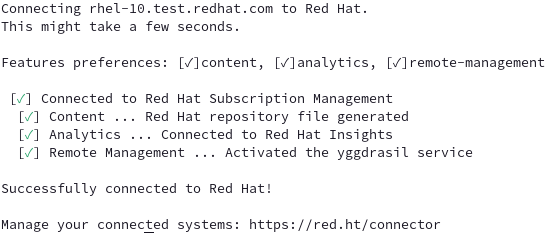
RHC is now the official and recommended tool for registering RHEL 10 systems to the Hybrid Cloud Console. This update with RHEL 10 allows users to enable or disable features during registration, providing control over the amount of data collected from the system.
The details of the new functionalities can be found in the Remote host configuration and management guide. In addition, the output of the rhc connect subcommand has been updated to reflect those changes:
8.2.2. Remediations
Table view for all remediation plans
Remediation plans in Red Hat Lightspeed now feature a searchable, sortable, and filterable table view, mirroring the rest of the Red Hat Lightspeed experience. This new format streamlines the process of locating specific plans, especially beneficial when handling numerous plans, by enabling users to define and apply criteria for their searches.

Quick start guide: Creating and executing remediation plans
A new quick start guide is available to help you get started with remediations. The guide helps you navigate the process of creating a remediation plan for advisor issues, confirming execution readiness, and executing the remediation plan on direct-connected hosts.
When you open the quick start, the quick start panel expands on the right side of the screen and persists as you navigate to other pages within Red Hat Lightspeed. You can launch the quick start from the Remediations page on console.redhat.com or in the Learning Resources page.
In-app execution readiness guidance
Remediation plan details now include a new Execution readiness card. This card offers a clear, step-by-step checklist of the permissions and configuration settings required for successful remote host execution. If any of your configuration settings are incorrect, the card specifies the exact steps needed for proper setup.

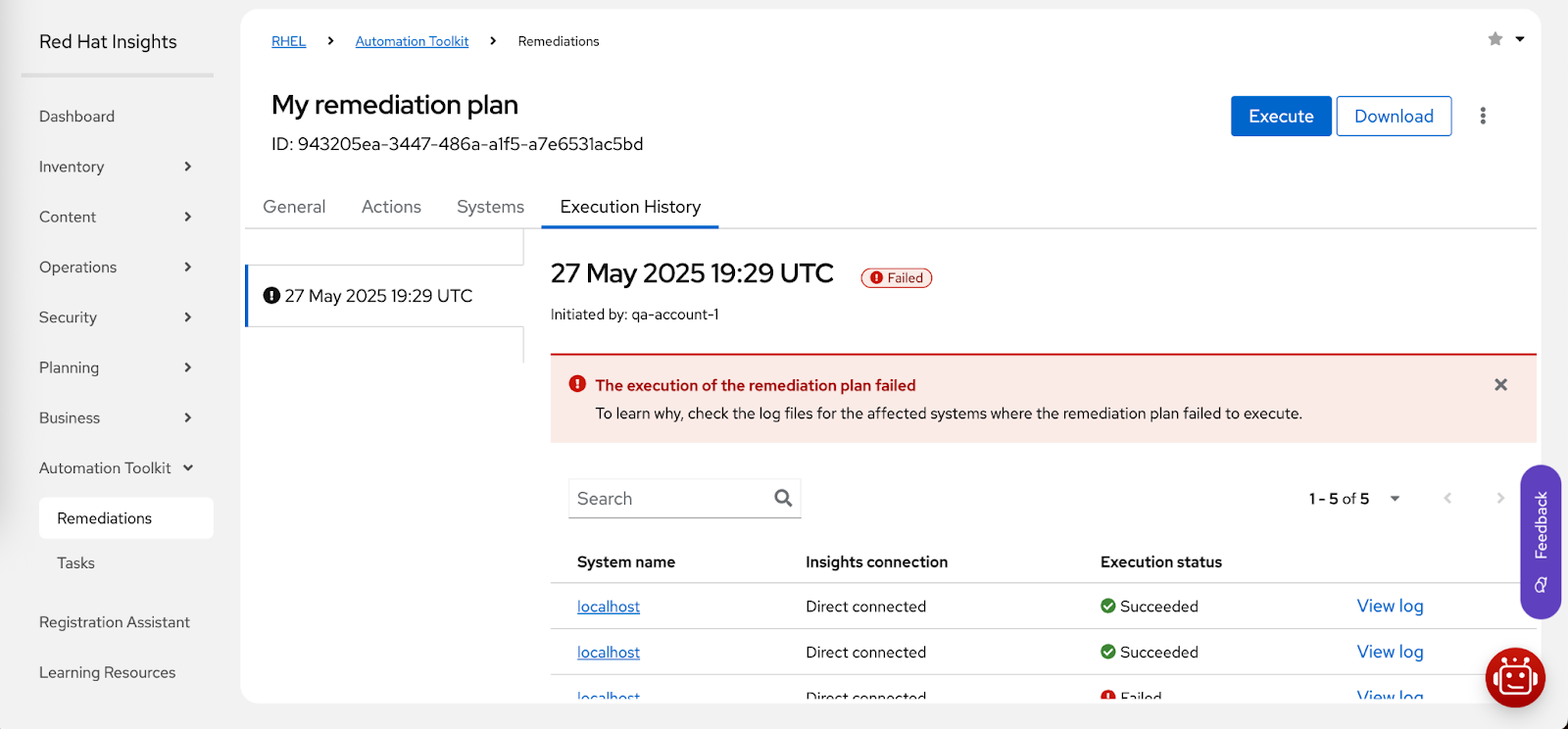
Execution History tab
The new Execution History tab provides a streamlined way to monitor the progress of acting on remediation plans. You can now access the status, history, and logs of a plan execution on each included system.
Additional fixes and enhancements
The following features have been implemented to improve Remediations:
- About remediations infotip: A new infotip on the overview page offers a quick description and direct links to documentation. This infotip is helpful if you’re new to Red Hat Lightspeed or in need of a quick refresher.
- Cleaner execution results: The broken issue counter in the details of a remediation plan has been removed for clarity.
- Consistent language: The Remediate button shown within Red Hat Lightspeed service pages has been renamed to the more accurate Plan remediation.
- Clearer labeling: We’ve removed the Ansible logo from the Playbook column (now called Remediation type) to better communicate that an Ansible subscription is not required to use remediations.
8.2.3. Inventory
UI fixes and improvements
Several updates and fixes have been implemented to improve Inventory, including:
- Group Creation Error Resolved: Attempting to create a group with a name that already exists no longer results in a server error.
- Group Rename Sync: Renaming a group is now properly reflected in the workspace interface.
-
Inventory Sorting Fixed: Sorting inventory groups by
host_countnow behaves as expected. - Inventory Helper Modal Update: The Inventory helper modal dialog box now includes guidance and a link to Configuring notifications for inventory events.
- Improved API Visibility: The Inventory API documentation now includes a direct link to Using APIs to configure Red Hat Lightspeed services product documentation.
8.2.4. Advisor
New recommendations released
The Red Hat Lightspeed Advisor service now detects and recommends solutions for the following issues:
-
Kdumpfails to savevmcoreon edge computing systems with AMD CPUs due to a known bug in the default kernel - High latency occurs when the cgroup update functions are called concurrently on RHEL 8 edge computing systems
- The system hangs due to improper I/O statistics on the edge computing system when a multipath device is in use
- Network packets are at risk of drop on a Broadcom NetXtreme II BCM57810 NIC after reboot when the network offloading feature is enabled and the firmware version is incompatible with the kernel version
-
This system cannot work as expectedmessage when encounteringsmartderrors - Boot failure occurs when local disks used for the root filesystem are not configured in the denylist
- Kernel panics after reboot on edge computing systems when the DFS Target Server is down
8.2.5. Tasks
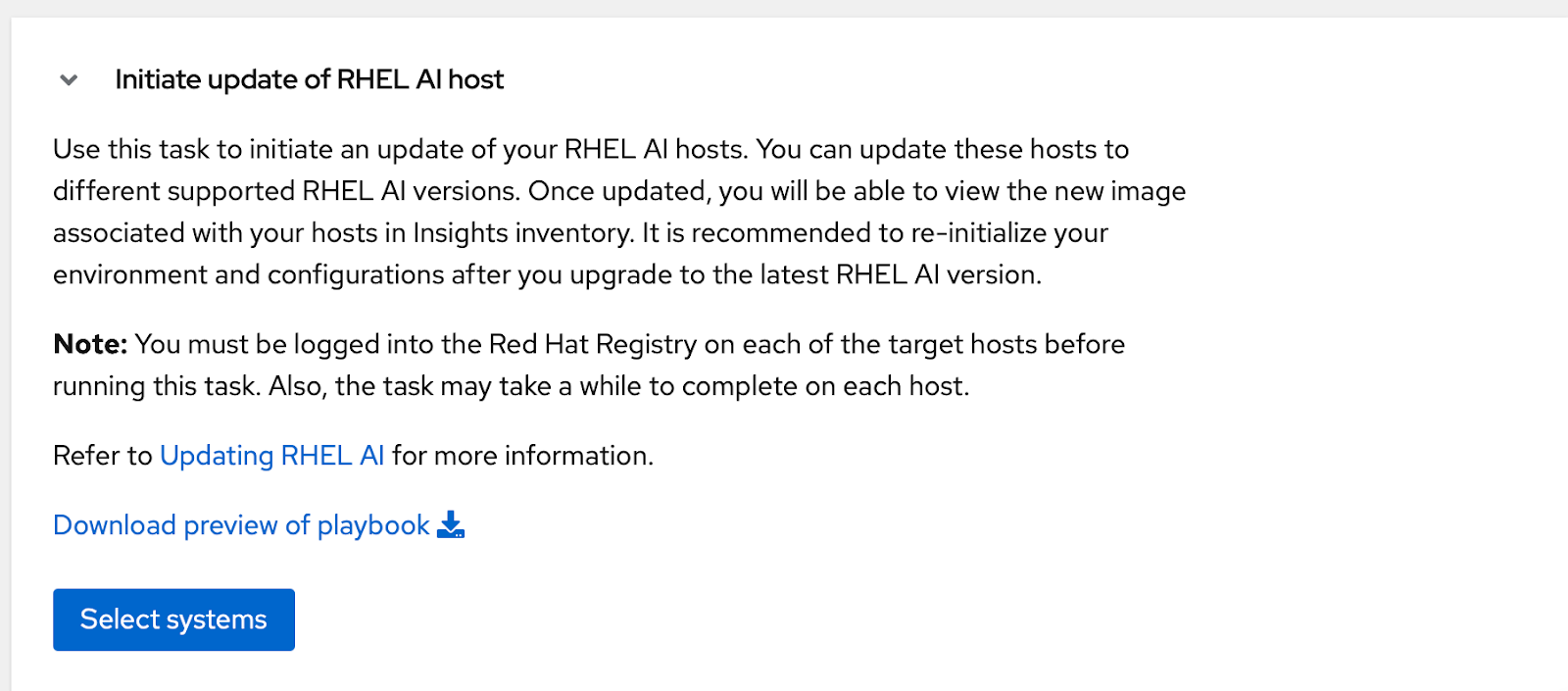
RHEL AI Update Task
You can now update a connected RHEL AI system using the Red Hat Lightspeed tasks service. Options include triggering a z-stream update or a minor version update to a supported version of RHEL AI. The Red Hat Lightspeed tasks service highlights systems running an unsupported RHEL AI version to help you quickly identify which systems need attention.
8.2.6. Image Builder
Image builder now shows AppStream lifecycle information
Image builder now shows lifecycle information for AppStreams that have multiple versions available. This enables customers to select an AppStream version with a lifecycle that aligns with their needs.

8.2.7. Planning
Red Hat Lightspeed planning for RHEL is now generally available
Red Hat Lightspeed planning for Red Hat Enterprise Linux (RHEL) is now available, delivering new features designed to assist with planning RHEL upgrades and monitoring the RHEL lifecycle status. In addition, Red Hat Lightspeed planning provides visibility into the tentative future roadmap for RHEL.
Red Hat Lightspeed planning introduces two new features:
- Life Cycle: Provides a centralized lifecycle view for Application Streams and RHEL minor releases, which helps you to plan for upgrades and monitor the status of your environment.
- Roadmap: Provides a view into the tentative roadmap for RHEL, enabling you to better plan ahead, and to anticipate the impact of upcoming roadmap items.

Providing feedback on Red Hat documentation
We appreciate and prioritize your feedback regarding our documentation. Provide as much detail as possible, so that your request can be quickly addressed.
Prerequisites
- You are logged in to the Red Hat Customer Portal.
Procedure
To provide feedback, perform the following steps:
- Click the following link: Create Issue
- Describe the issue or enhancement in the Summary text box.
- Provide details about the issue or requested enhancement in the Description text box.
- Type your name in the Reporter text box.
- Click the Create button.
This action creates a documentation ticket and routes it to the appropriate documentation team. Thank you for taking the time to provide feedback.

'%20d='M201.5%20305.5c-13.8%200-24.9-11.1-24.9-24.6%200-13.8%2011.1-24.9%2024.9-24.9%2013.6%200%2024.6%2011.1%2024.6%2024.9%200%2013.6-11.1%2024.6-24.6%2024.6zM504%20256c0%20137-111%20248-248%20248S8%20393%208%20256%20119%208%20256%208s248%20111%20248%20248zm-132.3-41.2c-9.4%200-17.7%203.9-23.8%2010-22.4-15.5-52.6-25.5-86.1-26.6l17.4-78.3%2055.4%2012.5c0%2013.6%2011.1%2024.6%2024.6%2024.6%2013.8%200%2024.9-11.3%2024.9-24.9s-11.1-24.9-24.9-24.9c-9.7%200-18%205.8-22.1%2013.8l-61.2-13.6c-3-.8-6.1%201.4-6.9%204.4l-19.1%2086.4c-33.2%201.4-63.1%2011.3-85.5%2026.8-6.1-6.4-14.7-10.2-24.1-10.2-34.9%200-46.3%2046.9-14.4%2062.8-1.1%205-1.7%2010.2-1.7%2015.5%200%2052.6%2059.2%2095.2%20132%2095.2%2073.1%200%20132.3-42.6%20132.3-95.2%200-5.3-.6-10.8-1.9-15.8%2031.3-16%2019.8-62.5-14.9-62.5zM302.8%20331c-18.2%2018.2-76.1%2017.9-93.6%200-2.2-2.2-6.1-2.2-8.3%200-2.5%202.5-2.5%206.4%200%208.6%2022.8%2022.8%2087.3%2022.8%20110.2%200%202.5-2.2%202.5-6.1%200-8.6-2.2-2.2-6.1-2.2-8.3%200zm7.7-75c-13.6%200-24.6%2011.1-24.6%2024.9%200%2013.6%2011.1%2024.6%2024.6%2024.6%2013.8%200%2024.9-11.1%2024.9-24.6%200-13.8-11-24.9-24.9-24.9z'/%3e%3c/svg%3e)