 Red Hat Summit
Share Feedback to help us keep improving.
Este contenido no está disponible en el idioma seleccionado.
Chapter 4. RPM topologies
Ansible Automation Platform provides tested topologies for RPM-based Ansible Automation Platform. Select the topology that best fits your RPM-based deployment requirements.
4.1. RPM growth topology
The RPM-based growth topology provides a smaller footprint deployment without redundancy for organizations getting started with Ansible Automation Platform. Included are the tested infrastructure topology, system requirements, network port configurations, and an example inventory file for installation.
4.1.1. Infrastructure topology
The Red Hat tested infrastructure topology for this deployment model:
Figure 4.1. Infrastructure topology diagram

Red Hat tests each VM with these requirements:
| Requirement | Minimum requirement |
|---|---|
| RAM | 16 GB |
| CPUs | 4 |
| Local disk | 60 GB |
| Disk IOPS | 3000 |
| VM count | Purpose | Example VM group names |
|---|---|---|
| 1 | Platform gateway with colocated Redis |
|
| 1 | Automation controller |
|
| 1 | Private automation hub |
|
| 1 | Event-Driven Ansible |
|
| 1 | Automation mesh execution node |
|
| 1 | Ansible Automation Platform managed database |
|
4.1.2. Tested system configurations
Red Hat has tested these configurations to install and run Red Hat Ansible Automation Platform:
| Type | Description | |
|---|---|---|
| Subscription | Valid Red Hat Ansible Automation Platform subscription | |
| Operating system | Red Hat Enterprise Linux 9.4 or later minor versions of Red Hat Enterprise Linux 9. | |
| CPU architecture | x86_64, AArch64, s390x (IBM Z), ppc64le (IBM Power) | |
|
|
| Ansible Automation Platform uses the system-wide ansible-core package to install the platform, but uses ansible-core 2.16 for both its control plane and built-in execution environments. |
| Browser | A currently supported version of Mozilla Firefox or Google Chrome | |
| Database |
|
|
| IP version | IPv4, IPv6 (single-stack and dual-stack) |
4.1.3. Network ports
Red Hat Ansible Automation Platform uses several ports to communicate with its services. These ports must be open and available for Red Hat Ansible Automation Platform to work. Ensure that these ports are available and are not blocked by a firewall.
| Port number | Protocol | Service | Source | Destination |
|---|---|---|---|---|
| 80/443 | TCP | HTTP/HTTPS | Event-Driven Ansible | Automation hub |
| 80/443 | TCP | HTTP/HTTPS | Event-Driven Ansible | Automation controller |
| 80/443 | TCP | HTTP/HTTPS | Automation controller | Automation hub |
| 80/443 | TCP | HTTP/HTTPS | Platform gateway | Automation controller |
| 80/443 | TCP | HTTP/HTTPS | Platform gateway | Automation hub |
| 80/443 | TCP | HTTP/HTTPS | Platform gateway | Event-Driven Ansible |
| 80/443 | TCP | HTTP/HTTPS | Execution node | Platform gateway |
| 5432 | TCP | PostgreSQL | Event-Driven Ansible | Database |
| 5432 | TCP | PostgreSQL | Platform gateway | Database |
| 5432 | TCP | PostgreSQL | Automation hub | Database |
| 5432 | TCP | PostgreSQL | Automation controller | Database |
| 6379 | TCP | Redis | Event-Driven Ansible | Redis node |
| 6379 | TCP | Redis | Platform gateway | Redis node |
| 8443 | TCP | HTTPS | Platform gateway | Platform gateway |
| 27199 | TCP | Receptor | Automation controller | Execution node |
If you change any port values by using inventory variables, refer to Inventory file variables to review all default port values and ensure there are no port conflicts.
4.1.4. Example inventory file
Use the example inventory file to perform an installation:
# This is the Ansible Automation Platform installer inventory file intended for the RPM growth deployment topology.
# Consult the Ansible Automation Platform product documentation about this topology's tested hardware configuration.
# https://docs.redhat.com/en/documentation/red_hat_ansible_automation_platform/2.6/html/tested_deployment_models/rpm-topologies
#
# Consult the docs if you are unsure what to add
# For all optional variables consult the Ansible Automation Platform documentation:
# https://docs.redhat.com/en/documentation/red_hat_ansible_automation_platform/2.6/html/rpm_installation/index


# This section is for your platform gateway hosts
# -----------------------------------------------------
[automationgateway]
gateway.example.org

# This section is for your automation controller hosts
# -----------------------------------------------------
[automationcontroller]
controller.example.org

[automationcontroller:vars]
peers=execution_nodes

# This section is for your Ansible Automation Platform execution hosts
# -----------------------------------------------------
[execution_nodes]
exec.example.org

# This section is for your automation hub hosts
# -----------------------------------------------------
[automationhub]
hub.example.org

# This section is for your Event-Driven Ansible controller hosts
# -----------------------------------------------------
[automationedacontroller]
eda.example.org

# This section is for the Ansible Automation Platform database
# -----------------------------------------------------
[database]
db.example.org

[all:vars]

# Common variables
# https://docs.redhat.com/en/documentation/red_hat_ansible_automation_platform/2.6/html/rpm_installation/appendix-inventory-files-vars#general-variables
# -----------------------------------------------------
registry_username=<your RHN username>
registry_password=<your RHN password>

redis_mode=standalone

# Platform gateway
# https://docs.redhat.com/en/documentation/red_hat_ansible_automation_platform/2.6/html/rpm_installation/appendix-inventory-files-vars#platform-gateway-variables
# -----------------------------------------------------
automationgateway_admin_password=<set your own>
automationgateway_pg_host=db.example.org
automationgateway_pg_password=<set your own>

# Automation controller
# https://docs.redhat.com/en/documentation/red_hat_ansible_automation_platform/2.6/html/rpm_installation/appendix-inventory-files-vars#controller-variables
# -----------------------------------------------------
admin_password=<set your own>
pg_host=db.example.org
pg_password=<set your own>

# Automation hub
# https://docs.redhat.com/en/documentation/red_hat_ansible_automation_platform/2.6/html/rpm_installation/appendix-inventory-files-vars#hub-variables
# -----------------------------------------------------
automationhub_admin_password=<set your own>
automationhub_pg_host=db.example.org
automationhub_pg_password=<set your own>

# Event-Driven Ansible controller
# https://docs.redhat.com/en/documentation/red_hat_ansible_automation_platform/2.6/html/rpm_installation/appendix-inventory-files-vars#event-driven-ansible-variables
# -----------------------------------------------------
automationedacontroller_admin_password=<set your own>
automationedacontroller_pg_host=db.example.org
automationedacontroller_pg_password=<set your own>
4.2. RPM enterprise topology
The RPM-based enterprise topology provides redundancy and higher compute for large volumes of automation. Included are the tested infrastructure topology, system requirements, network port configurations, and an example inventory file for installation.
4.2.1. Infrastructure topology
The Red Hat tested infrastructure topology for this deployment model:
Figure 4.2. Infrastructure topology diagram
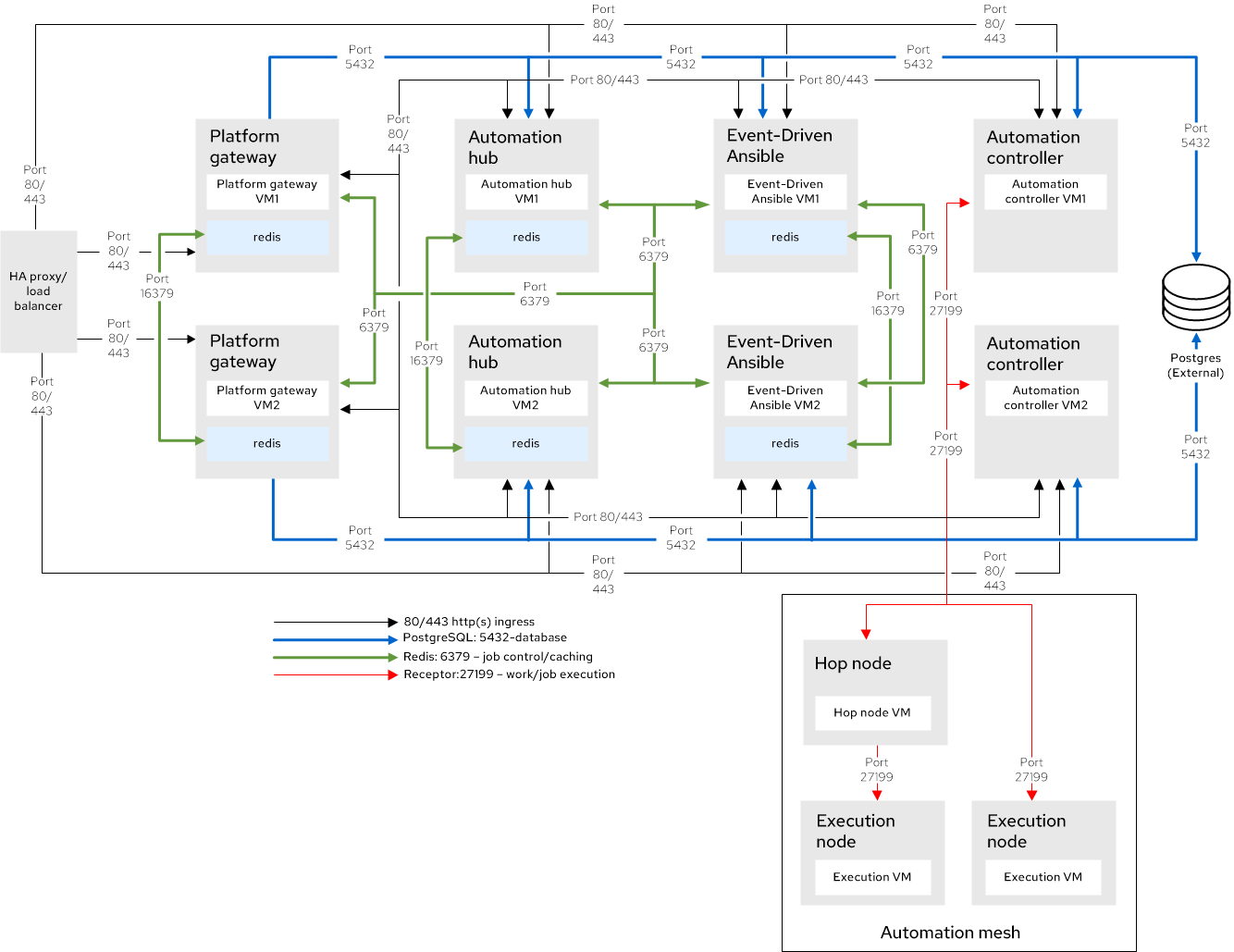
Red Hat tests each VM with these requirements:
| Requirement | Minimum requirement |
|---|---|
| RAM | 16 GB |
| CPUs | 4 |
| Local disk | 60 GB |
| Disk IOPS | 3000 |
| VM count | Purpose | Example VM group names |
|---|---|---|
| 2 | Platform gateway with colocated Redis |
|
| 2 | Automation controller |
|
| 2 | Private automation hub with colocated Redis |
|
| 2 | Event-Driven Ansible with colocated Redis |
|
| 1 | Automation mesh hop node |
|
| 2 | Automation mesh execution node |
|
| 1 | Externally managed database service | N/A |
| 1 | HAProxy load balancer in front of platform gateway (externally managed) | N/A |
- Redis high availability (HA) deployment requires 6 VMs. You can colocate Redis on each Ansible Automation Platform component VM except for automation controller, execution nodes, or the PostgreSQL database.
- RPM-based deployments of Ansible Automation Platform do not support external Redis.
4.2.2. Tested system configurations
Red Hat has tested these configurations to install and run Red Hat Ansible Automation Platform:
| Type | Description | |
|---|---|---|
| Subscription | Valid Red Hat Ansible Automation Platform subscription | |
| Operating system | Red Hat Enterprise Linux 9.4 or later minor versions of Red Hat Enterprise Linux 9. | |
| CPU architecture | x86_64, AArch64, s390x (IBM Z), ppc64le (IBM Power) | |
|
|
| Ansible Automation Platform uses the system-wide ansible-core package to install the platform, but uses ansible-core 2.16 for both its control plane and built-in execution environments. |
| Browser | A currently supported version of Mozilla Firefox or Google Chrome | |
| Database |
|
|
| IP version | IPv4, IPv6 (single-stack and dual-stack) |
4.2.3. Network ports
Red Hat Ansible Automation Platform uses several ports to communicate with its services. These ports must be open and available for Red Hat Ansible Automation Platform to work. Ensure that these ports are available and are not blocked by a firewall.
| Port number | Protocol | Service | Source | Destination |
|---|---|---|---|---|
| 80/443 | TCP | HTTP/HTTPS | Event-Driven Ansible | Automation hub |
| 80/443 | TCP | HTTP/HTTPS | Event-Driven Ansible | Automation controller |
| 80/443 | TCP | HTTP/HTTPS | Automation controller | Automation hub |
| 80/443 | TCP | HTTP/HTTPS | HAProxy load balancer | Platform gateway |
| 80/443 | TCP | HTTP/HTTPS | Platform gateway | Automation controller |
| 80/443 | TCP | HTTP/HTTPS | Platform gateway | Automation hub |
| 80/443 | TCP | HTTP/HTTPS | Platform gateway | Event-Driven Ansible |
| 80/443 | TCP | HTTP/HTTPS | Execution node | Platform gateway |
| 5432 | TCP | PostgreSQL | Event-Driven Ansible | External database |
| 5432 | TCP | PostgreSQL | Platform gateway | External database |
| 5432 | TCP | PostgreSQL | Automation hub | External database |
| 5432 | TCP | PostgreSQL | Automation controller | External database |
| 6379 | TCP | Redis | Event-Driven Ansible | Redis node |
| 6379 | TCP | Redis | Platform gateway | Redis node |
| 8443 | TCP | HTTPS | Platform gateway | Platform gateway |
| 16379 | TCP | Redis | Redis node | Redis node |
| 27199 | TCP | Receptor | Automation controller | Hop node and execution node |
| 27199 | TCP | Receptor | Hop node | Execution node |
If you change any port values by using inventory variables, refer to Inventory file variables to review all default port values and ensure there are no port conflicts.
4.2.4. Example inventory file
Use the example inventory file to perform an installation:
# This is the Ansible Automation Platform enterprise installer inventory file
# Consult the docs if you are unsure what to add
# For all optional variables consult the Red Hat documentation:
# https://docs.redhat.com/en/documentation/red_hat_ansible_automation_platform/2.6/html/rpm_installation/index

# This section is for your platform gateway hosts
# -----------------------------------------------------
[automationgateway]
gateway1.example.org
gateway2.example.org

# This section is for your automation controller hosts
# -----------------------------------------------------
[automationcontroller]
controller1.example.org
controller2.example.org

[automationcontroller:vars]
peers=execution_nodes

# This section is for your Ansible Automation Platform execution hosts
# -----------------------------------------------------
[execution_nodes]
hop1.example.org node_type='hop'
exec1.example.org
exec2.example.org

# This section is for your automation hub hosts
# -----------------------------------------------------
[automationhub]
hub1.example.org
hub2.example.org

# This section is for your Event-Driven Ansible controller hosts
# -----------------------------------------------------
[automationedacontroller]
eda1.example.org
eda2.example.org

[redis]
gateway1.example.org
gateway2.example.org
hub1.example.org
hub2.example.org
eda1.example.org
eda2.example.org

[all:vars]
# Common variables
# https://docs.redhat.com/en/documentation/red_hat_ansible_automation_platform/2.6/html/rpm_installation/appendix-inventory-files-vars#general-variables
# -----------------------------------------------------
registry_username=<your RHN username>
registry_password=<your RHN password>

# Platform gateway
# https://docs.redhat.com/en/documentation/red_hat_ansible_automation_platform/2.6/html/rpm_installation/appendix-inventory-files-vars#platform-gateway-variables
# -----------------------------------------------------
automationgateway_admin_password=<set your own>
automationgateway_pg_host=<set your own>
automationgateway_pg_database=<set your own>
automationgateway_pg_username=<set your own>
automationgateway_pg_password=<set your own>

# Automation controller
# https://docs.redhat.com/en/documentation/red_hat_ansible_automation_platform/2.6/html/rpm_installation/appendix-inventory-files-vars#controller-variables
# -----------------------------------------------------
admin_password=<set your own>
pg_host=<set your own>
pg_database=<set your own>
pg_username=<set your own>
pg_password=<set your own>

# Automation hub
# https://docs.redhat.com/en/documentation/red_hat_ansible_automation_platform/2.6/html/rpm_installation/appendix-inventory-files-vars#hub-variables
# -----------------------------------------------------
automationhub_admin_password=<set your own>
automationhub_pg_host=<set your own>
automationhub_pg_database=<set your own>
automationhub_pg_username=<set your own>
automationhub_pg_password=<set your own>

# Event-Driven Ansible controller
# https://docs.redhat.com/en/documentation/red_hat_ansible_automation_platform/2.6/html/rpm_installation/appendix-inventory-files-vars#event-driven-ansible-variables
# -----------------------------------------------------
automationedacontroller_admin_password=<set your own>
automationedacontroller_pg_host=<set your own>
automationedacontroller_pg_database=<set your own>
automationedacontroller_pg_username=<set your own>
automationedacontroller_pg_password=<set your own>
'%20d='M201.5%20305.5c-13.8%200-24.9-11.1-24.9-24.6%200-13.8%2011.1-24.9%2024.9-24.9%2013.6%200%2024.6%2011.1%2024.6%2024.9%200%2013.6-11.1%2024.6-24.6%2024.6zM504%20256c0%20137-111%20248-248%20248S8%20393%208%20256%20119%208%20256%208s248%20111%20248%20248zm-132.3-41.2c-9.4%200-17.7%203.9-23.8%2010-22.4-15.5-52.6-25.5-86.1-26.6l17.4-78.3%2055.4%2012.5c0%2013.6%2011.1%2024.6%2024.6%2024.6%2013.8%200%2024.9-11.3%2024.9-24.9s-11.1-24.9-24.9-24.9c-9.7%200-18%205.8-22.1%2013.8l-61.2-13.6c-3-.8-6.1%201.4-6.9%204.4l-19.1%2086.4c-33.2%201.4-63.1%2011.3-85.5%2026.8-6.1-6.4-14.7-10.2-24.1-10.2-34.9%200-46.3%2046.9-14.4%2062.8-1.1%205-1.7%2010.2-1.7%2015.5%200%2052.6%2059.2%2095.2%20132%2095.2%2073.1%200%20132.3-42.6%20132.3-95.2%200-5.3-.6-10.8-1.9-15.8%2031.3-16%2019.8-62.5-14.9-62.5zM302.8%20331c-18.2%2018.2-76.1%2017.9-93.6%200-2.2-2.2-6.1-2.2-8.3%200-2.5%202.5-2.5%206.4%200%208.6%2022.8%2022.8%2087.3%2022.8%20110.2%200%202.5-2.2%202.5-6.1%200-8.6-2.2-2.2-6.1-2.2-8.3%200zm7.7-75c-13.6%200-24.6%2011.1-24.6%2024.9%200%2013.6%2011.1%2024.6%2024.6%2024.6%2013.8%200%2024.9-11.1%2024.9-24.6%200-13.8-11-24.9-24.9-24.9z'/%3e%3c/svg%3e)