 Red Hat Summit
Este contenido no está disponible en el idioma seleccionado.
Chapter 1. Red Hat Device Edge overview
Red Hat Device Edge delivers an enterprise-ready distribution of the Red Hat-led open source community project Red Hat build of MicroShift (MicroShift) with Red Hat Enterprise Linux (RHEL) and Red Hat Ansible Automation Platform.
1.1. About Red Hat Device Edge
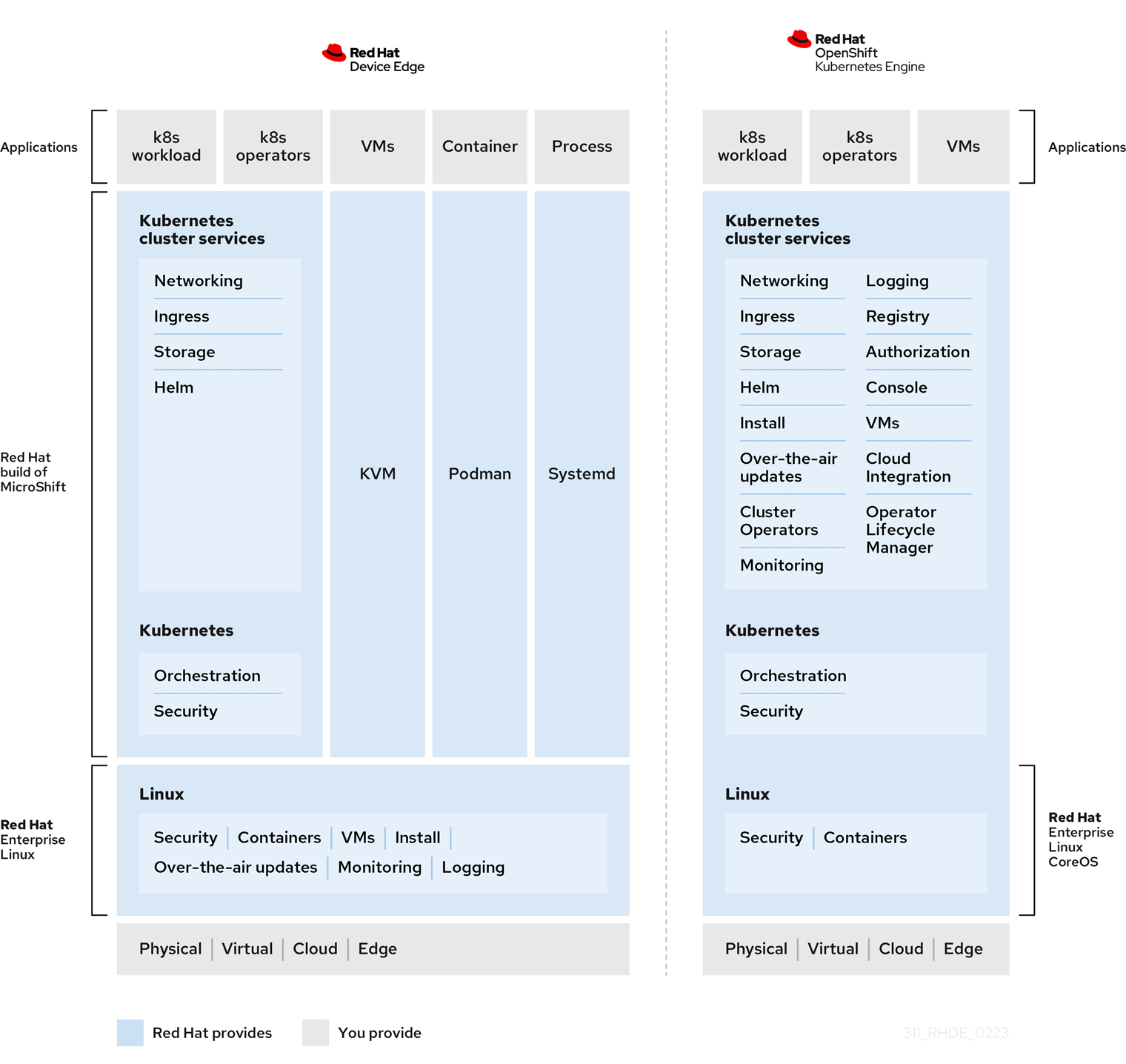
Red Hat Device Edge is for organizations that need small-form-factor edge devices and support for bare metal, virtualized, or containerized applications. Red Hat Device Edge is a solution for large-scale computing at the device edge that combines MicroShift and an edge-optimized Red Hat Enterprise Linux (RHEL) operating system. MicroShift is a Kubernetes orchestration in a smaller, lighter-weight footprint. Together, these components of Red Hat Device Edge provide all of the benefits of containers deployed to the edge. You can manage Red Hat Device Edge by using Red Hat Ansible Automation Platform.
Figure 1.1. Red Hat Device Edge components
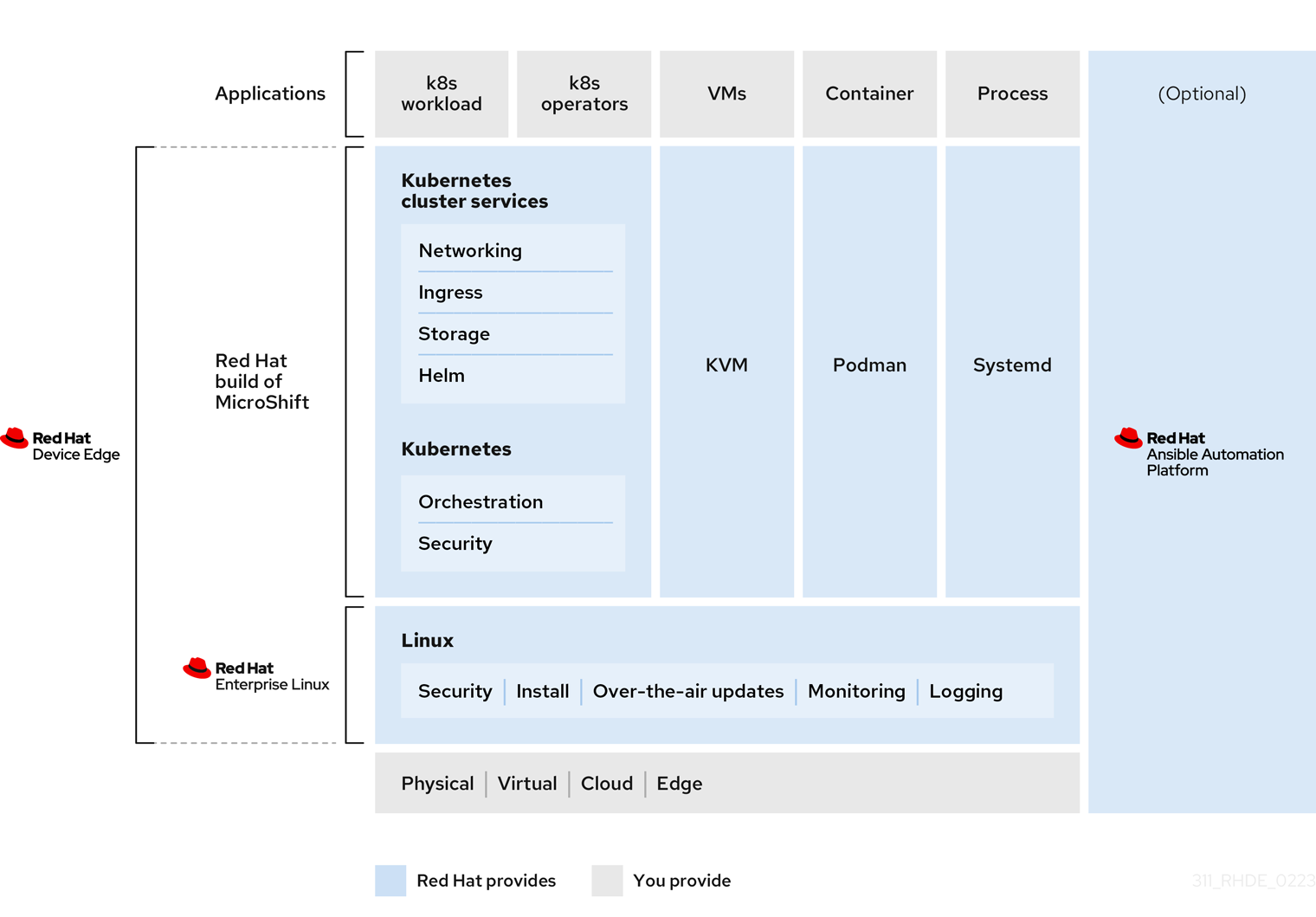
Figure 1.2. Red Hat Device Edge layers
For a non-technical description of Red Hat Device Edge, see Red Hat Device Edge.
1.1.1. Red Hat Device Edge product release notes
The latest release notes for each product that is part of Red Hat Device Edge are available at the following links:
- Red Hat build of MicroShift (MicroShift)
- Red Hat Enterprise Linux (RHEL) 9.2 release notes.
- Red Hat Enterprise Linux (RHEL) 9.4 release notes.
- Red Hat Enterprise Linux (RHEL) 9.6 release notes.
- Red Hat Ansible Automation Platform Release Notes
1.2. Compatibility table
You must pair a supported version of RHEL with the MicroShift version you are using as described in the following compatibility table.
1.2.1. Red Hat Device Edge product release compatibility matrix
RHEL and MicroShift work together as a single solution for device-edge computing. You can update each component separately, but the product versions must be compatible. Supported configurations of RHEL use verified releases for each together as listed in the following table:
Be sure to check the support status of a release on the product lifecycle page.
| RHEL Version(s) | MicroShift Version | Supported MicroShift Version → Version Updates |
| 10.0 | 4.21 | 4.21.0 → 4.21.z (Technology Preview) |
| 9.6 | 4.21 | 4.21.0 → 4.21.z |
| 9.6 | 4.20 | 4.20.0 → 4.20.z, 4.20 → 4.21 |
| 9.6 | 4.19 | 4.19.0 → 4.19.z, 4.19 → 4.20 |
| 9.4 | 4.18 | 4.18.0 →4.18.z, 4.18 → 4.20 on RHEL 9.6 |
| 9.4 | 4.17 | 4.17.1 → 4.17.z, 4.17 → 4.18 |
| 9.4 | 4.16 | 4.16.0 → 4.16.z, 4.16 →4.17, 4.16 → 4.18 |
| 9.2 | 4.14 | 4.14.0 → 4.14.z, 4.14 → 4.16 on RHEL 9.4 |

'%20d='M201.5%20305.5c-13.8%200-24.9-11.1-24.9-24.6%200-13.8%2011.1-24.9%2024.9-24.9%2013.6%200%2024.6%2011.1%2024.6%2024.9%200%2013.6-11.1%2024.6-24.6%2024.6zM504%20256c0%20137-111%20248-248%20248S8%20393%208%20256%20119%208%20256%208s248%20111%20248%20248zm-132.3-41.2c-9.4%200-17.7%203.9-23.8%2010-22.4-15.5-52.6-25.5-86.1-26.6l17.4-78.3%2055.4%2012.5c0%2013.6%2011.1%2024.6%2024.6%2024.6%2013.8%200%2024.9-11.3%2024.9-24.9s-11.1-24.9-24.9-24.9c-9.7%200-18%205.8-22.1%2013.8l-61.2-13.6c-3-.8-6.1%201.4-6.9%204.4l-19.1%2086.4c-33.2%201.4-63.1%2011.3-85.5%2026.8-6.1-6.4-14.7-10.2-24.1-10.2-34.9%200-46.3%2046.9-14.4%2062.8-1.1%205-1.7%2010.2-1.7%2015.5%200%2052.6%2059.2%2095.2%20132%2095.2%2073.1%200%20132.3-42.6%20132.3-95.2%200-5.3-.6-10.8-1.9-15.8%2031.3-16%2019.8-62.5-14.9-62.5zM302.8%20331c-18.2%2018.2-76.1%2017.9-93.6%200-2.2-2.2-6.1-2.2-8.3%200-2.5%202.5-2.5%206.4%200%208.6%2022.8%2022.8%2087.3%2022.8%20110.2%200%202.5-2.2%202.5-6.1%200-8.6-2.2-2.2-6.1-2.2-8.3%200zm7.7-75c-13.6%200-24.6%2011.1-24.6%2024.9%200%2013.6%2011.1%2024.6%2024.6%2024.6%2013.8%200%2024.9-11.1%2024.9-24.6%200-13.8-11-24.9-24.9-24.9z'/%3e%3c/svg%3e)