 Red Hat Summit
Este contenido no está disponible en el idioma seleccionado.
5.2. Publish-Subscribe Channel
Overview
Copiar enlaceEnlace copiado en el portapapeles!
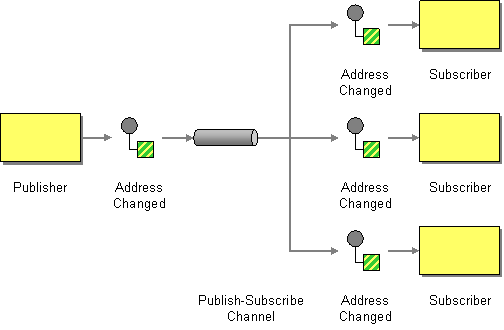
A publish-subscribe channel, shown in Figure 5.2, “Publish Subscribe Channel Pattern”, is a message channel that enables multiple subscribers to consume any given message. This is in contrast with a point-to-point channel. Publish-subscribe channels are frequently used as a means of broadcasting events or notifications to multiple subscribers.
Figure 5.2. Publish Subscribe Channel Pattern
Components that support publish-subscribe channel
Copiar enlaceEnlace copiado en el portapapeles!
The following Apache Camel components support the publish-subscribe channel pattern:
JMS
Copiar enlaceEnlace copiado en el portapapeles!
In JMS, a publish-subscribe channel is represented by a topic. For example, you can specify the endpoint URI for a JMS topic called
StockQuotes as follows:
jms:topic:StockQuotesActiveMQ
Copiar enlaceEnlace copiado en el portapapeles!
In ActiveMQ, a publish-subscribe channel is represented by a topic. For example, you can specify the endpoint URI for an ActiveMQ topic called
StockQuotes, as follows:
activemq:topic:StockQuotesXMPP
Copiar enlaceEnlace copiado en el portapapeles!
Static subscription lists
Copiar enlaceEnlace copiado en el portapapeles!
If you prefer, you can also implement publish-subscribe logic within the Apache Camel application itself. A simple approach is to define a static subscription list, where the target endpoints are all explicitly listed at the end of the route. However, this approach is not as flexible as a JMS or ActiveMQ topic.
Java DSL example
Copiar enlaceEnlace copiado en el portapapeles!
The following Java DSL example shows how to simulate a publish-subscribe channel with a single publisher,
seda:a, and three subscribers, seda:b, seda:c, and seda:d:
from("seda:a").to("seda:b", "seda:c", "seda:d");Note
This only works for the InOnly message exchange pattern.
XML configuration example
Copiar enlaceEnlace copiado en el portapapeles!
The following example shows how to configure the same route in XML:
<camelContext id="buildStaticRecipientList" xmlns="http://camel.apache.org/schema/spring">
  <route>
    <from uri="seda:a"/>
    <to uri="seda:b"/>
    <to uri="seda:c"/>
    <to uri="seda:d"/>
  </route>
</camelContext>
'%20d='M201.5%20305.5c-13.8%200-24.9-11.1-24.9-24.6%200-13.8%2011.1-24.9%2024.9-24.9%2013.6%200%2024.6%2011.1%2024.6%2024.9%200%2013.6-11.1%2024.6-24.6%2024.6zM504%20256c0%20137-111%20248-248%20248S8%20393%208%20256%20119%208%20256%208s248%20111%20248%20248zm-132.3-41.2c-9.4%200-17.7%203.9-23.8%2010-22.4-15.5-52.6-25.5-86.1-26.6l17.4-78.3%2055.4%2012.5c0%2013.6%2011.1%2024.6%2024.6%2024.6%2013.8%200%2024.9-11.3%2024.9-24.9s-11.1-24.9-24.9-24.9c-9.7%200-18%205.8-22.1%2013.8l-61.2-13.6c-3-.8-6.1%201.4-6.9%204.4l-19.1%2086.4c-33.2%201.4-63.1%2011.3-85.5%2026.8-6.1-6.4-14.7-10.2-24.1-10.2-34.9%200-46.3%2046.9-14.4%2062.8-1.1%205-1.7%2010.2-1.7%2015.5%200%2052.6%2059.2%2095.2%20132%2095.2%2073.1%200%20132.3-42.6%20132.3-95.2%200-5.3-.6-10.8-1.9-15.8%2031.3-16%2019.8-62.5-14.9-62.5zM302.8%20331c-18.2%2018.2-76.1%2017.9-93.6%200-2.2-2.2-6.1-2.2-8.3%200-2.5%202.5-2.5%206.4%200%208.6%2022.8%2022.8%2087.3%2022.8%20110.2%200%202.5-2.2%202.5-6.1%200-8.6-2.2-2.2-6.1-2.2-8.3%200zm7.7-75c-13.6%200-24.6%2011.1-24.6%2024.9%200%2013.6%2011.1%2024.6%2024.6%2024.6%2013.8%200%2024.9-11.1%2024.9-24.6%200-13.8-11-24.9-24.9-24.9z'/%3e%3c/svg%3e)