 Red Hat Summit
이 콘텐츠는 선택한 언어로 제공되지 않습니다.
18.2.2. WS-Transaction Architecture
WS-Transaction distinguishes the transaction-aware web service in its role executing business-logic, from the web service acting as a participant in the transaction, communicating with and responding to its transaction coordinator. Transaction-aware web services deal with application clients using business-level protocols, while the participant handles the underlying WS-Transaction protocols, as shown in Figure 18.4, “WS-Transaction Global View”.
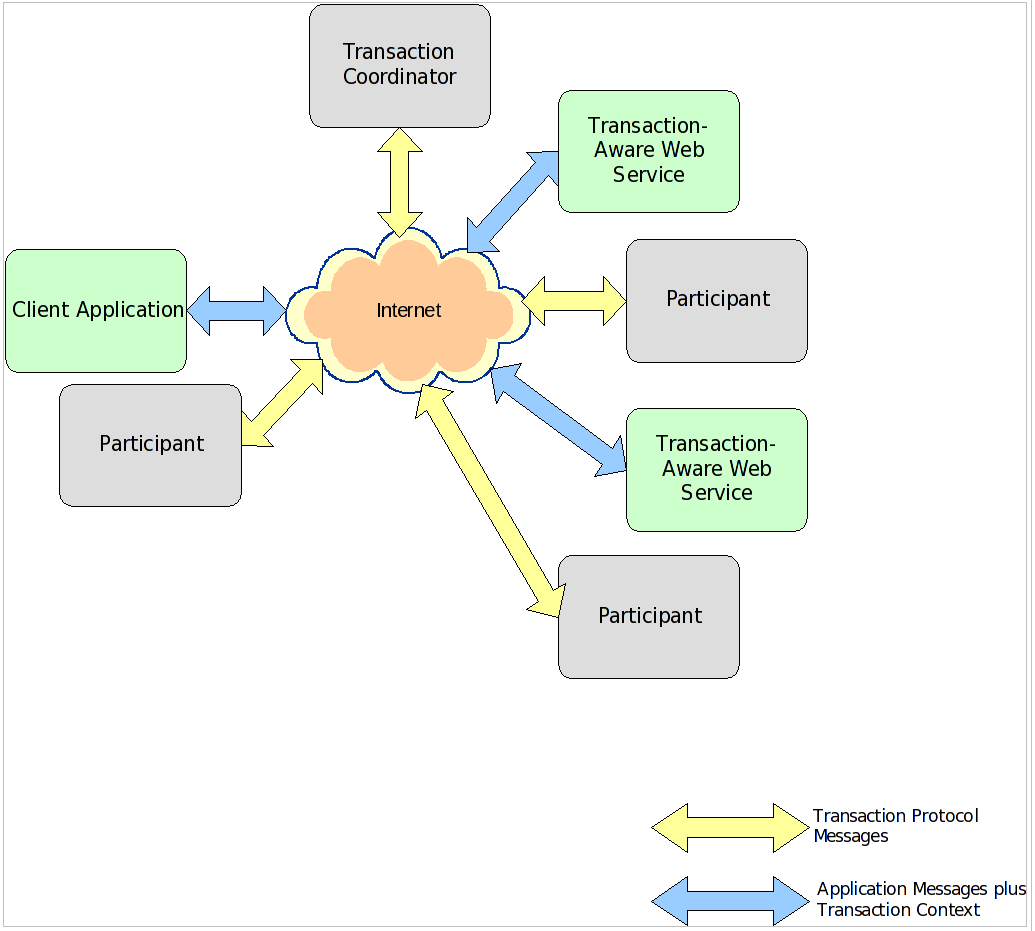
Figure 18.4. WS-Transaction Global View
A transaction-aware web service encapsulates the business logic or work that needs to be conducted within the scope of a transaction. This work cannot be confirmed by the application unless the transaction also commits. Thus, control is ultimately removed from the application and given to the transaction.
The participant is the entity that, under the dictates of the transaction coordinator, controls the outcome of the work performed by the transaction-aware Web service. In Figure 18.4, “WS-Transaction Global View”, each web service is shown with one associated participant that manages the transaction protocol messages on behalf of its web service. Figure 18.5, “WS-Transaction Web Services and Participants”, however, shows a close-up view of a single web service, and a client application with their associated participants.

Figure 18.5. WS-Transaction Web Services and Participants
The transaction-aware web service employs a back end database accessed via a JDBC driver, which sends SQL statements to the database for processing. However, those statements should only commit if the enclosing web service transaction does. For this to work, the web service must employ transaction bridging. Transaction bridging registers a participant with the coordinator for the web service transaction and creates a matching XA transaction within which it can invoke the driver to make tentative changes to the database. The web service ensures that service requests associated with a specific web service transaction are executed in the scope of the corresponding XA transaction, grouping changes common to a given transaction while isolating changes belonging to different transactions. The participant responds to prepare, commit, or rollback requests associated from the web service transaction coordinator by forwarding the same operations to the underlying XA transaction coordinator, ensuring that the local outcome in the database corresponds with the global outcome of the web service transaction as a whole.
Things are less complex for the client. Through its API, the client application registers a participant with the transaction, and uses this participant to control termination of the transaction.

'%20d='M201.5%20305.5c-13.8%200-24.9-11.1-24.9-24.6%200-13.8%2011.1-24.9%2024.9-24.9%2013.6%200%2024.6%2011.1%2024.6%2024.9%200%2013.6-11.1%2024.6-24.6%2024.6zM504%20256c0%20137-111%20248-248%20248S8%20393%208%20256%20119%208%20256%208s248%20111%20248%20248zm-132.3-41.2c-9.4%200-17.7%203.9-23.8%2010-22.4-15.5-52.6-25.5-86.1-26.6l17.4-78.3%2055.4%2012.5c0%2013.6%2011.1%2024.6%2024.6%2024.6%2013.8%200%2024.9-11.3%2024.9-24.9s-11.1-24.9-24.9-24.9c-9.7%200-18%205.8-22.1%2013.8l-61.2-13.6c-3-.8-6.1%201.4-6.9%204.4l-19.1%2086.4c-33.2%201.4-63.1%2011.3-85.5%2026.8-6.1-6.4-14.7-10.2-24.1-10.2-34.9%200-46.3%2046.9-14.4%2062.8-1.1%205-1.7%2010.2-1.7%2015.5%200%2052.6%2059.2%2095.2%20132%2095.2%2073.1%200%20132.3-42.6%20132.3-95.2%200-5.3-.6-10.8-1.9-15.8%2031.3-16%2019.8-62.5-14.9-62.5zM302.8%20331c-18.2%2018.2-76.1%2017.9-93.6%200-2.2-2.2-6.1-2.2-8.3%200-2.5%202.5-2.5%206.4%200%208.6%2022.8%2022.8%2087.3%2022.8%20110.2%200%202.5-2.2%202.5-6.1%200-8.6-2.2-2.2-6.1-2.2-8.3%200zm7.7-75c-13.6%200-24.6%2011.1-24.6%2024.9%200%2013.6%2011.1%2024.6%2024.6%2024.6%2013.8%200%2024.9-11.1%2024.9-24.6%200-13.8-11-24.9-24.9-24.9z'/%3e%3c/svg%3e)