 Red Hat Summit
이 콘텐츠는 선택한 언어로 제공되지 않습니다.
5.2. Publish-Subscribe Channel
Overview
링크 복사링크가 클립보드에 복사되었습니다!
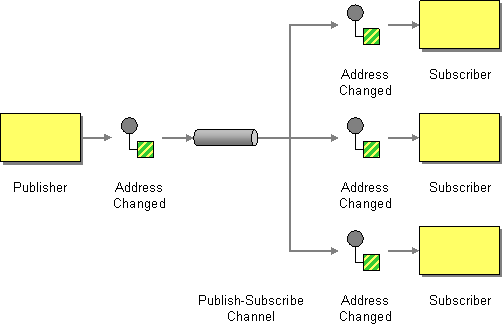
A publish-subscribe channel, shown in Figure 5.2, “Publish Subscribe Channel Pattern”, is a message channel that enables multiple subscribers to consume any given message. This is in contrast with a point-to-point channel. Publish-subscribe channels are frequently used as a means of broadcasting events or notifications to multiple subscribers.
Figure 5.2. Publish Subscribe Channel Pattern
Components that support publish-subscribe channel
링크 복사링크가 클립보드에 복사되었습니다!
The following Apache Camel components support the publish-subscribe channel pattern:
JMS
링크 복사링크가 클립보드에 복사되었습니다!
In JMS, a publish-subscribe channel is represented by a topic. For example, you can specify the endpoint URI for a JMS topic called
StockQuotes as follows:
jms:topic:StockQuotesActiveMQ
링크 복사링크가 클립보드에 복사되었습니다!
In ActiveMQ, a publish-subscribe channel is represented by a topic. For example, you can specify the endpoint URI for an ActiveMQ topic called
StockQuotes, as follows:
activemq:topic:StockQuotesXMPP
링크 복사링크가 클립보드에 복사되었습니다!
Static subscription lists
링크 복사링크가 클립보드에 복사되었습니다!
If you prefer, you can also implement publish-subscribe logic within the Apache Camel application itself. A simple approach is to define a static subscription list, where the target endpoints are all explicitly listed at the end of the route. However, this approach is not as flexible as a JMS or ActiveMQ topic.
Java DSL example
링크 복사링크가 클립보드에 복사되었습니다!
The following Java DSL example shows how to simulate a publish-subscribe channel with a single publisher,
seda:a, and three subscribers, seda:b, seda:c, and seda:d:
from("seda:a").to("seda:b", "seda:c", "seda:d");Note
This only works for the InOnly message exchange pattern.
XML configuration example
링크 복사링크가 클립보드에 복사되었습니다!
The following example shows how to configure the same route in XML:
<camelContext id="buildStaticRecipientList" xmlns="http://camel.apache.org/schema/spring">
  <route>
    <from uri="seda:a"/>
    <to uri="seda:b"/>
    <to uri="seda:c"/>
    <to uri="seda:d"/>
  </route>
</camelContext>
'%20d='M201.5%20305.5c-13.8%200-24.9-11.1-24.9-24.6%200-13.8%2011.1-24.9%2024.9-24.9%2013.6%200%2024.6%2011.1%2024.6%2024.9%200%2013.6-11.1%2024.6-24.6%2024.6zM504%20256c0%20137-111%20248-248%20248S8%20393%208%20256%20119%208%20256%208s248%20111%20248%20248zm-132.3-41.2c-9.4%200-17.7%203.9-23.8%2010-22.4-15.5-52.6-25.5-86.1-26.6l17.4-78.3%2055.4%2012.5c0%2013.6%2011.1%2024.6%2024.6%2024.6%2013.8%200%2024.9-11.3%2024.9-24.9s-11.1-24.9-24.9-24.9c-9.7%200-18%205.8-22.1%2013.8l-61.2-13.6c-3-.8-6.1%201.4-6.9%204.4l-19.1%2086.4c-33.2%201.4-63.1%2011.3-85.5%2026.8-6.1-6.4-14.7-10.2-24.1-10.2-34.9%200-46.3%2046.9-14.4%2062.8-1.1%205-1.7%2010.2-1.7%2015.5%200%2052.6%2059.2%2095.2%20132%2095.2%2073.1%200%20132.3-42.6%20132.3-95.2%200-5.3-.6-10.8-1.9-15.8%2031.3-16%2019.8-62.5-14.9-62.5zM302.8%20331c-18.2%2018.2-76.1%2017.9-93.6%200-2.2-2.2-6.1-2.2-8.3%200-2.5%202.5-2.5%206.4%200%208.6%2022.8%2022.8%2087.3%2022.8%20110.2%200%202.5-2.2%202.5-6.1%200-8.6-2.2-2.2-6.1-2.2-8.3%200zm7.7-75c-13.6%200-24.6%2011.1-24.6%2024.9%200%2013.6%2011.1%2024.6%2024.6%2024.6%2013.8%200%2024.9-11.1%2024.9-24.6%200-13.8-11-24.9-24.9-24.9z'/%3e%3c/svg%3e)