 Red Hat Summit
Este conteúdo não está disponível no idioma selecionado.
Part V. Cache Tiering (Tech Preview)
A cache tier provides Ceph Clients with better I/O performance for a subset of the data stored in a backing storage tier. Cache tiering involves creating a pool of relatively fast/expensive storage devices (e.g., solid state drives) configured to act as a cache tier, and a backing pool of either erasure-coded or relatively slower/cheaper devices configured to act as an economical storage tier. The Ceph objecter handles where to place the objects and the tiering agent determines when to flush objects from the cache to the backing storage tier. So the cache tier and the backing storage tier are completely transparent to Ceph clients.
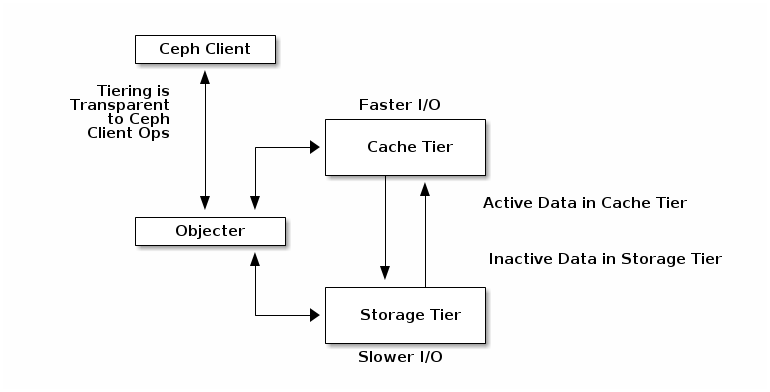
The cache tiering agent handles the migration of data between the cache tier and the backing storage tier automatically. However, admins have the ability to configure how this migration takes place. There are two main scenarios:
-
Writeback Mode: When admins configure tiers with
writebackmode, Ceph clients write data to the cache tier and receive an ACK from the cache tier. In time, the data written to the cache tier migrates to the storage tier and gets flushed from the cache tier. Conceptually, the cache tier is overlaid "in front" of the backing storage tier. When a Ceph client needs data that resides in the storage tier, the cache tiering agent migrates the data to the cache tier on read, then it is sent to the Ceph client. Thereafter, the Ceph client can perform I/O using the cache tier, until the data becomes inactive. This is ideal for mutable data (e.g., photo/video editing, transactional data, etc.). -
Read-only Mode: When admins configure tiers with
readonlymode, Ceph clients write data to the backing tier. On read, Ceph copies the requested object(s) from the backing tier to the cache tier. Stale objects get removed from the cache tier based on the defined policy. This approach is ideal for immutable data (e.g., presenting pictures/videos on a social network, DNA data, X-Ray imaging, etc.), because reading data from a cache pool that might contain out-of-date data provides weak consistency. Do not usereadonlymode for mutable data.
Since all Ceph clients can use cache tiering, it has the potential to improve I/O performance for Ceph Block Devices, Ceph Object Storage, the Ceph Filesystem and native bindings.

'%20d='M201.5%20305.5c-13.8%200-24.9-11.1-24.9-24.6%200-13.8%2011.1-24.9%2024.9-24.9%2013.6%200%2024.6%2011.1%2024.6%2024.9%200%2013.6-11.1%2024.6-24.6%2024.6zM504%20256c0%20137-111%20248-248%20248S8%20393%208%20256%20119%208%20256%208s248%20111%20248%20248zm-132.3-41.2c-9.4%200-17.7%203.9-23.8%2010-22.4-15.5-52.6-25.5-86.1-26.6l17.4-78.3%2055.4%2012.5c0%2013.6%2011.1%2024.6%2024.6%2024.6%2013.8%200%2024.9-11.3%2024.9-24.9s-11.1-24.9-24.9-24.9c-9.7%200-18%205.8-22.1%2013.8l-61.2-13.6c-3-.8-6.1%201.4-6.9%204.4l-19.1%2086.4c-33.2%201.4-63.1%2011.3-85.5%2026.8-6.1-6.4-14.7-10.2-24.1-10.2-34.9%200-46.3%2046.9-14.4%2062.8-1.1%205-1.7%2010.2-1.7%2015.5%200%2052.6%2059.2%2095.2%20132%2095.2%2073.1%200%20132.3-42.6%20132.3-95.2%200-5.3-.6-10.8-1.9-15.8%2031.3-16%2019.8-62.5-14.9-62.5zM302.8%20331c-18.2%2018.2-76.1%2017.9-93.6%200-2.2-2.2-6.1-2.2-8.3%200-2.5%202.5-2.5%206.4%200%208.6%2022.8%2022.8%2087.3%2022.8%20110.2%200%202.5-2.2%202.5-6.1%200-8.6-2.2-2.2-6.1-2.2-8.3%200zm7.7-75c-13.6%200-24.6%2011.1-24.6%2024.9%200%2013.6%2011.1%2024.6%2024.6%2024.6%2013.8%200%2024.9-11.1%2024.9-24.6%200-13.8-11-24.9-24.9-24.9z'/%3e%3c/svg%3e)