 红帽全球峰会
4.3.5. 对大量 v2v 操作进行脚本自动化
如果需要大量导入虚拟机,在同一个主机上运行 v2v 自动化脚本就会有很大的优势。到远程 Red Hat Enterprise Virtualization Manager 的操作可以使用 REST API 进行,这使在一个 Linux 主机上运行 v2v 自动化脚本成为可能。图 4.5 “对大量 v2v 操作进行脚本自动化” 展示了自动化脚本所进行的操作。
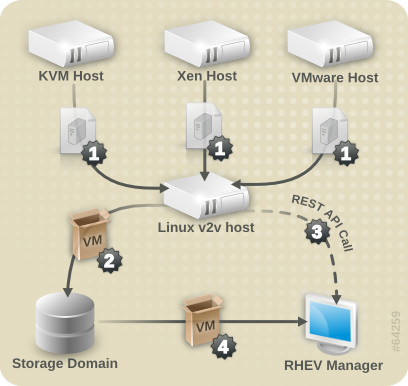
图 4.5. 对大量 v2v 操作进行脚本自动化
如 图 4.5 “对大量 v2v 操作进行脚本自动化” 所示,对大量 v2v 操作进行脚本自动化包括以下步骤:
- 从源虚拟机监控系统上获得虚拟机的映像。
- 对虚拟机映像进行打包,并复制到导出存储域。
- 使用一个到 Red Hat Enterprise Virtualization Manager 的远程调用来通知它导入虚拟机。
- Manager 从导出存储域中导入虚拟机。
配置并运行大量 v2v 操作的自动化脚本:
过程 4.9. 配置并运行大量 v2v 操作的自动化脚本
- 确认 Red Hat Enterprise Virtualization Manager 启用了 REST API,并可以被运行 v2v 脚本的 Linux 访问。如需了解更多关于 REST API 的信息,请参阅 Red Hat Enterprise Virtualization Developer Guide。
- 在 Linux 主机上,创建包括以下内容的
v2v.sh文件。请确认您根据您的具体环境对脚本中的相应内容进行了修改。例 4.5. 单独主机的 v2v 脚本
#!/bin/sh
# Declare all VMs to import
XENDOMAINS=("rhelxen" "rhel5")
KVMDOMAINS=("rhelkvm")
VMWAREVMS=("rhel54vmware")

# Iterate through each Xen domain, performing the conversion
for domain in ${XENDOMAINS[@]}
do
        virt-v2v -ic xen:///localhost -o rhev -os storage.example.com:/exportdomain --network rhevm $domain
done

# Iterate through each KVM domain, performing the conversion
for domain in ${KVMDOMAINS[@]}
do
        virt-v2v -o rhev -os storage.example.com:/exportdomain --network rhevm $domain
done

# Iterate through each VMware VM, performing the conversion
for vm in ${VMWAREVMS[@]}
do
        virt-v2v -ic esx://esx.example.com/?no_verify=1 -o rhev -os storage.example.com:/exportdomain --network rhevm $vm
done


# Call the import VM procedure remotely on the RHEV Manager

export BASE_URL='https://[rhevm-host]'
export HTTP_USER='user@internal'
export HTTP_PASSWORD='password'

curl -o rhevm.cer http://[rhevm-host]/ca.crt

# Get the export storage domains

curl -X GET -H "Accept: application/xml" -u "${HTTP_USER}:${HTTP_PASSWORD}" --cacert rhevm.cer ${BASE_URL}/api/storagedomains?search=nfs_export -o exportdomain
EXPORT_DOMAIN=`xpath exportdomain '/storage_domains/storage_domain/@id' | sed -e 's/ id=//' | sed -e 's/"//g'`

# Get the datacenter

curl -X GET -H "Accept: application/xml" -u "${HTTP_USER}:${HTTP_PASSWORD}" --cacert rhevm.cer ${BASE_URL}/api/datacenters?search=NFS -o dc
DC=`xpath dc '/data_centers/data_center/@id' | sed -e 's/ id=//' | sed -e 's/"//g'`

# Get the cluster

curl -X GET -H "Accept: application/xml" -u "${HTTP_USER}:${HTTP_PASSWORD}" --cacert rhevm.cer ${BASE_URL}/api/clusters?search=NFS -o cluster
CLUSTER_ELEMENT=`xpath cluster '/clusters/cluster/@id' | sed -e 's/ id=//' | sed -e 's/"//g'`

# List contents of export storage domain

curl -X GET -H "Accept: application/xml" -u "${HTTP_USER}:${HTTP_PASSWORD}" --cacert rhevm.cer ${BASE_URL}/api/storagedomains/${EXPORT_DOMAIN}/vms -o vms

# For each vm, export
VMS=`xpath vms '/vms/vm/actions/link[@rel="import"]/@href' | sed -e 's/ href="//g' | sed -e 's/"/ /g'`

for vms in $VMS
do
        curl -v -u "${HTTP_USER}:${HTTP_PASSWORD}" -H "Content-type: application/xml" -d '<action><cluster><name>cluster_name</name></cluster><storage_domain><name>data_domain</name></storage_domain><overwrite>true</overwrite><discard_snapshots>true</discard_snapshots></action>' --cacert rhevm.cer ${BASE_URL}$vms
done
注意
使用POST方法来通过 REST API 导出虚拟机。如需了解更多关于 REST API 的信息,请参阅 Red Hat Enterprise Virtualization Developer Guide。 - 运行
v2v.sh脚本。这可能需要几个小时才能完成转换并导入大量虚拟机的操作。

'%20d='M201.5%20305.5c-13.8%200-24.9-11.1-24.9-24.6%200-13.8%2011.1-24.9%2024.9-24.9%2013.6%200%2024.6%2011.1%2024.6%2024.9%200%2013.6-11.1%2024.6-24.6%2024.6zM504%20256c0%20137-111%20248-248%20248S8%20393%208%20256%20119%208%20256%208s248%20111%20248%20248zm-132.3-41.2c-9.4%200-17.7%203.9-23.8%2010-22.4-15.5-52.6-25.5-86.1-26.6l17.4-78.3%2055.4%2012.5c0%2013.6%2011.1%2024.6%2024.6%2024.6%2013.8%200%2024.9-11.3%2024.9-24.9s-11.1-24.9-24.9-24.9c-9.7%200-18%205.8-22.1%2013.8l-61.2-13.6c-3-.8-6.1%201.4-6.9%204.4l-19.1%2086.4c-33.2%201.4-63.1%2011.3-85.5%2026.8-6.1-6.4-14.7-10.2-24.1-10.2-34.9%200-46.3%2046.9-14.4%2062.8-1.1%205-1.7%2010.2-1.7%2015.5%200%2052.6%2059.2%2095.2%20132%2095.2%2073.1%200%20132.3-42.6%20132.3-95.2%200-5.3-.6-10.8-1.9-15.8%2031.3-16%2019.8-62.5-14.9-62.5zM302.8%20331c-18.2%2018.2-76.1%2017.9-93.6%200-2.2-2.2-6.1-2.2-8.3%200-2.5%202.5-2.5%206.4%200%208.6%2022.8%2022.8%2087.3%2022.8%20110.2%200%202.5-2.2%202.5-6.1%200-8.6-2.2-2.2-6.1-2.2-8.3%200zm7.7-75c-13.6%200-24.6%2011.1-24.6%2024.9%200%2013.6%2011.1%2024.6%2024.6%2024.6%2013.8%200%2024.9-11.1%2024.9-24.6%200-13.8-11-24.9-24.9-24.9z'/%3e%3c/svg%3e)