 红帽全球峰会
此内容没有您所选择的语言版本。
Chapter 3. Red Hat JBoss Enterprise Application Platform setups
You can configure a JBoss EAP instance on single servers that run one or more applications, or you can configure multiple JBoss EAP server instances that are clustered together with an external load balancer for load balancing and failover.
A simple JBoss EAP setup consists of a single server running one or more deployed applications.
Figure 3.1. Simple setup using a single JBoss EAP server instance
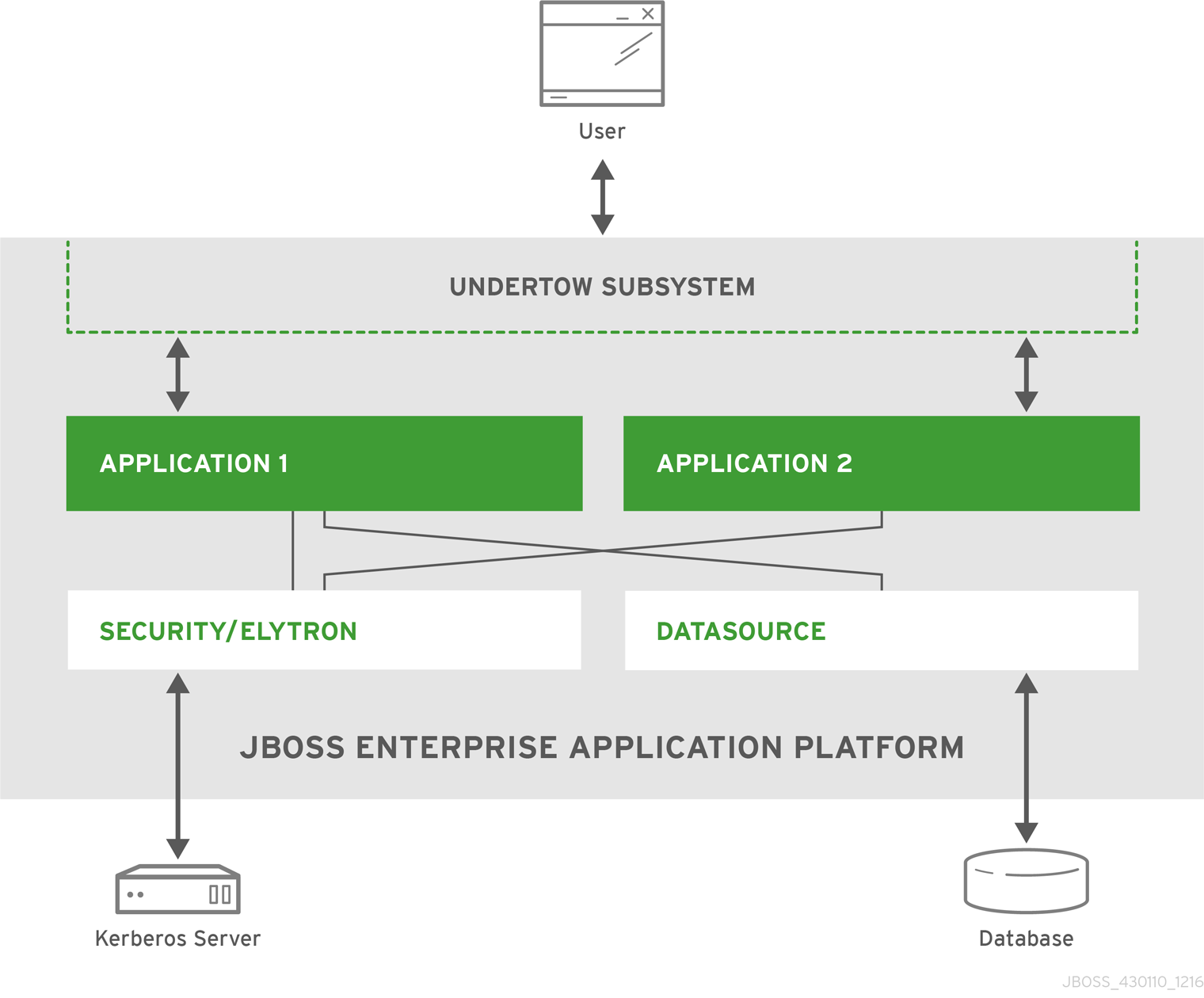
The JBoss EAP instance uses the datasources subsystem to connect to the following components:
- A database
- A Kerberos server
JBoss EAP uses the elytron (security) subsystem to connect to the Kerberos server and expose the server to the two deployed applications.
JBoss EAP uses the undertow subsystem to handle requests from the client server and send requests to an appropriate application.
The application uses the APIs exposed by JBoss EAP to connect to the database and Kerberos server. The application completes its task and the undertow subsystem sends the response back to requester.
A complex setup may involve multiple JBoss EAP server instances. For example, you can use a load balancer to distribute the processing load across {JBoss EAP} instances in a managed domain.
The following diagram displays three JBoss EAP instances that are arranged by a load balancer in a managed domain:
Figure 3.2. Complex setup using multiple JBoss EAP server instances
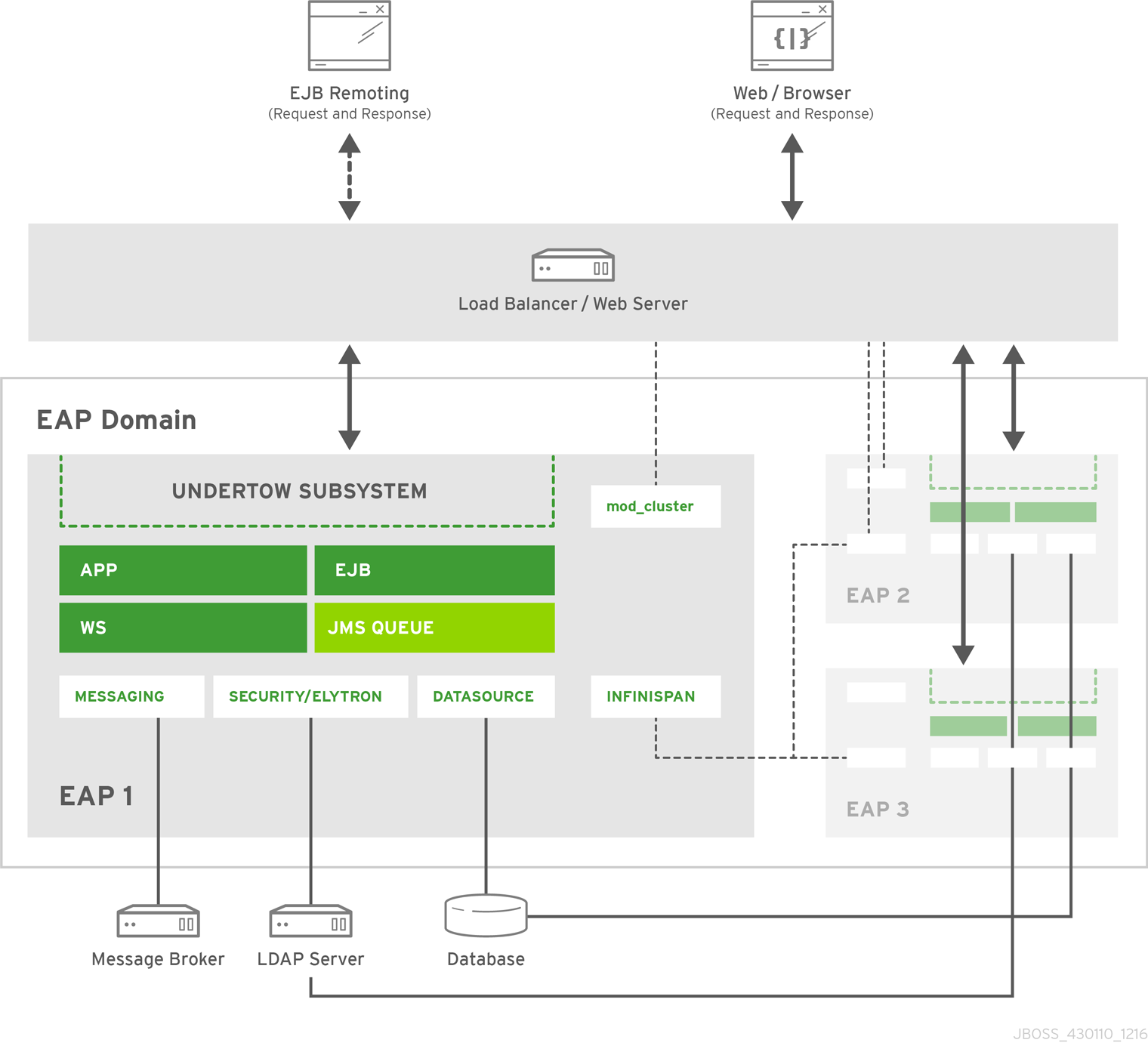
In this example, the administrator configured each instance to use mod_cluster and infinispan session replication to provide high availability (HA) support for applications. Each instance includes the following components:
- A web application
- A web service
- A deployed enterprise bean
-
A database connection that was established with the
datasourcessubsystem -
A connection with the LDAP server that was established with the
elytron(security) subsystem
The diagram displays the following configurations associated with a complex JBoss EAP setup:
-
EAP 1 has a
messaging-activemqsubsystem that is configured with a Jakarta Messaging queue that connects to an external message broker. - The external message broker is shared among all running JBoss EAP instances.
All inbound requests go through the load balancer.
- Depending on the configued load-balancing algorithm and the information provided by each JBoss EAP instance, the load balancer directs the requests to the appropriate JBoss EAP instance.
-
Each JBoss EAP instance uses the
undertowsubsystem to direct the requests to the appropriate application. - Each application uses the APIs exposed by JBoss EAP to connect to the database and Kerberos server.
-
After an application performs its work, the
undertowsubsystem to send a response to the requester.
The infinispan subsystem propagates non-persisted information, such as session information, among the JBoss EAP instances.
Revised on 2022-12-16 12:18:15 UTC

'%20d='M201.5%20305.5c-13.8%200-24.9-11.1-24.9-24.6%200-13.8%2011.1-24.9%2024.9-24.9%2013.6%200%2024.6%2011.1%2024.6%2024.9%200%2013.6-11.1%2024.6-24.6%2024.6zM504%20256c0%20137-111%20248-248%20248S8%20393%208%20256%20119%208%20256%208s248%20111%20248%20248zm-132.3-41.2c-9.4%200-17.7%203.9-23.8%2010-22.4-15.5-52.6-25.5-86.1-26.6l17.4-78.3%2055.4%2012.5c0%2013.6%2011.1%2024.6%2024.6%2024.6%2013.8%200%2024.9-11.3%2024.9-24.9s-11.1-24.9-24.9-24.9c-9.7%200-18%205.8-22.1%2013.8l-61.2-13.6c-3-.8-6.1%201.4-6.9%204.4l-19.1%2086.4c-33.2%201.4-63.1%2011.3-85.5%2026.8-6.1-6.4-14.7-10.2-24.1-10.2-34.9%200-46.3%2046.9-14.4%2062.8-1.1%205-1.7%2010.2-1.7%2015.5%200%2052.6%2059.2%2095.2%20132%2095.2%2073.1%200%20132.3-42.6%20132.3-95.2%200-5.3-.6-10.8-1.9-15.8%2031.3-16%2019.8-62.5-14.9-62.5zM302.8%20331c-18.2%2018.2-76.1%2017.9-93.6%200-2.2-2.2-6.1-2.2-8.3%200-2.5%202.5-2.5%206.4%200%208.6%2022.8%2022.8%2087.3%2022.8%20110.2%200%202.5-2.2%202.5-6.1%200-8.6-2.2-2.2-6.1-2.2-8.3%200zm7.7-75c-13.6%200-24.6%2011.1-24.6%2024.9%200%2013.6%2011.1%2024.6%2024.6%2024.6%2013.8%200%2024.9-11.1%2024.9-24.6%200-13.8-11-24.9-24.9-24.9z'/%3e%3c/svg%3e)