 Red Hat Summit
Ce contenu n'est pas disponible dans la langue sélectionnée.
6.4. Securing the Web Services Client
Overview
Copier lienLien copié sur presse-papiers!
In the basic Camel CXF proxy demonstration, the Web services client is actually implemented as a JUnit test under the
src/test directory. This means that the client can easily be run using the Maven command, mvn test. To enable SSL/TLS security on the client, the Java implementation of the test client is completely replaced and a Spring file, containing the SSL/TLS configuration, is added to the src/test/resources/META-INF/spring directory. Before describing the steps you need to perform to set up the client, this section explains some details of the client's Java code and Spring configuration.
Implicit configuration
Copier lienLien copié sur presse-papiers!
Apart from changing the URL scheme on the endpoint address to
https:, most of the configuration to enable SSL/TLS security on a client proxy is contained in a http:conduit element in Spring configuration. The way in which this configuration is applied to the client proxy, however, is potentially confusing, for the following reason: the http:conduit element does not explicitly reference the client proxy and the client proxy does not explicitly reference the http:conduit element. The connection between the http:conduit element and the client proxy is established implicitly, in that they both reference the same WSDL port, as illustrated by Figure 6.3, “Client Proxy Implicitly Configured by http:conduit Element”.
Figure 6.3. Client Proxy Implicitly Configured by http:conduit Element
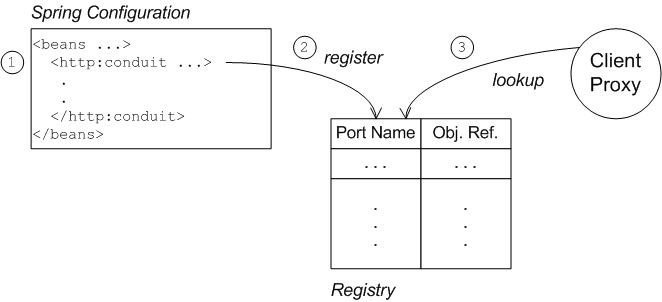
The connection between the client proxy and the
http:conduit element is established as follows:
- The client loads and parses the Spring configuration file containing the
http:conduitelement. - When the
http:conduitbean is created, a corresponding entry is created in the registry, which stores a reference to the bean under the specified WSDL port name (where the name is stored in QName format). - When the JAX-WS client proxy is created, it scans the registry to see if it can find a
http:conduitbean associated with the proxy's WSDL port name. If it finds such a bean, it automatically injects the configuration details into the proxy.
Certificates needed on the client side
Copier lienLien copié sur presse-papiers!
The client is configured with the following
clientKeystore.jks keystore file from the src/main/resources/certs directory. This keystore contains two entries, as follows:
- Trusted cert entry
- A trusted certificate entry containing the CA certificate that issued and signed both the server certificate and the client certificate.
- Private key entry
- A private key entry containing the client's own X.509 certificate and private key. In fact, this certificate is not strictly necessary to run the current example, because the server does not require the client to send a certificate during the TLS handshake (see Example 6.2, “httpj:engine-factory Element with SSL/TLS Enabled”).
Loading Spring definitions into the client
Copier lienLien copié sur presse-papiers!
The example client is not deployed directly into a Spring container, but it requires some Spring definitions in order to define a secure HTTP conduit. So how can you create the Spring definitions without a Spring container? It turns out that it is easy to read Spring definitions into a Java-based client using the
org.apache.cxf.bus.spring.SpringBusFactory class.
The following code shows how to read Spring definitions from the file,
META-INF/spring/cxf-client.xml, and create an Apache CXF Bus object that incorporates those definitions:
// Java
import org.apache.cxf.bus.spring.SpringBusFactory;
...
protected void startCxfBus() throws Exception {
    bf = new SpringBusFactory();
    Bus bus = bf.createBus("META-INF/spring/cxf-client.xml");
    bf.setDefaultBus(bus);
}
Creating the client proxy
Copier lienLien copié sur presse-papiers!
In principle, there are several different ways of creating a WSDL proxy: you could use the JAX-WS API to create a proxy based on the contents of a WSDL file; you could use the JAX-WS API to create a proxy without a WSDL file; or you could use the Apache CXF-specific class,
JaxWsProxyFactoryBean, to create a proxy.
For this SSL/TLS client, the most convenient approach is to use the JAX-WS API to create a proxy without using a WSDL file, as shown in the following Java sample:
// Java
import javax.xml.ws.Service;
import org.apache.camel.example.reportincident.ReportIncidentEndpoint;
...
// create the webservice client and send the request
Service s = Service.create(SERVICE_NAME);
s.addPort(
    PORT_NAME,
    "http://schemas.xmlsoap.org/soap/",
    ADDRESS_URL
  );
ReportIncidentEndpoint client =
  s.getPort(PORT_NAME, ReportIncidentEndpoint.class);
Note
In this example, you cannot use the
JaxWsProxyFactoryBean approach to create a proxy, because a proxy created in this way fails to find the HTTP conduit settings specified in the Spring configuration file.
The
SERVICE_NAME and PORT_NAME constants are the QNames of the WSDL service and the WSDL port respectively, as defined in Example 6.1, “The ReportIncidentEndpointService WSDL Service”. The ADDRESS_URL string has the same value as the proxy Web service address and is defined as follows:
private static final String ADDRESS_URL =
  "https://localhost:9080/camel-example-cxf-proxy/webservices/incident";
In particular, note that the address must be defined with the URL scheme,
https, which selects HTTP over SSL/TLS.
Steps to add SSL/TLS security to the client
Copier lienLien copié sur presse-papiers!
To define a JAX-WS client with SSL/TLS security enabled, perform the following steps:
Create the Java client as a test case
Copier lienLien copié sur presse-papiers!
Example 6.3, “ReportIncidentRoutesTest Java client” shows the complete code for a Java client that is implemented as a JUnit test case. This client replaces the existing test,
ReportIncidentRoutesTest.java, in the src/test/java/org/apache/camel/example/reportincident sub-directory of the examples/camel-example-cxf-proxy demonstration.
To add the client to the
CamelInstallDir/examples/camel-example-cxf-proxy demonstration, go to the src/test/java/org/apache/camel/example/reportincident sub-directory, move the existing ReportIncidentRoutesTest.java file to a backup location, then create a new ReportIncidentRoutesTest.java file and paste the code from Example 6.3, “ReportIncidentRoutesTest Java client” into this file.
Example 6.3. ReportIncidentRoutesTest Java client
// Java
package org.apache.camel.example.reportincident;

import org.apache.camel.spring.Main;
import org.apache.cxf.jaxws.JaxWsProxyFactoryBean;
import org.junit.Test;

import java.net.URL;
import javax.xml.namespace.QName;
import javax.xml.ws.Service;

import org.apache.cxf.Bus;
import org.apache.cxf.bus.spring.SpringBusFactory;
import org.apache.camel.example.reportincident.ReportIncidentEndpoint;
import org.apache.camel.example.reportincident.ReportIncidentEndpointService;

import static org.junit.Assert.assertEquals;

/**
 * Unit test of our routes
 */
public class ReportIncidentRoutesTest {

    private static final QName SERVICE_NAME
        = new QName("http://reportincident.example.camel.apache.org", "ReportIncidentEndpointService");

    private static final QName PORT_NAME =
        new QName("http://reportincident.example.camel.apache.org", "ReportIncidentEndpoint");

    private static final String WSDL_URL = "file:src/main/resources/etc/report_incident.wsdl";

    // should be the same address as we have in our route
    private static final String ADDRESS_URL = "https://localhost:9080/camel-example-cxf-proxy/webservices/incident";

    protected SpringBusFactory bf;

    protected void startCxfBus() throws Exception {
        bf = new SpringBusFactory();
        Bus bus = bf.createBus("META-INF/spring/cxf-client.xml");
        bf.setDefaultBus(bus);
    }

    @Test
    public void testRendportIncident() throws Exception {
        startCxfBus();
        runTest();
    }

    protected void runTest() throws Exception {

        // create input parameter
        InputReportIncident input = new InputReportIncident();
        input.setIncidentId("123");
        input.setIncidentDate("2008-08-18");
        input.setGivenName("Claus");
        input.setFamilyName("Ibsen");
        input.setSummary("Bla");
        input.setDetails("Bla bla");
        input.setEmail("davsclaus@apache.org");
        input.setPhone("0045 2962 7576");

        // create the webservice client and send the request
        Service s = Service.create(SERVICE_NAME);
        s.addPort(PORT_NAME, "http://schemas.xmlsoap.org/soap/", ADDRESS_URL);
        ReportIncidentEndpoint client = s.getPort(PORT_NAME, ReportIncidentEndpoint.class);

        OutputReportIncident out = client.reportIncident(input);

        // assert we got a OK back
        assertEquals("OK;456", out.getCode());
    }
}
Add the http:conduit element to Spring configuration
Copier lienLien copié sur presse-papiers!
Example 6.4, “http:conduit Element with SSL/TLS Enabled” shows the Spring configuration that defines a
http:conduit element for the ReportIncidentEndpoint WSDL port. The http:conduit element is configured to enable SSL/TLS security for any client proxies that use the specified WSDL port.
To add the Spring configuration to the client test case, create the
src/test/resources/META-INF/spring sub-directory, use your favorite text editor to create the file, cxf-client.xml, and then paste the contents of Example 6.4, “http:conduit Element with SSL/TLS Enabled” into the file.
Example 6.4. http:conduit Element with SSL/TLS Enabled
<?xml version="1.0" encoding="UTF-8"?>
<beans xmlns="http://www.springframework.org/schema/beans"
       xmlns:xsi="http://www.w3.org/2001/XMLSchema-instance"
       xmlns:cxf="http://camel.apache.org/schema/cxf"
       xmlns:sec="http://cxf.apache.org/configuration/security"
       xmlns:http="http://cxf.apache.org/transports/http/configuration"
       xsi:schemaLocation="
       http://www.springframework.org/schema/beans http://www.springframework.org/schema/beans/spring-beans.xsd
       http://camel.apache.org/schema/cxf http://camel.apache.org/schema/cxf/camel-cxf.xsd
       http://cxf.apache.org/configuration/security http://cxf.apache.org/schemas/configuration/security.xsd
       http://cxf.apache.org/transports/http/configuration http://cxf.apache.org/schemas/configuration/http-conf.xsd
       ">

  <http:conduit name="{http://reportincident.example.camel.apache.org}ReportIncidentEndpoint.http-conduit">
    <http:tlsClientParameters disableCNCheck="true" secureSocketProtocol="TLSv1">
      <sec:keyManagers keyPassword="ckpass">
          <sec:keyStore password="cspass" type="JKS"
          resource="certs/clientKeystore.jks" />
      </sec:keyManagers>
      <sec:trustManagers>
          <sec:keyStore password="cspass" type="JKS"
          resource="certs/clientKeystore.jks" />
      </sec:trustManagers>
      <sec:cipherSuitesFilter>
        <sec:include>.*_WITH_3DES_.*</sec:include>
        <sec:include>.*_WITH_DES_.*</sec:include>
        <sec:exclude>.*_WITH_NULL_.*</sec:exclude>
        <sec:exclude>.*_DH_anon_.*</sec:exclude>
      </sec:cipherSuitesFilter>
    </http:tlsClientParameters>
   </http:conduit>

</beans>
Please note the following points about the preceding configuration:
- The
http:andsec:namespace prefixes are needed to define thehttp:conduitelement. In thexsi:schemaLocationelement, it is also essential to specify the locations of the correspondinghttp://cxf.apache.org/configuration/securityandhttp://cxf.apache.org/transports/http/configurationnamespaces. - The
disableCNCheckattribute of thehttp:tlsClientParameterselement is set totrue. This means that the client does not check whether the Common Name in the server's X.509 certificate matches the server hostname. For more details, see Appendix A, Managing Certificates.ImportantDisabling the CN check is not recommended in a production deployment. - In the
sec:keystoreelements, the certificate locations are specified using theresourceattribute, which finds the certificates on the classpath. When Maven runs the test, it automatically makes the contents ofsrc/main/resourcesavailable on the classpath, so that the certificates can be read from thesrc/main/resources/certsdirectory.NoteYou also have the option of specifying a certificate location using thefileattribute, which looks in the filesystem. But theresourceattribute is more suitable for use with applications packaged in bundles. - The
sec:cipherSuitesFilterelement is configured to exclude cipher suites matching.*_WITH_NULL_.*and.*_DH_anon_.*. These cipher suites are effectively incomplete and are not intended for normal use.ImportantIt is recommended that you always exclude the ciphers matching.*_WITH_NULL_.*and.*_DH_anon_.*. - The
secureSocketProtocolattribute should be set to TLSv1, to match the server protocol and to ensure that the SSLv3 protocol is not used (POODLE security vulnerability (CVE-2014-3566)).
Run the client
Copier lienLien copié sur presse-papiers!
Because the client is defined as a test case, you can run the client using the standard Maven test goal. To run the client, open a new command window, change directory to
CamelInstallDir/examples/camel-example-cxf-proxy, and enter the following Maven command:
mvn test
If the test runs successfully, you should see the following output in the OSGi console window:
Incident was 123, changed to 456

Invoked real web service: id=456 by Claus Ibsen
'%20d='M201.5%20305.5c-13.8%200-24.9-11.1-24.9-24.6%200-13.8%2011.1-24.9%2024.9-24.9%2013.6%200%2024.6%2011.1%2024.6%2024.9%200%2013.6-11.1%2024.6-24.6%2024.6zM504%20256c0%20137-111%20248-248%20248S8%20393%208%20256%20119%208%20256%208s248%20111%20248%20248zm-132.3-41.2c-9.4%200-17.7%203.9-23.8%2010-22.4-15.5-52.6-25.5-86.1-26.6l17.4-78.3%2055.4%2012.5c0%2013.6%2011.1%2024.6%2024.6%2024.6%2013.8%200%2024.9-11.3%2024.9-24.9s-11.1-24.9-24.9-24.9c-9.7%200-18%205.8-22.1%2013.8l-61.2-13.6c-3-.8-6.1%201.4-6.9%204.4l-19.1%2086.4c-33.2%201.4-63.1%2011.3-85.5%2026.8-6.1-6.4-14.7-10.2-24.1-10.2-34.9%200-46.3%2046.9-14.4%2062.8-1.1%205-1.7%2010.2-1.7%2015.5%200%2052.6%2059.2%2095.2%20132%2095.2%2073.1%200%20132.3-42.6%20132.3-95.2%200-5.3-.6-10.8-1.9-15.8%2031.3-16%2019.8-62.5-14.9-62.5zM302.8%20331c-18.2%2018.2-76.1%2017.9-93.6%200-2.2-2.2-6.1-2.2-8.3%200-2.5%202.5-2.5%206.4%200%208.6%2022.8%2022.8%2087.3%2022.8%20110.2%200%202.5-2.2%202.5-6.1%200-8.6-2.2-2.2-6.1-2.2-8.3%200zm7.7-75c-13.6%200-24.6%2011.1-24.6%2024.9%200%2013.6%2011.1%2024.6%2024.6%2024.6%2013.8%200%2024.9-11.1%2024.9-24.6%200-13.8-11-24.9-24.9-24.9z'/%3e%3c/svg%3e)