 Red Hat Summit
이 콘텐츠는 선택한 언어로 제공되지 않습니다.
Chapter 7. Clustering
Clustering is sharing load between hosts. Each instance must be able to act as an entry point for UI and API access. This must enable the automation controller administrators to use load balancers in front of as many instances as they want and keep good data visibility.
Load balancing is optional, and it is entirely possible to have ingress on one or all instances as needed.
Each instance must be able to join the automation controller cluster and expand its ability to run jobs. This is a simple system where jobs can run anywhere rather than be directed on where to run. Also, you can group clustered instances into different pools or queues, called Instance groups.
Ansible Automation Platform supports container-based clusters by using Kubernetes, meaning you can install new automation controller instances on this platform without any variation or diversion in functionality. You can create instance groups to point to a Kubernetes container. For more information, see the Container and instance groups section.
Supported operating systems
The following operating systems are supported for establishing a clustered environment:
- Red Hat Enterprise Linux 8 or later
Isolated instances are not supported in conjunction with running automation controller in OpenShift.
7.1. Setup considerations
Learn about the initial setup of clusters. To upgrade an existing cluster, see Upgrade Planning in the Ansible Automation Platform Upgrade and Migration Guide.
Note the following important considerations in the new clustering environment:
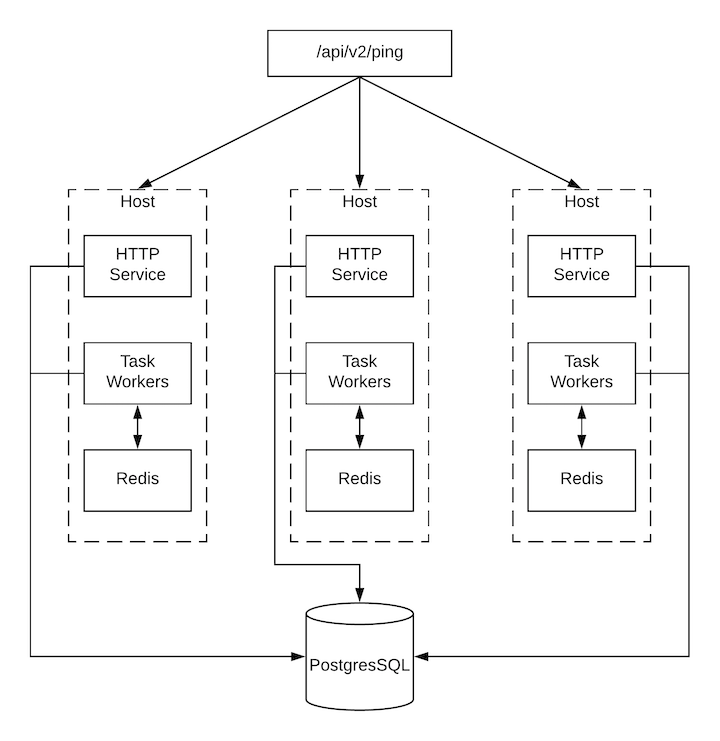
- PostgreSQL is a standalone instance and is not clustered. Automation controller does not manage replica configuration or database failover (if the user configures standby replicas).
- When you start a cluster, the database node must be a standalone server, and PostgreSQL must not be installed on one of the automation controller nodes.
-
PgBouncer is not recommended for connection pooling with automation controller. Automation controller relies on
pg_notifyfor sending messages across various components, and therefore, PgBouncer cannot readily be used in transaction pooling mode. - All instances must be reachable from all other instances and they must be able to reach the database. It is also important for the hosts to have a stable address or hostname (depending on how the automation controller host is configured).
- All instances must be geographically collocated, with reliable low-latency connections between instances.
-
To upgrade to a clustered environment, your primary instance must be part of the
defaultgroup in the inventory and it needs to be the first host listed in thedefaultgroup. - Manual projects must be manually synced to all instances by the customer, and updated on all instances at once.
-
The
inventoryfile for platform deployments should be saved or persisted. If new instances are to be provisioned, the passwords and configuration options, as well as host names, must be made available to the installer.
7.2. Install and configure
Provisioning new instances involves updating the inventory file and re-running the setup playbook. It is important that the inventory file contains all passwords and information used when installing the cluster or other instances might be reconfigured. The inventory file contains a single inventory group, automationcontroller.
All instances are responsible for various housekeeping tasks related to task scheduling, such as determining where jobs are supposed to be launched and processing playbook events, as well as periodic cleanup.
If no groups are selected for a resource, then the automationcontroller group is used, but if any other group is selected, then the automationcontroller group is not used in any way.
The database group remains for specifying an external PostgreSQL. If the database host is provisioned separately, this group must be empty:
When a playbook runs on an individual controller instance in a cluster, the output of that playbook is broadcast to all of the other nodes as part of automation controller’s websocket-based streaming output functionality. You must handle this data broadcast using internal addressing by specifying a private routable address for each node in your inventory:
[automationcontroller]
hostA routable_hostname=10.1.0.2
hostB routable_hostname=10.1.0.3
hostC routable_hostname=10.1.0.4
routable_hostname
[automationcontroller]
hostA routable_hostname=10.1.0.2
hostB routable_hostname=10.1.0.3
hostC routable_hostname=10.1.0.4
routable_hostname
For more information about routable_hostname, see General variables in the Red Hat Ansible Automation Platform Installation Guide.
Previous versions of automation controller used the variable name rabbitmq_host. If you are upgrading from a previous version of the platform, and you previously specified rabbitmq_host in your inventory, rename rabbitmq_host to routable_hostname before upgrading.
7.2.1. Instances and ports used by automation controller and automation hub
Ports and instances used by automation controller and also required by the on-premise automation hub node are as follows:
- Port 80, 443 (normal automation controller and automation hub ports)
- Port 22 (ssh - ingress only required)
- Port 5432 (database instance - if the database is installed on an external instance, it must be opened to automation controller instances)
7.3. Status and monitoring by browser API
Automation controller reports as much status as it can using the browser API at /api/v2/ping to validate the health of the cluster. This includes the following:
- The instance servicing the HTTP request
- The timestamps of the last heartbeat of all other instances in the cluster
- Instance Groups and Instance membership in those groups
View more details about Instances and Instance Groups, including running jobs and membership information at /api/v2/instances/ and /api/v2/instance_groups/.
7.4. Instance services and failure behavior
Each automation controller instance is made up of the following different services working collaboratively:
- HTTP services
- This includes the automation controller application itself as well as external web services.
- Callback receiver
- Receives job events from running Ansible jobs.
- Dispatcher
- The worker queue that processes and runs all jobs.
- Redis
- This key value store is used as a queue for event data propagated from ansible-playbook to the application.
- Rsyslog
- The log processing service used to deliver logs to various external logging services.
Automation controller is configured so that if any of these services or their components fail, then all services are restarted. If these fail often in a short span of time, then the entire instance is placed offline in an automated fashion to allow remediation without causing unexpected behavior.
For backing up and restoring a clustered environment, see the Backup and restore clustered environments section.
7.5. Job runtime behavior
The way jobs are run and reported to a normal user of automation controller does not change. On the system side, note the following differences:
When a job is submitted from the API interface it is pushed into the dispatcher queue. Each automation controller instance connects to and receives jobs from that queue using a scheduling algorithm. Any instance in the cluster is just as likely to receive the work and execute the task. If an instance fails while executing jobs, then the work is marked as permanently failed.
- Project updates run successfully on any instance that could potentially run a job. Projects synchronize themselves to the correct version on the instance immediately before running the job. If the required revision is already locally checked out and Galaxy or Collections updates are not required, then a sync cannot be performed.
-
When the synchronization happens, it is recorded in the database as a project update with a
launch_type = syncandjob_type = run. Project syncs do not change the status or version of the project; instead, they update the source tree only on the instance where they run. -
If updates are required from Galaxy or Collections, a sync is performed that downloads the required roles, consuming more space in your
/tmp file. In cases where you have a large project (around 10 GB), disk space on/tmpcan be an issue.
7.5.1. Job runs
By default, when a job is submitted to the automation controller queue, it can be picked up by any of the workers. However, you can control where a particular job runs, such as restricting the instances from which a job runs on.
To support taking an instance offline temporarily, there is a property enabled defined on each instance. When this property is disabled, no jobs are assigned to that instance. Existing jobs finish, but no new work is assigned.
Troubleshooting
When you issue a cancel request on a running automation controller job, automation controller issues a SIGINT to the ansible-playbook process. While this causes Ansible to stop dispatching new tasks and exit, in many cases, module tasks that were already dispatched to remote hosts will run to completion. This behavior is similar to pressing Ctrl-c during a command-line Ansible run.
With respect to software dependencies, if a running job is canceled, the job is removed but the dependencies remain.
7.6. Deprovisioning instances
Re-running the setup playbook does not automatically deprovision instances since clusters do not currently distinguish between an instance that was taken offline intentionally or due to failure. Instead, shut down all services on the automation controller instance and then run the deprovisioning tool from any other instance.
Procedure
-
Shut down the instance or stop the service with the command:
automation-controller-service stop. Run the following deprovision command from another instance to remove it from the automation controller cluster:
awx-manage deprovision_instance --hostname=<name used in inventory file>
$ awx-manage deprovision_instance --hostname=<name used in inventory file>Copy to Clipboard Copied! Toggle word wrap Toggle overflow
Example
awx-manage deprovision_instance --hostname=hostB
awx-manage deprovision_instance --hostname=hostBDeprovisioning instance groups in automation controller does not automatically deprovision or remove instance groups. For more information, see the Deprovisioning instance groups section.

'%20d='M201.5%20305.5c-13.8%200-24.9-11.1-24.9-24.6%200-13.8%2011.1-24.9%2024.9-24.9%2013.6%200%2024.6%2011.1%2024.6%2024.9%200%2013.6-11.1%2024.6-24.6%2024.6zM504%20256c0%20137-111%20248-248%20248S8%20393%208%20256%20119%208%20256%208s248%20111%20248%20248zm-132.3-41.2c-9.4%200-17.7%203.9-23.8%2010-22.4-15.5-52.6-25.5-86.1-26.6l17.4-78.3%2055.4%2012.5c0%2013.6%2011.1%2024.6%2024.6%2024.6%2013.8%200%2024.9-11.3%2024.9-24.9s-11.1-24.9-24.9-24.9c-9.7%200-18%205.8-22.1%2013.8l-61.2-13.6c-3-.8-6.1%201.4-6.9%204.4l-19.1%2086.4c-33.2%201.4-63.1%2011.3-85.5%2026.8-6.1-6.4-14.7-10.2-24.1-10.2-34.9%200-46.3%2046.9-14.4%2062.8-1.1%205-1.7%2010.2-1.7%2015.5%200%2052.6%2059.2%2095.2%20132%2095.2%2073.1%200%20132.3-42.6%20132.3-95.2%200-5.3-.6-10.8-1.9-15.8%2031.3-16%2019.8-62.5-14.9-62.5zM302.8%20331c-18.2%2018.2-76.1%2017.9-93.6%200-2.2-2.2-6.1-2.2-8.3%200-2.5%202.5-2.5%206.4%200%208.6%2022.8%2022.8%2087.3%2022.8%20110.2%200%202.5-2.2%202.5-6.1%200-8.6-2.2-2.2-6.1-2.2-8.3%200zm7.7-75c-13.6%200-24.6%2011.1-24.6%2024.9%200%2013.6%2011.1%2024.6%2024.6%2024.6%2013.8%200%2024.9-11.1%2024.9-24.6%200-13.8-11-24.9-24.9-24.9z'/%3e%3c/svg%3e)