 Red Hat Summit
이 콘텐츠는 선택한 언어로 제공되지 않습니다.
Chapter 36. Subcases
Subcases provide the flexibility to compose complex cases that consist of other cases. This means that you can split large and complex cases into multiple layers of abstraction and even multiple case projects. This is similar to splitting a process into multiple sub-processes.
A subcase is another case definition that is invoked from within another case instance or a regular process instance. It has all of the capabilities of a regular case instance:
- It has a dedicated case file.
- It is isolated from any other case instance.
- It has its own set of case roles.
- It has its own case prefix.
You can use the process designer to add subcases to your case definition. A subcase is a case within your case project, similar to having a sub-process within your process. Subcases can also be added to a regular business process. Doing this enables you to start a case from within a process instance.
For more information about adding a subcase to your case definition, see Getting started with case management.
The Sub Case Data I/O window supports the following set of input parameters that enable you to configure and start the subcase:
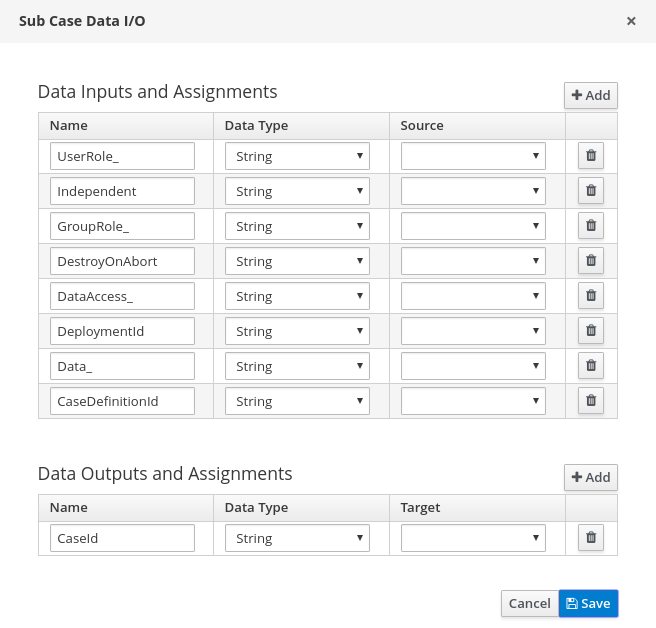
- Independent
-
Optional indicator that tells the process engine whether or not the case instance is independent. If it is independent, the main case instance does not wait for its completion. The value of this property is
falseby default. - GroupRole_XXX
-
Optional group to case role mapping. The role names belonging to this case instance can be referenced here, meaning that participants of the main case can be mapped to participants of the subcase. This means that the group assigned to the main case is automatically assigned to the subcase, where
XXXis the role name and the value of the property is the value of the group role assignment. - DataAccess_XXX
-
Optional data access restrictions where
XXXis the name of the data item and the value of the property is the access restrictions. - DestroyOnAbort
-
Optional indicator that tells the process engine whether to cancel or destroy the subcase when the subcase activity is aborted. The default value is
true. - UserRole_XXX
-
Optional user to case role mapping. You can reference the case instance role names here, meaning that an owner of the main case can be mapped to an owner of the subcase. The person assigned to the main case is automatically assigned to the subcase, where
XXXis the role name and the value of the property is the value of the user role assignment. - Data_XXX
-
Optional data mapping from this case instance or business process to a subcase, where
XXXis the name of the data in the subcase being targeted. This parameter can be provided as many times as needed. - DeploymentId
- Optional deployment ID (or container ID in the context of KIE Server) that indicates where the targeted case definition is located.
- CaseDefinitionId
- The mandatory case definition ID to be started.
- CaseId
- The case instance ID of the subcase after it is started.

'%20d='M201.5%20305.5c-13.8%200-24.9-11.1-24.9-24.6%200-13.8%2011.1-24.9%2024.9-24.9%2013.6%200%2024.6%2011.1%2024.6%2024.9%200%2013.6-11.1%2024.6-24.6%2024.6zM504%20256c0%20137-111%20248-248%20248S8%20393%208%20256%20119%208%20256%208s248%20111%20248%20248zm-132.3-41.2c-9.4%200-17.7%203.9-23.8%2010-22.4-15.5-52.6-25.5-86.1-26.6l17.4-78.3%2055.4%2012.5c0%2013.6%2011.1%2024.6%2024.6%2024.6%2013.8%200%2024.9-11.3%2024.9-24.9s-11.1-24.9-24.9-24.9c-9.7%200-18%205.8-22.1%2013.8l-61.2-13.6c-3-.8-6.1%201.4-6.9%204.4l-19.1%2086.4c-33.2%201.4-63.1%2011.3-85.5%2026.8-6.1-6.4-14.7-10.2-24.1-10.2-34.9%200-46.3%2046.9-14.4%2062.8-1.1%205-1.7%2010.2-1.7%2015.5%200%2052.6%2059.2%2095.2%20132%2095.2%2073.1%200%20132.3-42.6%20132.3-95.2%200-5.3-.6-10.8-1.9-15.8%2031.3-16%2019.8-62.5-14.9-62.5zM302.8%20331c-18.2%2018.2-76.1%2017.9-93.6%200-2.2-2.2-6.1-2.2-8.3%200-2.5%202.5-2.5%206.4%200%208.6%2022.8%2022.8%2087.3%2022.8%20110.2%200%202.5-2.2%202.5-6.1%200-8.6-2.2-2.2-6.1-2.2-8.3%200zm7.7-75c-13.6%200-24.6%2011.1-24.6%2024.9%200%2013.6%2011.1%2024.6%2024.6%2024.6%2013.8%200%2024.9-11.1%2024.9-24.6%200-13.8-11-24.9-24.9-24.9z'/%3e%3c/svg%3e)