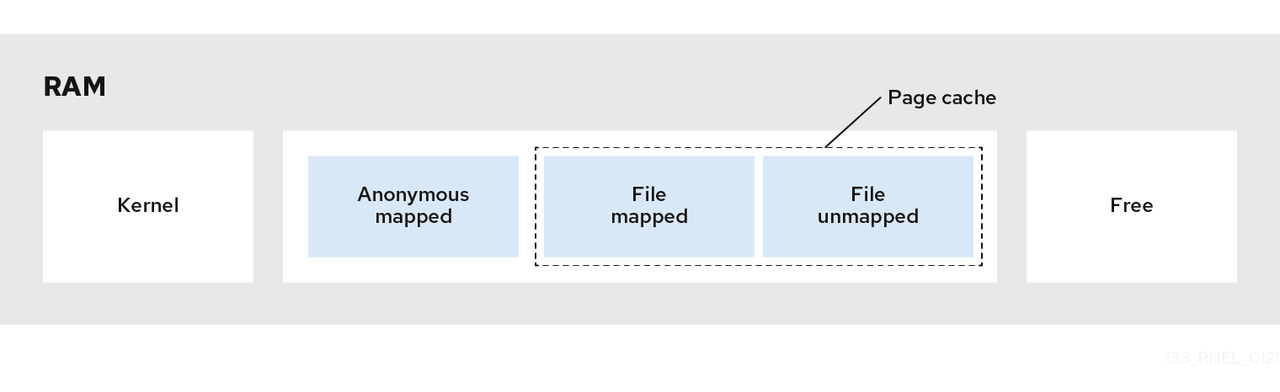
Overview of system memory
The Linux Kernel is designed to maximize the utilization of resources in system memory (RAM). Due to these design characteristics, Kernel operations use most system memory for the workload, while leaving a small portion free.
This free memory is reserved for: special system allocations and other low or high priority system services. The rest of the system memory is dedicated to the workload itself, and divided into the following two categories:
- File memory
-
Pages added in this category represent parts of files in permanent storage. These pages, from the page cache, can be mapped or unmapped in address spaces of an application. Applications can map files into their address space by using the
mmapsystem calls or operate on files by using the buffered I/O read or write system calls.Buffered I/O system calls, as well as applications that map pages directly, can re-use unmapped pages. As a result, the kernel caches these pages to avoid repeated, slow I/O operations, particularly during periods of low memory usage.
- Anonymous memory
- These pages are used by dynamic processes or have no related files in permanent storage. These pages back up the in-memory control structures of each task, such as the application stack and heap.